


DUBAI, United Arab Emirates — An Iranian missile attack Friday wounded at least 10 U.S. troops and damaged several planes at a military base in Saudi Arabia, according to two U.S. officials familiar with the situation.
Two of the service members were seriously wounded, one of the officials said. The attack on Prince Sultan Air Base damaged several U.S. refueling aircraft, said the officials, who spoke on condition of anonymity to discuss sensitive military matters.
The confirmation, reported earlier by The Wall Street Journal, came after satellite imagery that appeared to show the damage to the aircraft appeared online.
Army Sgt. Benjamin N. Pennington, 26, died days after being wounded during a March 1 attack on the base.
U.S. Central Command said earlier in the day that more than 300 service members were wounded in the conflict. At least 13 American troops were killed.

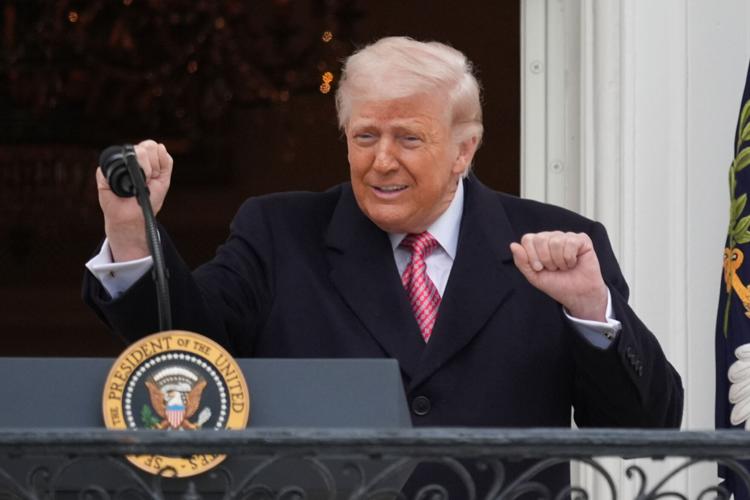
President Donald Trump gestures Friday after speaking during an event with farmers on the South Lawn of the White House in Washington.
Meanwhile, Iranian state media said two of the country's nuclear facilities were attacked.
Also Friday, President Donald Trump said it will be time for Saudi Arabia and Israel to normalize ties after the war in Iran wraps up. He has pressed Israel and Saudi Arabia, the two biggest powers in the Middle East, for years to normalize ties as part of his Abraham Accords efforts.
Meanwhile the Iranian ambassador to the United Nations in Geneva said Tehran agreed to "facilitate and expedite" humanitarian aid through the Strait of Hormuz, even as it endures strikes on its nuclear facilities.
Ali Bahreini said Tehran accepted a request from the U.N. to let humanitarian aid and agricultural shipments move through the vital waterway, which usually handles a fifth of the world's oil shipments and nearly a third of the world's fertilizer trade.
The aid plan would be the first breakthrough at the shipping chokepoint after a month of war.
Russian drones
Meanwhile, U.S. and European officials told The Associated Press this week that Russia is sending a shipment of drones to Iran, including upgraded versions of the drone technology that Tehran originally supplied to Moscow after Russia invaded Ukraine.
While Iran has its own stocks of Shahed drones, Russia has made improvements to the design during the war in Ukraine, including adding better navigation capabilities.
Russian and Iranian officials have had “very active” discussions this month regarding transferring drones from Russia to Iran, the European intelligence official told AP. A U.S. defense official said it is unclear if the shipment is a one-time delivery or part of a series.
Neither official could say how significant the delivery is or how many drones were sent. Another European official said a small number of drones wouldn't have a major impact on the outcome of the war. All the officials spoke on condition of anonymity.
The U.S. defense official said Moscow’s motivation in giving Tehran more advanced drones is also unclear given that every munition sent to Tehran is one Russia is not able to launch at Ukraine.

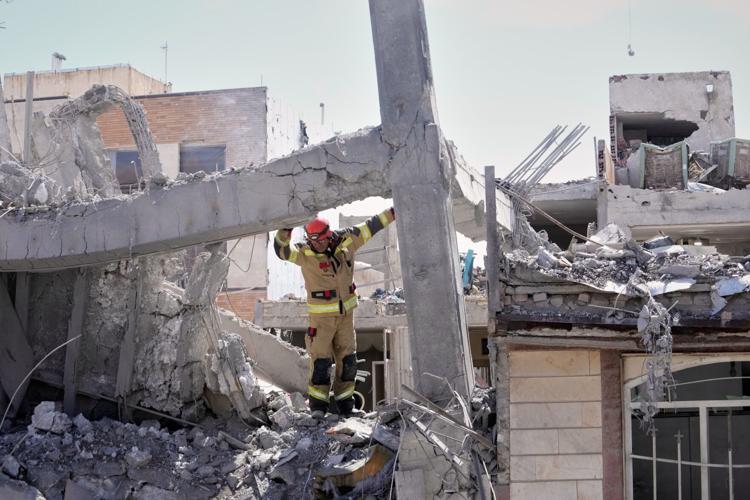
A first responder inspects the damaged structure of a residential building Friday in Tehran.
Israel strikes Iranian nuclear facilities
Iranian state media said two nuclear facilities were attacked. Israel, which threatened to "escalate and expand" its campaign against Tehran, claimed responsibility, and Iran quickly threatened to retaliate.
"Iran will exact HEAVY price for Israeli crimes," Iranian Foreign Minister Abbas Araghchi wrote on social media.
Iran's Atomic Energy Organization said the Shahid Khondab Heavy Water Complex in Arak and the Ardakan yellowcake production plant in Yazd Province were targeted, IRNA reported. The strikes did not cause any casualties and there was no risk of contamination, it said. The Arak plant has not been operational since Israel attacked it last June.
Yellowcake is a concentrated form of uranium after impurities are removed from the raw ore. Heavy water is used as a moderator in nuclear reactors.
The Israeli military later said raw materials are processed for enrichment at the Yazd plant and that the strike was a major blow to Iran's nuclear program.
The Islamic Revolutionary Guard Corps warned Iran would retaliate, IRNA reported. Seyed Majid Moosavi, IRGC's Aerospace Force commander, posted on social media that employees of companies tied to the U.S. and Israel should abandon their workplaces.
"This time, the equation will no longer be 'an eye for an eye,' just wait," he said.

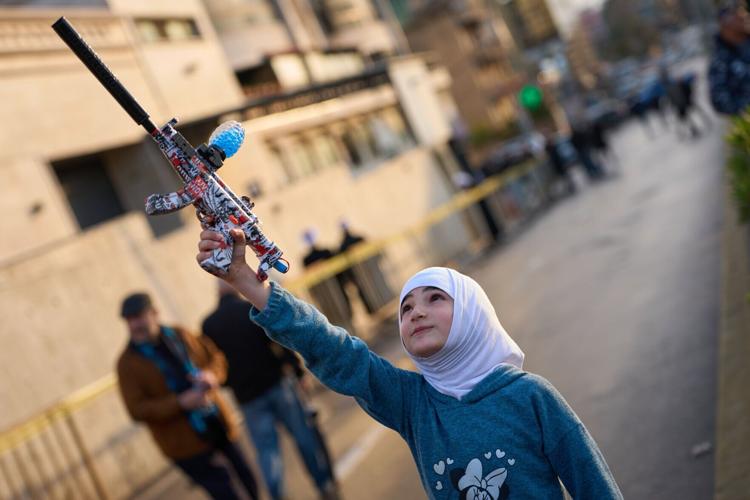
A girl holds a toy gun Thursday during a protest outside Iran's embassy in Beirut, Lebanon.
US pushes talks
Word of the attacks on Iran came after Trump claimed talks on ending the war were going "very well" and that he gave Tehran more time to reopen the Strait of Hormuz. Iran maintained it did not engage in negotiations.
A Gulf Arab bloc said Thursday that Iran exacted tolls from ships to ensure safe passage.
Trump claimed if Iran doesn't reopen the strait to all traffic by April 6, he will order the destruction of Iran's energy plants.

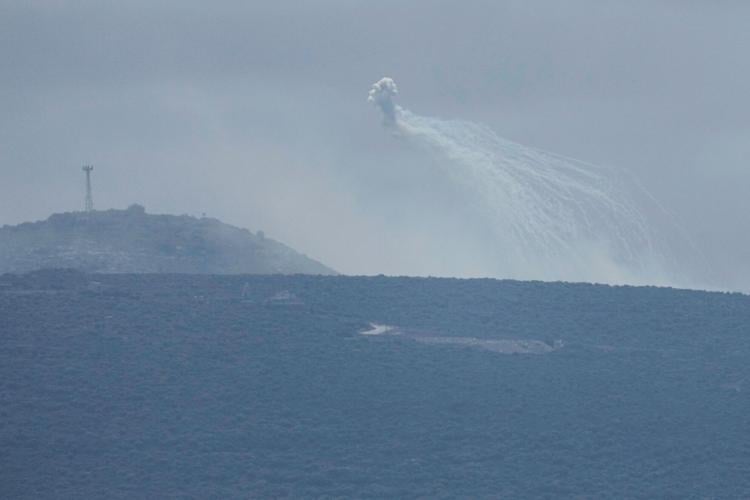
A shell that appears to be white phosphorus from Israeli artillery explodes Friday over a road leading to Chamaa village, seen from Tyre city, south Lebanon.
Death toll climbs, primarily in Iran and Lebanon
Diplomats from several countries tried to organize a direct meeting between U.S. and Iranian envoys.
Meanwhile, U.S. ships drew closer to the region carrying about 2,500 Marines, and at least 1,000 paratroopers from the 82nd Airborne — trained to land in hostile territory to secure key positions and airfields — were ordered to the Middle East.
Israel deployed the 162nd Division into southern Lebanon to support efforts to protect its northern border towns from Hezbollah attacks and uproot the militant group, the military said.
The U.N.'s International Organization for Migration said Friday that 82,000 civilian buildings in Iran, including hospitals and the homes of 180,000 people, are damaged.
Nineteen people were killed in Israel, while four Israeli soldiers were killed in Lebanon. Two Israeli soldiers were severely injured Friday in Lebanon during an "operational accident," the military said.
Authorities said more than 1,100 people died in Lebanon and over 1,900 people were killed in Iran. Four people in the occupied West Bank and 20 in Gulf Arab states also were killed.
In Iraq, where Iranian-supported militia groups entered the conflict, 80 members of the security forces were killed.
Photos from the Mideast in the 4th week of the Iran war

A man takes cover as air raid sirens sound, warning of rockets launched from Lebanon toward Israel, in Kiryat Shmona, northern Israel, Monday, March 23, 2026. (AP Photo/Ariel Schalit)

Israeli security forces and rescue team respond at the site of an Iranian missile strike in Tel Aviv, Israel, Tuesday, March 24, 2026. (AP Photo/Ohad Zwigenberg)

Relatives grieve in Baghdad, Iraq, Tuesday, March 24, 2026, during a funeral of members of the Popular Mobilization Forces who were killed in a U.S. airstrike in Anbar, Iraq. (AP Photo/Hadi Mizban)

Israeli soldiers secure the site where an Iranian missile wreckage landed in the West Bank village of Kifl Haris Tuesday, March 24, 2026. (AP Photo/Majdi Mohammed)

An Israeli soldier jumps from a tank in northern Israel near the border with Lebanon, Saturday, March 21, 2026. (AP Photo/Ariel Schalit)

Israeli security forces and rescue teams work at the site struck by an Iranian missile in Arad, southern Israel, Sunday, March 22, 2026. (AP Photo/Ohad Zwigenberg)

Israeli security forces survey the site that was struck by an Iranian missile in Dimona, southern Israel, Sunday, March 22, 2026. (AP Photo/Ariel Schalit)

Smoke and flames rise from an Israeli airstrike that hit the Qasmiyeh Bridge near the coastal city of Tyre, Lebanon, Sunday, March 22, 2026. (AP Photo/Mohammad Zaatari)

Rescue workers and first responders work at a residential building hit in an earlier U.S.-Israeli strike in Tehran, Iran, Monday, March 23, 2026. (AP Photo/Vahid Salemi)

Children play beside a fragment of an Iranian ballistic missile that landed in a schoolyard in the Israeli settlement of Peduel in the West Bank Monday, March 23, 2026. (AP Photo/Ohad Zwigenberg)

People follow a truck carrying the flag draped coffins of Gen. Ali Mohammad Naeini, a spokesperson for Iran’s paramilitary Revolutionary Guard and one of his comrades Amir Hossein Bidi , during their funeral procession in Tehran, Iran, Saturday, March 21, 2026. (AP Photo/Vahid Salemi)

Iranian worshippers perform Eid al-Fitr prayers marking the end of the holy fasting month of Ramadan as one of them wears an Iranian flag at the Imam Khomeini Grand Mosque in Tehran, Iran, Saturday, March 21, 2026. (AP Photo/Vahid Salemi)

A displaced woman who fled Israeli airstrikes in southern Lebanon, carries her belonging as she moves to a better spot to shelter from the rain, past an Arabic anti-war poster that reads, "Sacrificing for whom? Lebanon does not need war," in Beirut, Saturday, March 21, 2026.(AP Photo/Hussein Malla)

Iranian Kurdish Mariam crosses the Haji Omeran border crossing on foot between Iran and the autonomous Kurdistan Region of Iraq (KRI), Iraq, Sunday, March 15, 2026, as the border remains open. (AP Photo/Leo Correa)

A man cleans debris from his apartment damaged when a nearby police station was hit Friday in a U.S.-Israeli strike in Tehran, Iran, Sunday, March 15, 2026. (AP Photo/Vahid Salemi)

The shattered structure of a police station is seen after it was hit Friday in a U.S.-Israeli strike in Tehran, Iran, Sunday, March 15, 2026. (AP Photo/Vahid Salemi)

A FlyDubai plane is parked at Dubai International Airport as smoke rises in the background after a drone struck a fuel tank early morning, forcing the temporary suspension of flights, in Dubai, United Arab Emirates, Monday, March 16, 2026. (AP Photo)

A member of the armed wing of the Kurdish-Iranian opposition group Organization of Iranian Kurdistan Struggle, known as Khabat, stands in front of a shrapnel pockmarked wall that allegedly was damaged in strike by Iranian-backed militias in Iraq last week at a military base on the outskirts of Irbil, Iraq, Monday, March 16, 2026. (AP Photo/Leo Correa)

Israeli security forces inspect a house in east Jerusalem where a fragment of an Iranian missile crashed onto the rooftop, Monday, March 16, 2026. (AP Photo/Mahmoud Illean)

Israeli soldiers operate next to their mobile artillery unit on the border with Lebanon in northern Israel, Monday, March 16, 2026. (AP Photo/Ariel Schalit)

Nofar Eliash holds her dog as she takes shelter with others while air raid sirens warn of incoming Iranian and Hezbollah missile strikes in Kiryat Shmona, northern Israel, Monday, March 16, 2026. (AP Photo/Ariel Schalit)

A man runs past a bulldozer clearing debris from a building damaged in an Israeli airstrike in Dahiyeh, Beirut's southern suburbs, Lebanon, Tuesday, March 17, 2026. (AP Photo/Hassan Ammar)

Residents inspect a house damaged yesterday by a projectiles launched from Lebanon in Nahariya, northern Israel, Tuesday, March 17, 2026. (AP Photo/Ariel Schalit)

Israeli air defense system fires to intercept missiles during an Iranian attack over Tel Aviv, Israel, early Sunday, March 15, 2026. (AP Photo/Ohad Zwigenberg)

Volunteers clean debris from a residential building damaged when a nearby police station was hit Friday in a U.S.-Israeli strike in Tehran, Iran, Sunday, March 15, 2026. (AP Photo/Vahid Salemi)

People walk past tents sheltering people displaced by Israeli airstrikes at a public space along the Beirut waterfront at sunset in Beirut, Lebanon, Sunday, March 15, 2026. (AP Photo/Hassan Ammar)

Fire and plumes of smoke rise after a drone struck a fuel tank forcing the temporary suspension of flights. near Dubai International Airport, in United Arab Emirates, early Monday, March 16, 2026. (AP Photo)

