


MONT BELVIEU, Texas — A Black high school student in Texas who served an in-school suspension over his hairstyle received the same punishment again when he arrived Monday wearing his hair in twisted dreadlocks tied on top of his head, his mother said.
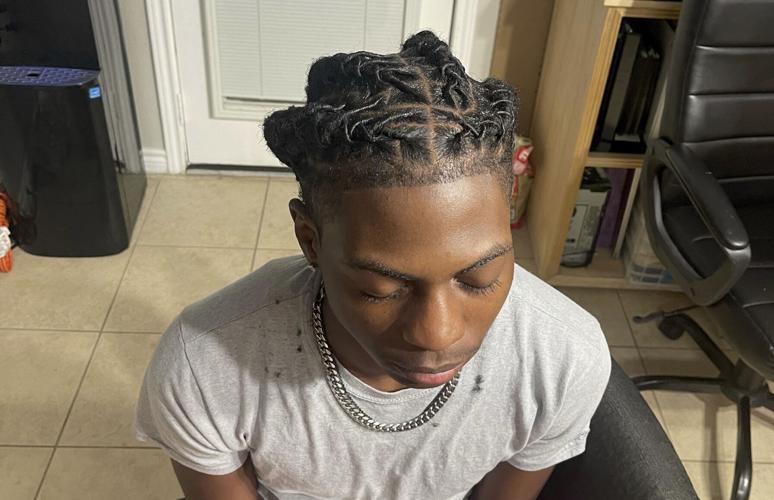
Darryl George, a junior at Barbers Hill High School in Mont Belvieu, was initially suspended the same week his state outlawed racial discrimination based on hairstyles. School officials said his dreadlocks fell below his eyebrows and ear lobes and violated the district’s dress code.
George, 17, served the first suspension last week at the Houston-area school. He was in tears when he was sent back to in-school suspension Monday, his mother Darresha George said.

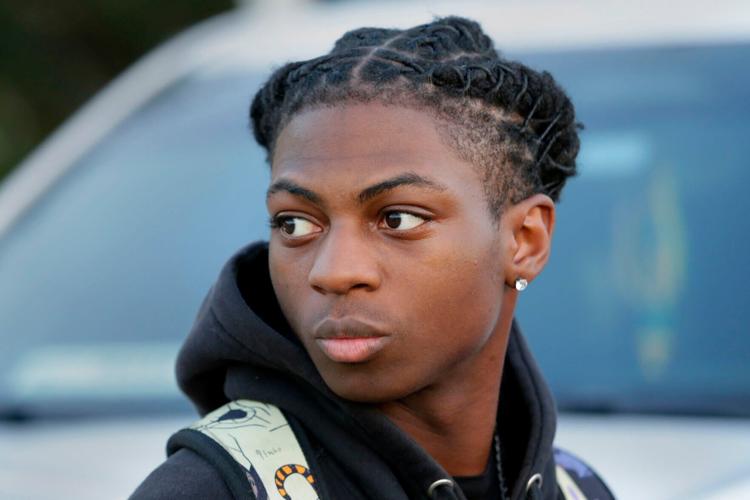
Darryl George, a 17-year-old junior, heads Monday to Barbers Hill High School in Mont Belvieu after serving a 5-day in-school suspension for not cutting his hair. The same week a state law went into effect prohibiting discrimination on the basis of hair, George was suspended because his locs did not comply with the district's dress code.
“He has to sit on a stool for eight hours in a cubicle,” she said. “That’s very uncomfortable. Every day he’d come home, he’d say his back hurts because he has to sit on a stool.”
The incident recalls debates over hair discrimination in schools and the workplace and is already testing the state's newly enacted CROWN Act, which took effect Sept. 1.
The law, an acronym for “Create a Respectful and Open World for Natural Hair,” is intended to prohibit race-based hair discrimination and bars employers and schools from penalizing people because of hair texture or protective hairstyles including Afros, braids, dreadlocks, twists or Bantu knots. Texas is one of 24 states that have enacted a version of the CROWN Act.
A federal version of the CROWN Act passed in the House of Representatives last year, but was not successful in the Senate.

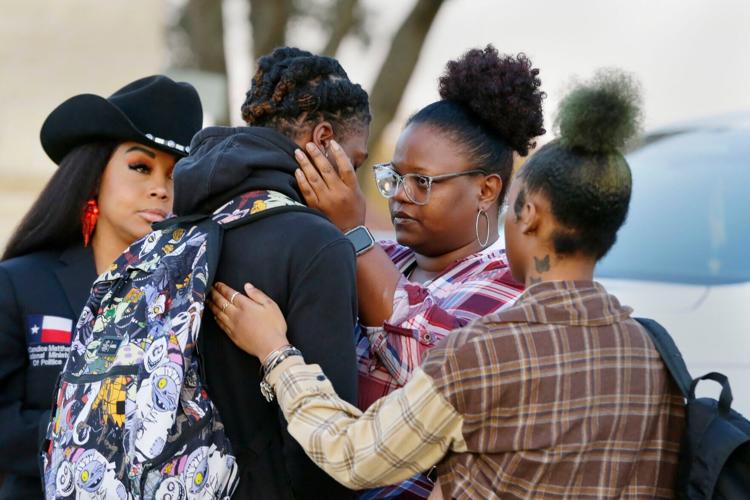
Darryl George, center left, a 17-year-old junior, and his mother Darresha George, center right, share words of encouragement Monday before walking across the street to go into Barbers Hill High School after Darryl served a 5-day in-school suspension for not cutting his hair.
For Black people, hairstyles are more than just a fashion statement. Hair has always played an important role across the Black diaspora, said Candice Matthews, national minister of politics for the New Black Panther Nation.
“Dreadlocks are perceived as a connection to wisdom,” Matthews said. “This is not a fad, and this is not about getting attention. Hair is our connection to our soul, our heritage and our connection to God.”
In George's family, all the men have dreadlocks, going back generations. To them, the hairstyle has cultural and religious importance, his mother said.
“Our hair is where our strength is, that’s our roots,” Darresha George said. “He has his ancestors locked into his hair, and he knows that.”
Historians say braids and other hairstyles served as methods of communication across African societies, including to identify tribal affiliation or marriage status, and as clues to safety and freedom for those who were captured and enslaved.

Darryl George, 17, a junior at Barbers Hill High School in Mont Belvieu, Texas, shows his dreadlocks Sept. 10 at the family's home.
After slavery was abolished, Black American hair became political. Although the Civil Rights Act of 1964 banned discrimination on the basis of race, color, religion, sex and national origin, Black people continued to face professional and social stigma for not adopting grooming habits that fit white, European beauty standards and norms.
The issue of race-based hair discrimination in the workplace has long existed alongside concerns in public and private schools. In 2018, a white referee in New Jersey told a Black high school wrestler to cut his dreadlocks or forfeit a match. Viral video of the wrestler having his hair cut with scissors as the crowd watched prompted the referee's suspension and spurred passage of the state's CROWN Act.
Darresha George said her son has been growing his dreadlocks for nearly 10 years and the family never received pushback or complaints until now. When let down, his dreadlocks hang above his shoulders. She said she couldn't understand how he violated the dress code when his hair was pinned up.
The school previously clashed with another Black male student over the dress code. Barbers Hill officials told a student he had to cut his dreadlocks to return to school or participate in graduation in 2020, which garnered national attention.
Greg Poole, who has been district superintendent since 2006, said the policy is legal and teaches students to conform as a sacrifice benefitting everyone.
“When you are asked to conform … and give up something for the betterment of the whole, there is a psychological benefit," Poole said. "We need more teaching (of) sacrifice.”
George's situation has drawn solidarity from young Black people around the nation, who say they have long dealt with discriminatory dress codes and comments from adults about their hair.
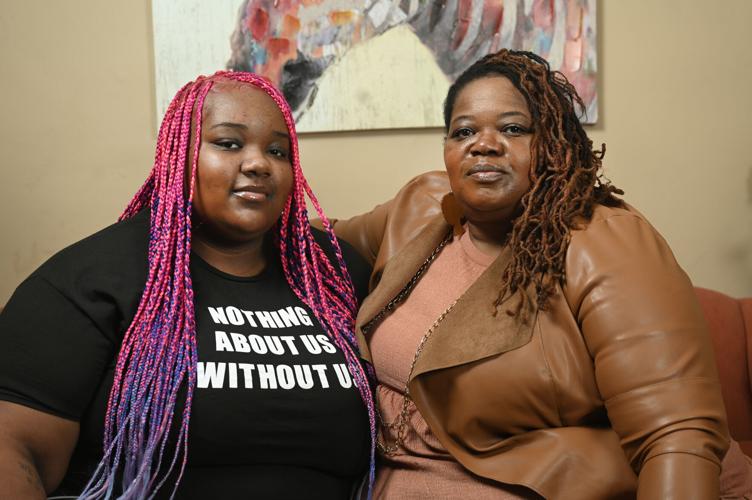
“When I was in fifth grade, I had a teacher tell me that my blue hair, my pink hair, was unnatural and too distracting for the other students in the class,” said Victoria Bradley, 19, who lives in Detroit. Michigan passed the CROWN Act into law this year.
Bradley, whose hair is braided and currently dyed multiple colors, said she attributes a lot of her hair confidence to her mother, Bernita Bradley, a longtime hair stylist and director of parent voice for the National Parents Union.

Victoria Bradley, left, 19, relaxes at home Sunday with her mother, Bernita, in Detroit. Historians say braids and other hairstyles served as methods of communication across African societies. After slavery was abolished, Black American hair became political. Although the Civil Rights Act of 1964 banned discrimination on the basis of race, color, religion, sex, and national origin, Black people continue to face professional and social stigma for not adopting grooming habits that fit white European beauty standards and norms.
Bernita Bradley said her first introduction to the CROWN Act was in 2021, when a biracial, 7-year-old girl in Michigan had her hair cut by a school worker without her parents’ permission. The girl’s father, Jimmy Hoffmeyer, filed a $1 million lawsuit against the school district. The lawsuit was settled earlier this year.
“That was modern-day scalping of this Black child,” Bradley said.

