


INDIAN ROCKS BEACH, Fla. — Just as they have for millions of years, sea turtles by the thousands made their labored crawl from the ocean to U.S. beaches to lay their eggs over the past several months. This year, record nesting was found in Florida and elsewhere despite growing concern about threats from climate change.
In Florida, preliminary state statistics show more than 133,840 loggerhead turtle nests, breaking a record set in 2016. Same for green turtles, where the estimate of at least 76,500 nests is well above the previous mark set in 2017.
High sea turtle nest numbers also have been reported in South Carolina, Alabama, North Carolina and Georgia, although not all set records like Florida, where Justin Perrault, vice president of research at Loggerhead Marinelife Center in Juno Beach, said the number of nests is remarkable this year.

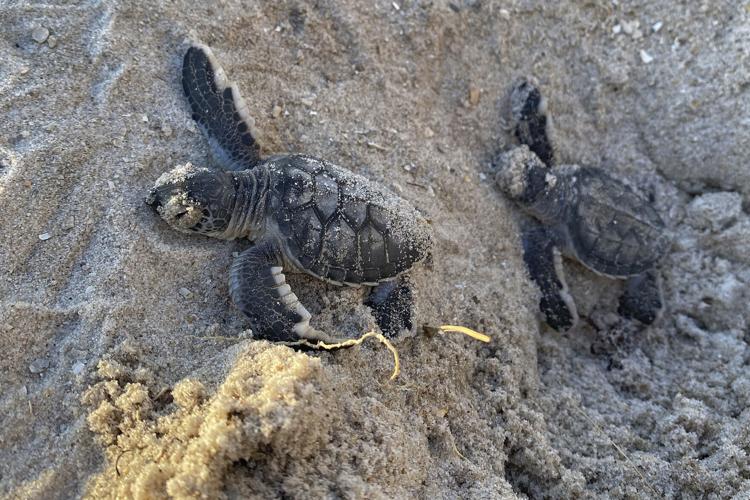
A pair of green sea turtle hatchlings make their way Aug. 8 to the Atlantic Ocean at the Canaveral Sea Shore in Cape Canaveral, Fla.
“We had more nests than we had ever seen before on our local beaches,” said Perrault, whose organization monitors Palm Beach County and broke a local record by 4,000 nests. “That's quite a bit of nesting.”
There are seven species of sea turtles: loggerhead, green, leatherback, hawksbill, Kemp's ridley, olive ridley and flatback. All are considered either endangered or threatened. They come ashore on summer nights, digging pits in the sand and depositing dozens of eggs before covering them up and returning to the sea. Florida beaches are one of the most important hatcheries for loggerheads in the world.

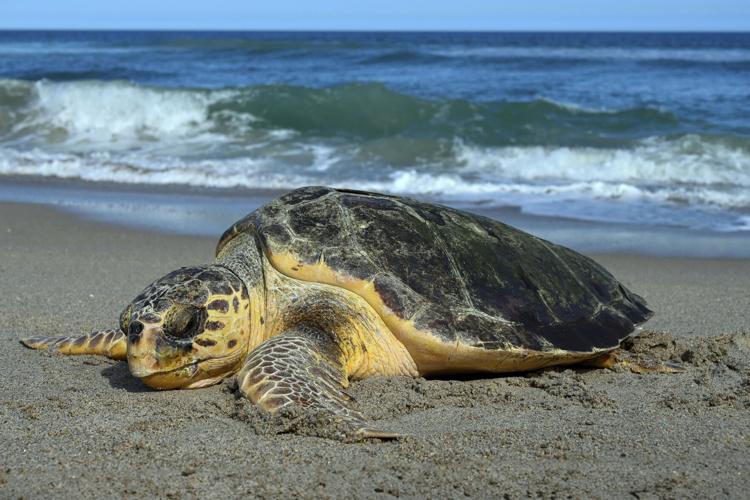
A loggerhead sea turtle digs a nest along the Atlantic Ocean in this undated photo, in Juno Beach, Fla.
Only about one in 1,000 sea turtle hatchlings live to adulthood. They face myriad natural threats, including predators on land and in the ocean, disruptions to nests and failure to make it to the water after hatching. This year along one stretch of Florida's Gulf Coast where 75 nests had been counted, most were wiped out by the surge from Hurricane Idalia in August.
“Unfortunately, the nests pre-Idalia were almost all lost due to the high tides and flooding on our barrier islands,” said Carly Oakley, senior turtle conservation biologist at Clearwater Marine Aquarium.
Female turtles generally lay eggs in a three-year cycle, leading to up-and-down years of nests, she said. “The nesting process is very exhausting and, in this break, females regain the energy to do the process again,” Oakley said.
Climate change has added to those challenges, reducing beaches as sea levels rise and causing more powerful tropical storms. Hotter air, water and sand and changes in the ocean currents turtles use to migrate also lower the odds of surviving, according to Oceana, an international conservation group.
Sand temperatures play a major role in determining sea turtle sex. In general, warmer temperatures produce more female turtles, and sand temperatures are projected to increase dramatically around the world by 2100, according to researchers at Florida State University.

A loggerhead sea turtle makes its way to the Atlantic Ocean in Juno Beach, Fla.
“So the warmer the nest is, the more likely that nest is to produce females,” Perrault said. “Additionally, hatchlings that come out of warmer nests are much smaller and often slower.”
A study led by FSU professor Mariana Fuentes that was published recently in the Global Change Biology journal found sea turtles will have to nest much later or much earlier than they currently do to cope with changing environmental conditions.
Even that may not be enough for every species, said Fuentes, who works in FSU's Department of Earth, Ocean and Atmospheric Science. Turtles have adapted to altered climates over millions of years, but today's rapid changes could happen too quickly for them to evolve, she said.
“We have found that even if they do change the timing of their nesting, that's not going to be sufficient to maintain the temperatures of current nesting grounds,” Fuentes said.

Sea turtle mothers already have to lumber out of the water to find a good spot to nest, which can be difficult in areas where humans have built seawalls. Some female turtles make several attempts, known as false crawls, before finding a suitable location.
Racoons, coyotes and other predators raid the nests and hatchlings, once they dig their way out, have to crawl to the sea before being snatched up by birds and other animals. Electric lights can disorient them, causing turtles to head the wrong way on the beach instead of following light from the moon and stars. And when the lucky ones finally start swimming, hungry fish await.

Michelle Pate, biologist at the South Carolina Department of Natural Resources, said tens of thousands of hatchlings don’t make it to the water, even as nest numbers trend higher across much of the Southeast.
“If we can't get hatchlings to emerge and make it to the ocean, then an increase in nest numbers doesn't help,” she said.
The increase in turtle nests this year conceals an ominous future for the animals, Perrault said.
“Yes, we’re seeing record numbers, but our hatchling production may not be that great,” he said. “And so in the future, 20 to 30 years from now, and these things come back to nest, we may not be seeing these record numbers that we’re seeing now.”
Photos: How one country is working to protect vulnerable sea turtles

Sea turtles swim at a tank inside the Marine Rehabilitation center of the Abu Dhabi National Aquarium in Abu Dhabi, United Arab Emirates, on June 13, 2023. Turtles that wash ashore in Abu Dhabi are rescued, rehabilitated and then released back into the ocean.

A girl carries a sea turtle to release on Saadiyat Island of Abu Dhabi, United Arab Emirates, on June 6, 2023. As sea turtles around the world grow more vulnerable due to climate change, the United Arab Emirates is is working to protect the creatures.

Members of the Wildlife Rescue program of Environment Agency Abu Dhabi carry a sea turtle to release on Saadiyat Island of Abu Dhabi, United Arab Emirates, on June 6, 2023.

Members of the Wildlife Rescue program of Environment Agency Abu Dhabi carry a sea turtle to release June 6 on Saadiyat Island of Abu Dhabi, United Arab Emirates. Scientists hope the turtle will thrive back in its natural habitat, joining about 500 sea turtles that have been rescued, rehabilitated and released since Abu Dhabi's Environment Agency launched a program three years ago to aid turtles.

People pet a sea turtle to release June 6 on Saadiyat Island of Abu Dhabi, United Arab Emirates.

Members of the Wildlife Rescue program of Environment Agency Abu Dhabi carry a sea turtle to release in Saadiyat Island of Abu Dhabi, United Arab Emirates, on June 6, 2023. As sea turtles around the world grow more vulnerable due to climate change, the United Arab Emirates is is working to protect the creatures. Many were outfitted with satellite tracking gear to help scientists better understand migration patterns and the success of rehabilitation methods.

A man pushes a sea turtle to the water during a turtle releasing program in Saadiyat Island of Abu Dhabi, United Arab Emirates, on June 6, 2023. As sea turtles around the world grow more vulnerable due to climate change, the United Arab Emirates is is working to protect the creatures. Many were outfitted with satellite tracking gear to help scientists better understand migration patterns and the success of rehabilitation methods.

A girl reacts during sea turtle releasing program on Saadiyat Island of Abu Dhabi, United Arab Emirates, on June 6, 2023. As sea turtles around the world grow more vulnerable due to climate change, the United Arab Emirates is is working to protect the creatures.

Children comfort a sea turtle to release at a hotel on Saadiyat Island of Abu Dhabi, United Arab Emirates, on June 6, 2023. As sea turtles around the world grow more vulnerable due to climate change, the United Arab Emirates is is working to protect the creatures.

A sea turtle moves to the water during a turtle releasing program on Saadiyat Island of Abu Dhabi, United Arab Emirates, on June 6, 2023. As sea turtles around the world grow more vulnerable due to climate change, the United Arab Emirates is is working to protect the creatures.

Sea turtles swim at a tank inside the Marine Rehabilitation center of the Abu Dhabi National Aquarium in Abu Dhabi, United Arab Emirates, on June 13, 2023. Turtles that wash ashore in Abu Dhabi are rescued, rehabilitated and then released back into the ocean.

Anne Valentina, Education & Conservation manager, weighs a sea turtle June 13 at the Marine Rehabilitation center of the Abu Dhabi National Aquarium in Abu Dhabi, United Arab Emirates.

