


BERLIN — Charlotte Knobloch was 6 years old when she saw the synagogues of Munich burning and watched helplessly as two Nazi officers marched away a beloved friend of her father who was beaten up and bleeding on the forehead.
It was Nov. 9, 1938, or Kristallnacht — the "Night of Broken Glass" — when Nazis terrorized Jews throughout Germany and Austria.
On Thursday, on the 85th anniversary of Kristallnacht, Knobloch remembered that night with horror and says it will be burned into her memory forever.
"My whole life, I've never been able to get those pictures out of my head," she told The Associated Press.
Knobloch, 91, still lives in Munich where she is the President of the Jewish Community of Munich and Upper Bavaria. She worries that the atrocities of the Nazis' persecution of Jews may get forgotten and thinks it is especially important to teach the young generation about the past.

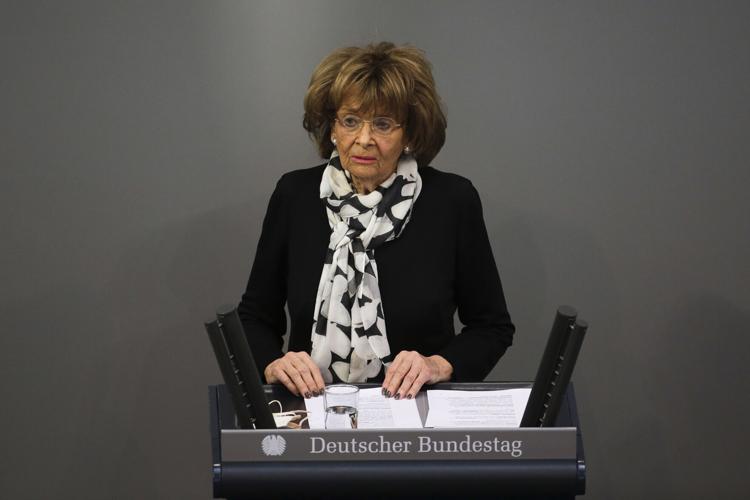
Holocaust survivor Charlotte Knobloch delivers a speech Jan. 27, 2021, at the German Federal Parliament in Berlin, Germany.
"We have to address young people, because without them there is no remembrance," said Knobloch, a Holocaust survivor. "It is important that Jewish voices can still be heard in the future, because there are hardly any survivors left."
So she teamed up with the New York-based Conference on Jewish Material Claims Against Germany, also referred to as the Claims Conference, for an interactive, virtual reality experience to tell her story about the pogroms of that night.
"Kristallnacht was a critical moment in which Nazi propaganda and antisemitism turned from words of hate into physical violence against Jews," said Gideon Taylor, the president of the Claims Conference, as he presented the immersive project on Thursday.
"This virtual reality project combines cutting edge technology with much needed Holocaust education," he added. "This important collaboration provides a new lens to Holocaust education by providing an immersive experience that will help users, including future generations, understand the Holocaust from inside the historical moments in a way that has never been possible."
The project, which the Claims Conference began shooting with Knobloch in Munich last month, includes video footage of her as she walks the viewer through the streets of her childhood neighborhood in Munich, just as she did with her father on Nov. 9, 1938, when they were afraid to go home fearing the Nazis would attack them there as well.

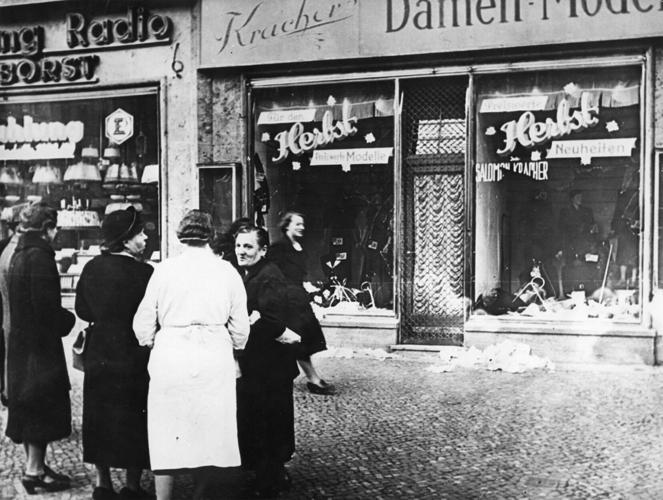
A November 1938 file photo shows a group of people standing outside a Jewish-owned shop in an unnamed German town after the Kristallnacht, when Nazi-incited mass riots left more than 91 Jews dead, damaged more than 1,000 synagogues and left some 7,500 Jewish businesses ransacked and looted.
Knobloch guides users through interactive reconstructions of spaces, such as synagogues, that were destroyed during Kristallnacht, in addition to archival photos, video footage, and authentic audio recordings of speeches by members of the Third Reich.
During Kristallnacht, the Nazis killed at least 91 people and vandalized 7,500 Jewish businesses. They also burned more than 1,400 synagogues, according to Israel's Yad Vashem Holocaust memorial.
Up to 30,000 Jewish men were arrested, many of them taken to concentration camps such as Dachau or Buchenwald. Hundreds more committed suicide or died as a result of the mistreatment in the camps years before the official mass deportations began.
Kristallnacht was a turning point in the escalating persecution of Jews which eventually led to the murder of six million European Jews by the Nazis and their henchmen during the Holocaust.
In the Claims Conference's virtual reality project, users will be able to engage in a Q&A, asking questions about Kristallnacht, Knobloch's family and the Holocaust in general. The full immersive VR experience and accompanying education materials will be released in 2024.
The Claims Conference is creating the project in partnership with the USC Shoah Foundation, Meta, UNESCO and the World Jewish Congress.
It comes as antisemitism in Germany has risen again following Hamas' attack that killed 1,400 people in Israel on Oct. 7 and triggered an ongoing war in Gaza.

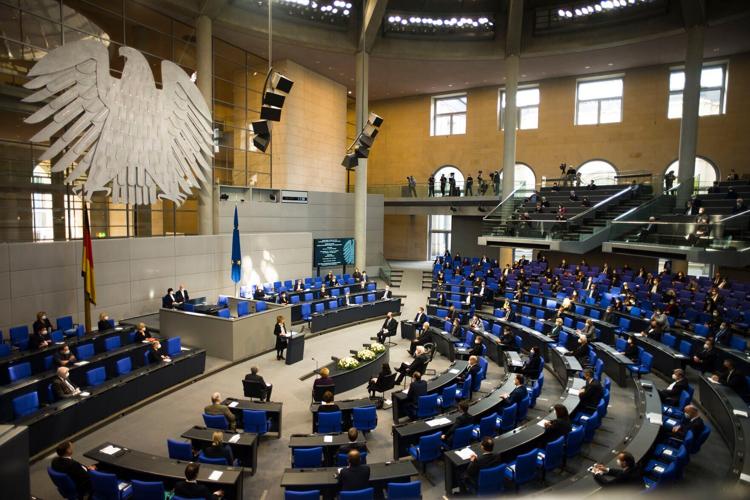
Holocaust survivor Charlotte Knobloch, at the podium center, delivers a speech Jan. 27, 2021, at the German Federal Parliament in Berlin.
A synagogue in Berlin was attacked with firebombs three weeks ago, Jews had Stars of David painted on their homes in the German capital and Jewish students in schools and universities have experienced bullying and discrimination.
While there's no comparison to the pogroms 85 years ago, which were state-sponsored by the Nazis, many Jews are living in fear again in Germany, trying to hide their identity in public and avoiding certain neighborhoods that recently were the scene of protests.
"We're living through a pandemic of hate now. We know this hate. We've seen what it can do. We know what fuels it and how it spreads," said Greg Schneider, the vice president of the Claims Conference.
Knobloch, too, is worried about the rise in antisemitism, despite the German government's staunch support for Israel and its unwavering solidarity with Jews in Germany.
"There was a great wave of solidarity in politics and among the population in Germany," she said, "but unfortunately it is already clearly waning again."
Photos: Stolen silver heirlooms headed back to descendants

Art historian Matthias Weniger, from the Bavarian National Museum arranges silver owned by Jews, in Tel Aviv, Israel, on June 1, 2023. The German curator has made it his mission to return a treasure trove of priceless silver objects stolen by the Nazis to Jewish families around the globe.

Art historian Matthias Weniger, from the Bavarian National Museum, holds silver glass by Jews, in Tel Aviv, Israel, on June 1, 2023.

Art historian Matthias Weniger, from the Bavarian National Museum shows silver art objects owned by Jewish relatives of Orna Lavy Flint, in Tel Aviv, Israel, on June 1, 2023.

Matthias Weniger, curator of the Bavarian National Museum, shows a catalogue of silver objects stolen by the Nazis from the Jews during the Third Reich, in Munich, Germany, on June 10, 2023. Museum staff have made it their mission to return as many of the silver objects as possible to the descendants of the original owners.

Matthias Weniger, curator of the Bavarian National Museum, lifts one of the 111 silver objects stolen by the Nazis from the Jews during the Third Reich, in Munich, Germany, on June 10, 2023. Museum staff have made it their mission to return as many of the silver objects as possible to the descendants of the original owners.

Matthias Weniger, curator of the Bavarian National Museum, lifts one of the 111 silver objects stolen by the Nazis from the Jews during the Third Reich. Says Hila Gutman: “He treats these little objects with so much care — like they are holy.”

Matthias Weniger, curator of the Bavarian National Museum, shows one of the 111 registered silver objects stolen by the Nazis from the Jews during the Third Reich, in Munich, Germany, on June 10, 2023.

Some of the 111 silver objects stolen by the Nazis from the Jews during the Third Reich, stand at the Bavarian National Museum in Munich, Germany, on June 10, 2023. Museum staff have made it their mission to return as many of the silver objects as possible to the descendants of the original owners.

Matthias Weniger, curator of the Bavarian National Museum, holds one of the 111 silver registered objects stolen by the Nazis from the Jews during the Third Reich, in Munich, Germany, on June 10, 2023. Museum staff have made it their mission to return as many of the silver objects as possible to the descendants of the original owners.

Some of the 111 silver objects stolen by the Nazis from the Jews during the Third Reich, stand at the Bavarian National Museum in Munich, Germany, on June 10, 2023. Museum staff have made it their mission to return as many of the silver objects as possible to the descendants of the original owners.

Matthias Weniger, curator of the Bavarian National Museum, lifts one of the 111 silver objects stolen by the Nazis from the Jews during the Third Reich, in Munich, Germany, on June 10, 2023. Museum staff have made it their mission to return as many of the silver objects as possible to the descendants of the original owners.

Some of the 111 silver objects stolen by the Nazis from the Jews during the Third Reich, stand at the Bavarian National Museum in Munich, Germany, on June 10, 2023.

