


EAGLE PASS, Texas — Wrecking ball-sized buoys on the Rio Grande. Razor wire strung across private property without permission. Bulldozers changing the very terrain of America's southern border.
For more than two years, Texas Republican Gov. Greg Abbott has escalated measures to keep migrants from entering the U.S., pushing legal boundaries with a go-it-alone bravado along the state's 1,200-mile border with Mexico. Now blowback over the tactics is widening, including from within Texas.
A state trooper's account of officers denying migrants water in 100-degree Fahrenheit temperatures and razor wire leaving asylum-seekers bloodied has prompted renewed criticism. The Mexican government, some Texas residents along the border and the Biden administration are pushing back.

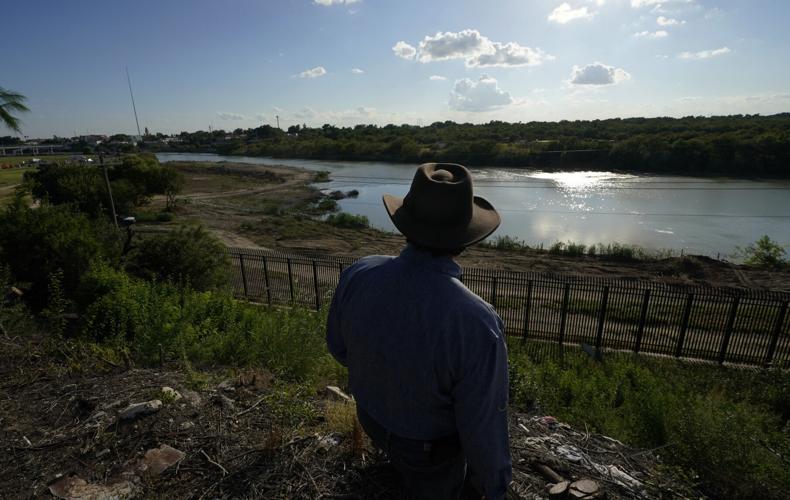
Kayak outfitter Jessie Fuentes stands above the Rio Grande on July 6 in Eagle Pass, Texas, where concertina wire lines the banks of the river. Texas Republican Gov. Greg Abbott has escalated measures to keep migrants from entering the U.S., including installing razor wire and massive buoys on the Rio Grande and bulldozing border islands in the river.
On Monday, the U.S. Justice Department sued Abbott over the buoy barrier that it says raises humanitarian and environmental concerns, asking a federal court to require Texas to dismantle it.
Abbott, who cruised to a third term in November while promising tougher border crackdowns, has used disaster declarations as the legal bedrock for some measures.
Critics call that a warped view.
“There are so many ways that what Texas is doing right now is just flagrantly illegal,” said David Donatti, an attorney for the Texas American Civil Liberties Union.
Abbott did not respond to requests for comment. He has repeatedly attacked President Joe Biden's border policies, tweeting Friday that they "encourage migrants to risk their lives crossing illegally through the Rio Grande, instead of safely and legally over a bridge.”
The Biden administration has said illegal border crossings have declined significantly since new immigration rules took effect in May.
Under the international bridge connecting Eagle Pass, Texas, with Piedras Negras, Mexico, protesters gathered at Shelby Park this month, chanting “save the river” and blowing a conch shell in a ceremony. A few yards away, crews unloaded neon-orange buoys from trailers parked by a boat ramp off the Rio Grande.
Jessie Fuentes stood with the environmental advocates, watching as state troopers restricted access to the water where he holds an annual kayak race. Shipping containers and layers of concertina wire lined the riverbank.
The experienced kayaker often took clients and race participants into the water through a shallow channel formed by a border island covered in verdant brush. That has been replaced by a bulldozed stretch of barren land connected to the mainland and fortified with razor wire.
“The river is a federally protected river by so many federal agencies, and I just don’t know how it happened,” Fuentes told the Eagle Pass City Council the night before.
Neither did the City Council.

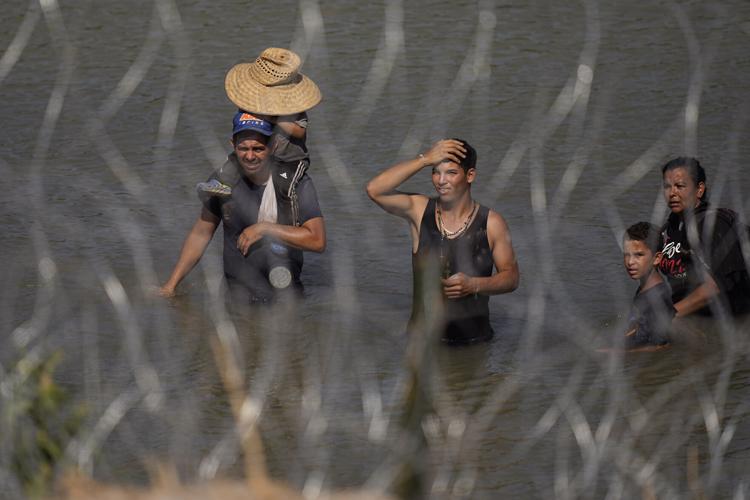
Migrants stand in the Rio Grande behind concertina wire July 11 as they try to enter the U.S. from Mexico near the site where workers are assembling large buoys to be used as a border barrier in Eagle Pass, Texas.
“I feel like the state government has kind of bypassed local government in a lot of different ways. And so I felt powerless at times,” council member Elias Diaz said.
The International Boundary of Water Commission says it was not notified when Texas modified several islands or deployed the massive buoys to create a barrier covering 1,000 feet of the middle of the Rio Grande, with anchors in the riverbed.
Abbott on Monday sent a letter to Biden that defended Texas’ right to install the barrier. He accused Biden of putting migrants at risk by not doing more to deter them from making the journey to the U.S.
The floating barrier also provoked tension with Mexico, which says it violates treaties. Mexico's secretary of foreign relations asked the U.S. government to remove the buoys and razor wire in a June letter.
Fuentes sued over the buoys, arguing that border crossings are not covered by the Texas Disaster Act.
As for the river islands, the Texas General Land Office gave the state Department of Public Safety access starting in April “to curb the ongoing border crisis.”
“Additionally, the General Land Office will also permit vegetation management, provided compliance with all applicable state and federal regulations is upheld,” said a letter from the office's commissioner, Dawn Buckingham.

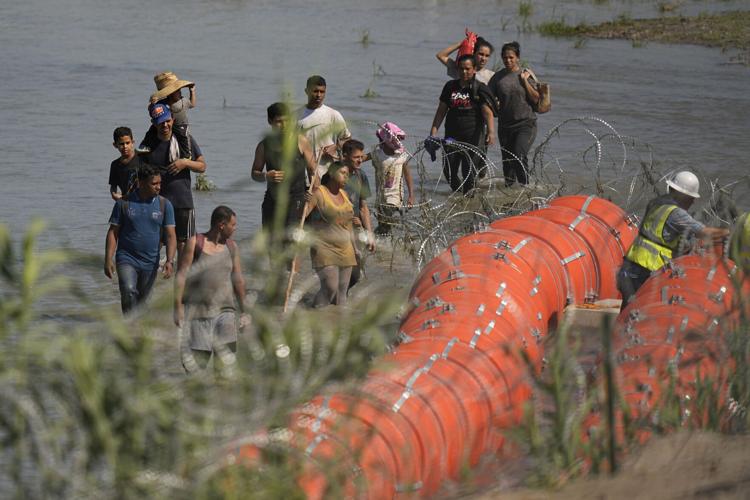
Migrants trying to enter the U.S. from Mexico on July 11 approach the site where workers are assembling large buoys to be used as a border barrier along the banks of the Rio Grande near Eagle Pass, Texas.
The Texas Military Department cleared out carrizo cane, which Buckingham's office called an “invasive plant” in its response to questions from the AP, and changed the landscape, affecting the river's flow.
Environmental experts are concerned.
“As far as I know, if there’s flooding in the river, it’s much more severe in Piedras Negras than it is in Eagle Pass because that’s the lower side of the river. And so next time the river really gets up, it’s going to push a lot of water over on the Mexican side, it looks like to me,” said Tom Vaughan, a retired professor and co-founder of the Rio Grande International Study Center.
Fuentes recently sought special permission from the city and DPS to navigate through his familiar kayaking route.
“Since they rerouted the water on the island, the water is flowing differently,” Fuentes said. “I can feel it.”
Victor Escalon, a DPS regional director overseeing Del Rio down to Brownsville, pointed to the governor's emergency disaster declaration. “We do everything we can to prevent crime, period. And that’s the job.”
Greece evacuates thousands of tourists amid wildfires, and more of today's top videos
Firefighters in Greece have continued to battle wildfires across the country, scientists are investigating the heat tolerance humans have during heatwaves across the world, and more of today's top videos.

Sea evacuations have begun to move tourists and locals to safety.

