


Every Earth Day, which began in 1970 and is observed on April 22, we are bombarded with messages about the state of the planet, what humans are doing to it, and how we can be better stewards of the environment.
With respect to the warming climate, there is good news and bad news.
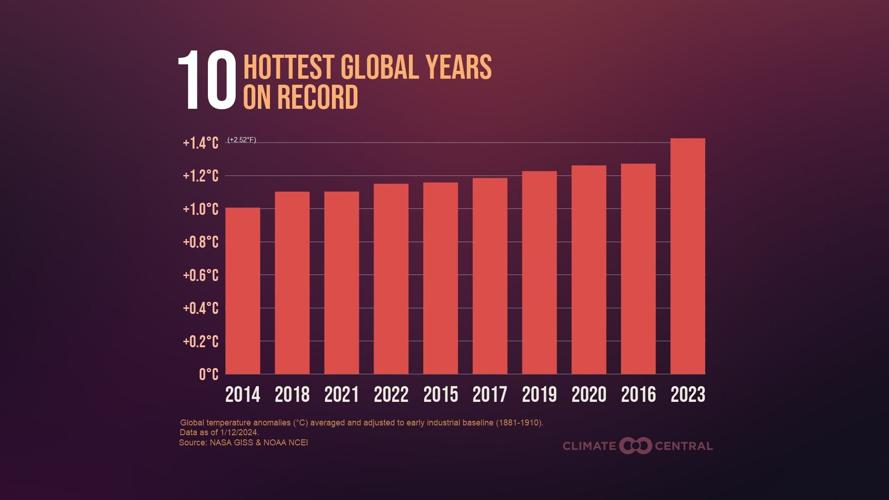
Each of the last 10 years has been among the 10 warmest on record globally, and last year was the warmest of those ten. Numerous lines of physical evidence indicate the burning of fossil fuels for energy is the root cause.

In the shorter term, each of the last 10 months has also been its warmest on record. Not coincidentally, 2023 also saw a jump in the average temperature of the world’s oceans. Because it takes more energy to raise the temperature of water than land, this sudden increase has many scientists looking for answers.

Data: NOAA, NASA. Graphic: Climate Central
In an article last month from the publication "Nature," the director of the NASA Goddard Institute for Space Studies, Gavin Schmidt, was searching for a definitive reason for the jump. “Many reasons for this discrepancy have been proposed but, as yet, no combination of them has been able to reconcile our theories with what has happened,” Schmidt wrote.
Similarly, studies continue regarding a key ocean circulation that moves warm ocean water from the East Coast toward the colder North Atlantic. This circulation keeps most of Europe from having a much colder climate given its latitude. Most of the data indicate that circulation is slowing.
Stefan Rahmstorf, a scientist at the Potsdam Institute for Climate Impact Research in Germany, has been studying the circulation for 30 years. This month in "Oceanography," he indicated that there are “multiple lines of evidence” to indicate the recent slowing of the circulation is a result of planetary warming from the burning of coal, oil and natural gas.
While it is not something that would happen in a matter of days or months, a full shutdown of that circulation would undoubtedly modify weather patterns. Europe would not go into an ice age, but it certainly would be colder. Early evidence also suggests it would lead to faster sea level rise on the East Coast and much drier islands in the Caribbean Sea.
While not immediately obvious, the movement away from fossil fuels to renewable energy is already underway, not just for altruistic reasons, but for financial ones.

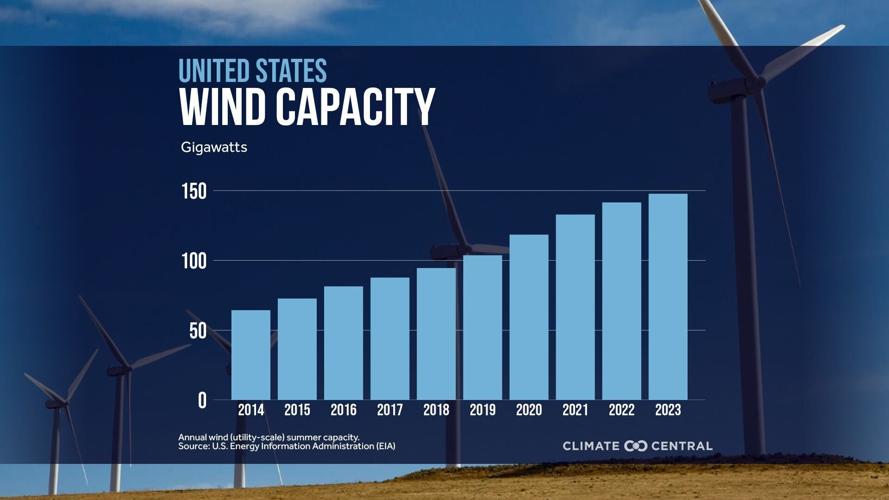
Data: US EIA. Graphic: Climate Central
Nationally, capacity from wind energy has more than doubled since 2014, with the greatest concentration in the Midwest and the Great Plains where the wind is more consistent than in other parts of the country. Offshore wind is beginning to get a footing, as the supports for 176 wind turbines will begin installation this summer off the Virginia coast.
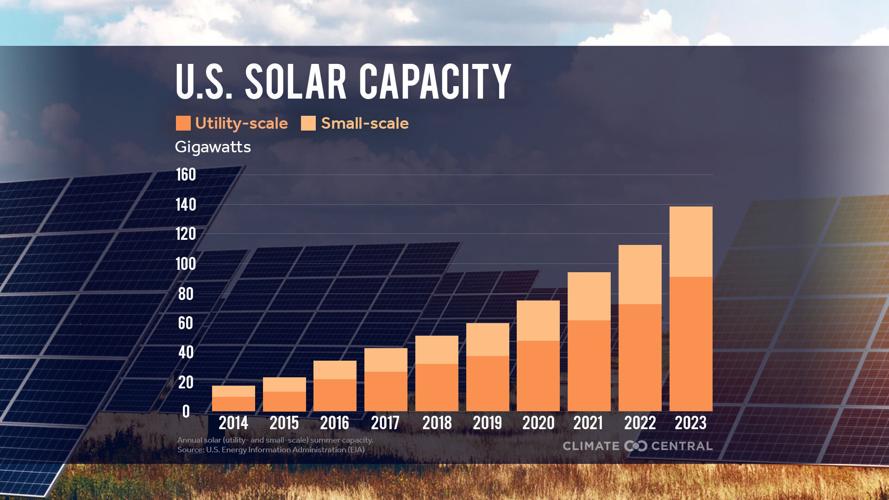
Solar energy capacity has increased by a factor of eight since 2014, as its costs have dropped dramatically, making it the least expensive energy source now being deployed. Not surprisingly, more than half of the new utility scale solar expected to come online this year are from three sunny states: California, Florida and Texas.

Data: US EIA. Graphic: Climate Central
Utility scale batteries still have a long way to go to make up the difference when the sun does not shine and the wind slows down, and this energy storage capacity is expected to double nationally this year. In the meantime, existing nuclear energy installations may provide steadier background power when the renewable installations are not at peak. But in total, solar and storage installations are expected to account for 81 percent of new U.S. capacity this year.
An additional sign of this change comes in the job sector. According to the International Energy Agency, there has been more job growth in the renewable energy sector versus the fossil fuel sector over the last three years, suggesting there is plenty of work to be done in transforming the nation’s electric grid to one that does not emit pollutants into the atmosphere.
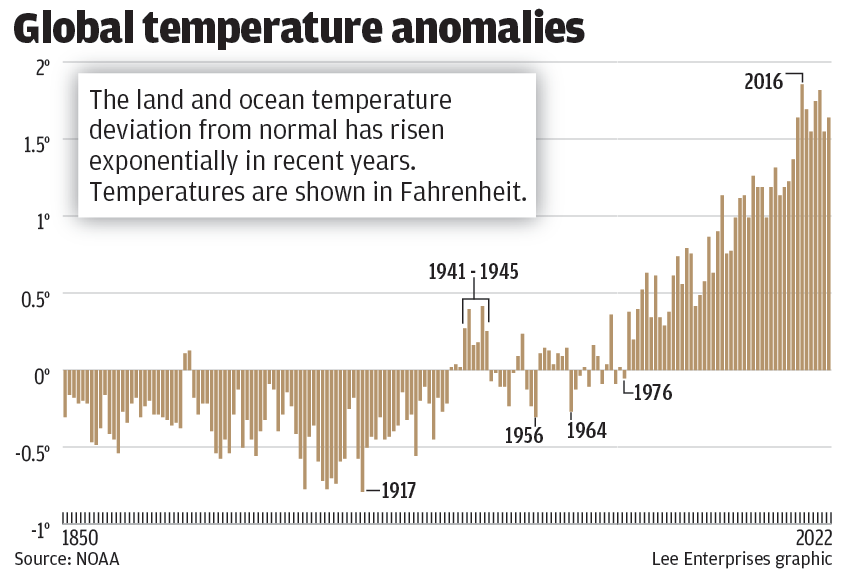
Even with more work to be done, important goals are within reach, so despair is not a good strategy. Nonetheless, there are physical aspects of the climate system that will change irreversibly as the climate warms. Sea level rise is one of them.
While it is not accurate to say we only have a few years to save the Earth, each bit of planetary warming incrementally makes heat waves more likely and more intense, and it locks us into inescapable sea level rise in the decades that follow.
Like any other planning project, the more we are able to do now, the better off we and our children will be. This effectively mirrors a rule famously invoked at the end of almost any Boy Scout campout — leave it better than you found it.
Learn more about climate concerns from these two episodes of the Across the Sky podcast
Notable events in the history of Earth Day
The history of Earth Day
Updated
The first Earth Day on April 22, 1970, came on the heels of events in the ’60s. Some point to the Santa Barbara oil spill of 1969; others say the first Earth Day was inspired by the publication of Rachel Carson’s "Silent Spring" in 1962, which shed light on the destruction of pesticides like DDT. Whichever milestone you associate with the founding of the event, Earth Day has evolved into part of an international movement bringing people together under the unified cause of preserving the planet for future generations.
Since its inception, Earth Day has been adopted in dozens of countries around the world and recognized by the United Nations as a global effort. In the last half-century, the world has seen hundreds of demonstrations, marches, protests, and subsequent movements all centered around the crucial goal of nurturing and protecting the environment. From wastewater standards to global initiatives to plant trees, the largest climate strike in the world, and national cleanups, what started as a single day created by a U.S. senator from Wisconsin is now a bonafide worldwide sensation.
In observance of Earth Day, Stacker used a variety of authoritative resources from news articles to organization websites such as the Earth Day Network to compile a list of 20 notable events in the history of Earth Day. Keep reading to learn about many of the Earth Day milestones throughout its five decades.
You may also like: 25 terms you should know to understand the climate change conversation
September 1962: ‘Silent Spring’ is published
Updated
In 1962, Rachel Carson's “Silent Spring” hit the shelves. The book exposed the damage that pesticides like DDT have on the environment, including the effect on both people and natural ecosystems. Though she was hit with a firestorm of criticism from the chemical industry, Carson helped fuel the movement that fought for the creation of the Environmental Protection Agency.
January 1969: Santa Barbara oil spill
Updated
California had one of its darkest days in history on Jan. 28, 1969. Workers on an offshore oil rig saw the eruption of gas and drilling mud from a freshly bored well in the bay off the coast of Santa Barbara. That spill hurled 3 million gallons of crude oil into the Pacific Ocean, destroying wildlife, greasing beaches, and reaching about 800 square miles of ocean. There were no government regulations in place for disasters such as these, which led to the biggest oil spill in U.S. history at the time. The disaster inspired members of Congress to establish the first Earth Day in April 1970.
January 1970: Santa Barbara Environmental Rights Day
Updated
The devastating oil spill off the coast of Santa Barbara helped spawn a new age of environmental protection, including the University of California, Santa Barbara leading a charge to create the Santa Barbara Declaration of Environmental Rights in 1970. These rights were read Jan. 28, 1970, exactly a year after the spill, and also read into the U.S. Congressional Record. The opening line was, "All people have the right to an environment capable of sustaining life and promoting happiness."
April 1970: First Earth Day
Updated
A growing understanding of environmental awareness brought about by the Santa Barbara oil spill and “Silent Spring” led U.S. Sen. Gaylord Nelson of Wisconsin to conceive of a national day of action to expand awareness of the need for protecting the environment. The first Earth Day involved 20 million Americans gathering in streets, parks, and auditoriums to rally for a healthy environment.
December 1970: Congress authorizes creation of the EPA
Updated
Prior to 1970, there were no government regulations in place to regulate factory waste. Earth Day changed that: On the heels of the growing environmental movement, Congress in approved the creation of a new arm of government to handle all environmental issues going forward called the U.S. Environmental Protection Agency, which began operations in December 1970.
You may also like: Best-run cities in America
February 1971: Earth Day recognized by the United Nations
Updated
While the United States and other nations had their own ways to commemorate Earth Day, it was officially recognized by the United Nations in 1971 on the vernal equinox, the first day of spring. UN Secretary-General U Thant signed a proclamation in February of that year. Today, while there is no one global Earth Day, nearly 200 countries in the world celebrate Earth Day on either April 22 or the vernal equinox.
October 1972: Congress passes the Clean Water Act
Updated
Congress passed the Clean Water Act in 1972 to regulate the discharge of toxins into U.S. water. The act gave the EPA leverage to create pollution control programs and develop wastewater standards.
April 1980: First Canadian Earth Day
Updated
Canada began celebrating Earth Day in April 1980 and has expanded the event to Earth Week (and sometimes Earth Month in certain places.) Projects undertaken by Canada in conjunction with the observance include Edmonton's Earth Day Festival and Ontario's Waterways Clean-up.
April 1990: 20th Earth Day recognized by 141 countries
Updated
Earth Day made its mark in its first couple of decades: By 1990 141 countries observed some form of the holiday. Within those countries, an estimated 200 million people participated in Earth Day-related events.
September 1995: Sen. Gaylord Nelson awarded Presidential Medal of Freedom
Updated
Twenty-five years after founding Earth Day in the United States, Gaylord Nelson was awarded the Presidential Medal of Freedom. President Clinton honored him with the medal, which represents the highest honor given to civilians in the country.
You may also like: How top Democratic candidates compare on major issues
April 2000: Leonardo DiCaprio hosts 30th Earth Day
Updated
Leonardo DiCaprio’s commitment to the environment includes his work with the Leonardo DiCaprio Foundation and his role in the 2016 documentary “Before the Flood.” His involvement in Earth Day and interest in environmental causes can be traced back to 2000 when DiCaprio hosted an Earth Day special on ABC.
April 2007: Earth Day crowds set records in Chicago
Updated
2007 remains one of the biggest milestones for the environmental movement, when more than 40,000 people showed up for the festivities in Chicago's Lincoln Park Zoo. It was a single-day attendance record for the global holiday.
April 2010: Earth Day 2010 coincides with International Year of Biodiversity
Updated
The 40th anniversary Earth Day coincided with the UN's Biodiversity Year. The International Year of Biodiversity had a calendar of events planned that highlighted the role that wildlife plays in supporting the function of the earth. The official launch was in Berlin in January, with other events being held in Paris, Norway, India, Qatar, Colombia, China, and New York.
April 2016: Earth Day Network launches 7.8 billion trees campaign
Updated
"Trees For The Earth" was a campaign created by Earth Day Network for Earth Day in 2016. The goal? To plant 7.8 billion trees by Earth Day 2020. The 7.8 billion figure represented, at the time, every person on the planet. India's Telangana state committed 460 million trees on its own.
April 2016: Paris Agreement opens for signatures
Updated
The foundation for the Paris Agreement was laid in 2015 when Parties to the UNFCCC agreed to combat climate change and ramp up initiatives to reach a low-carbon future. The Paris Agreement aims to unify nations under a common goal: to keep global temperature rise this century under 2 degrees Celsius. It officially opened for signatures on April 22, 2016, at the UN Headquarters in New York.
You may also like: Famous declassified government secrets
April 2017: Earth Day Network co-organizes March for Science
Updated
On the anniversary of the Paris Agreement, Earth Day Network organized the March for Science Rally and Teach-Ins, starting in Washington D.C. and spreading to numerous cities around the U.S. and world. The marches came in response to President Donald Trump's hostility to science when it came to making decisions around climate change and vaccines.
August 2018: Greta Thunberg begins School Strike for Climate
Updated
When she was 15 years old, Greta Thunberg started skipping school to call on the Swedish Parliament to take action on climate change by holding up a sign reading "school strike for climate" outside the building. Within a year, her efforts inspired others to join, in Sweden and around the world, with school children striking on Fridays to demand their governments take stronger action to protect the Earth. Thunberg gave a fiery address to the 2018 United Nations Climate Change Conference, and in 2019 she was the face of the largest climate strike in history.
April 2019: Great Global Clean-up for Earth Day 2019
Updated
Earth Day Network in 2019 launched a national event bringing together volunteers in 13 cities around the country for the Great Global Clean-up for Earth Day to clean parks, cities, and waterways. The cleanups were held in Chicago, Dallas, Denver, Honolulu, Los Angeles, Miami, New York, Richmond, San Diego, San Francisco, Seattle, and Washington D.C.
September 2019: Global climate strike draws more than 4 million
Updated
Inspired by Greta Thunberg, the September 2019 Global Climate Strike was the largest climate strike in the world to date. Across 163 countries, 2,500 events were scheduled on all seven continents. It’s estimated that more than 4 million people were part of the international movement, though it is a tough number for experts to confirm.
April 2021: Earth Day, with a focus on climate change
Updated
The efforts of Greta Thunberg and youth-led organizations like the Sunrise Movement, as well as the increased presence of leftist politicians like Alexandria Ocasio-Cortez in Congress, have fueled a new wave of environmental activism. For Earth Day 2021, President Joe Biden is hosting a "Summit on Climate" with other world leaders to address climate change. This comes on the heels of his pitch for a $2 trillion infrastructure overhaul, which puts combating climate change and moving America to green energy at the center of improving infrastructure and providing jobs.
You may also like: Earth Day to school strikes: A timeline of the American environmental movement
Notable events in the history of Earth Day
Updated
The first Earth Day on April 22, 1970, came on the heels of events in the ’60s. Some point to the Santa Barbara oil spill of 1969; others say the first Earth Day was inspired by the publication of Rachel Carson’s “Silent Spring” in 1962, which shed light on the destruction of pesticides like DDT. Whichever milestone you associate with the founding of the event, Earth Day has evolved into part of an international movement bringing people together under the unified cause of preserving the planet for future generations.
Since its inception, Earth Day has been adopted in dozens of countries around the world and recognized by the United Nations as a global effort. In the last half-century, the world has seen hundreds of demonstrations, marches, protests, and subsequent movements all centered around the crucial goal of nurturing and protecting the environment. From wastewater standards to global initiatives to plant trees, the largest climate strike in the world, and national cleanups, what started as a single day created by a U.S. senator from Wisconsin is now a bonafide worldwide sensation.
In observance of Earth Day, Stacker used a variety of authoritative resources from news articles to organization websites such as the Earth Day Network to compile a list of 20 notable events in the history of Earth Day. Keep reading to learn about many of the Earth Day milestones throughout its five decades.
You may also like: 25 terms you should know to understand the climate change conversation

September 1962: ‘Silent Spring’ is published
Updated
In 1962, Rachel Carson’s “Silent Spring” hit the shelves. The book exposed the damage that pesticides like DDT have on the environment, including the effect on both people and natural ecosystems. Though she was hit with a firestorm of criticism from the chemical industry, Carson helped fuel the movement that fought for the creation of the Environmental Protection Agency.
January 1969: Santa Barbara oil spill
Updated
California had one of its darkest days in history on Jan. 28, 1969. Workers on an offshore oil rig saw the eruption of gas and drilling mud from a freshly bored well in the bay off the coast of Santa Barbara. That spill hurled 3 million gallons of crude oil into the Pacific Ocean, destroying wildlife, greasing beaches, and reaching about 800 square miles of ocean. There were no government regulations in place for disasters such as these, which led to the biggest oil spill in U.S. history at the time. The disaster inspired members of Congress to establish the first Earth Day in April 1970.
January 1970: Santa Barbara Environmental Rights Day
Updated
The devastating oil spill off the coast of Santa Barbara helped spawn a new age of environmental protection, including the University of California, Santa Barbara leading a charge to create the Santa Barbara Declaration of Environmental Rights in 1970. These rights were read Jan. 28, 1970, exactly a year after the spill, and also read into the U.S. Congressional Record. The opening line was, “All people have the right to an environment capable of sustaining life and promoting happiness.”
April 1970: First Earth Day
Updated
A growing understanding of environmental awareness brought about by the Santa Barbara oil spill and “Silent Spring” led U.S. Sen. Gaylord Nelson of Wisconsin to conceive of a national day of action to expand awareness of the need for protecting the environment. The first Earth Day involved 20 million Americans gathering in streets, parks, and auditoriums to rally for a healthy environment.
December 1970: Congress authorizes creation of the EPA
Updated
Prior to 1970, there were no government regulations in place to regulate factory waste. Earth Day changed that: On the heels of the growing environmental movement, Congress in approved the creation of a new arm of government to handle all environmental issues going forward called the U.S. Environmental Protection Agency, which began operations in December 1970.
You may also like: Best-run cities in America
February 1971: Earth Day recognized by the United Nations
Updated
While the United States and other nations had their own ways to commemorate Earth Day, it was officially recognized by the United Nations in 1971 on the vernal equinox, the first day of spring. UN Secretary-General U Thant signed a proclamation in February of that year. Today, while there is no one global Earth Day, nearly 200 countries in the world celebrate Earth Day on either April 22 or the vernal equinox.
October 1972: Congress passes the Clean Water Act
Updated
Congress passed the Clean Water Act in 1972 to regulate the discharge of toxins into U.S. water. The act gave the EPA leverage to create pollution control programs and develop wastewater standards.
April 1980: First Canadian Earth Day
Updated
Canada began celebrating Earth Day in April 1980 and has expanded the event to Earth Week (and sometimes Earth Month in certain places). Projects undertaken by Canada in conjunction with the observance include Edmonton’s Earth Day Festival and Ontario's Waterways Clean-up.
April 1990: 20th Earth Day recognized by 141 countries
Updated
Earth Day made its mark in its first couple of decades: By 1990, 141 countries observed some form of the holiday. Within those countries, an estimated 200 million people participated in Earth Day-related events.
September 1995: Sen. Gaylord Nelson awarded Presidential Medal of Freedom
Updated
Twenty-five years after founding Earth Day in the United States, Gaylord Nelson was awarded the Presidential Medal of Freedom. President Clinton honored him with the medal, which represents the highest honor given to civilians in the country.
You may also like: How top Democratic candidates compare on major issues
April 2000: Leonardo DiCaprio hosts 30th Earth Day
Updated
Leonardo DiCaprio’s commitment to the environment includes his work with the Leonardo DiCaprio Foundation and his role in the 2016 documentary “Before the Flood.” His involvement in Earth Day and interest in environmental causes can be traced back to 2000 when DiCaprio hosted an Earth Day special on ABC.
April 2007: Earth Day crowds set records in Chicago
Updated
2007 remains one of the biggest milestones for the environmental movement when more than 40,000 people showed up for the festivities in Chicago’s Lincoln Park Zoo. It was a single-day attendance record for the global holiday.
April 2010: Earth Day 2010 coincides with International Year of Biodiversity
Updated
The 40th anniversary Earth Day coincided with the UN’s Biodiversity Year. The International Year of Biodiversity had a calendar of events planned that highlighted the role that wildlife plays in supporting the function of Earth. The official launch was in Berlin in January, with other events being held in Paris, Norway, India, Qatar, Colombia, China, and New York.
April 2016: Earth Day Network launches 7.8 billion trees campaign
Updated
“Trees For The Earth” was a campaign created by Earth Day Network for Earth Day in 2016. The goal? To plant 7.8 billion trees by Earth Day 2020. The 7.8 billion figure represented, at the time, every person on the planet. India’s Telangana state committed 460 million trees on its own.
April 2016: Paris Agreement opens for signatures
Updated
The foundation for the Paris Agreement was laid in 2015 when Parties to the UNFCCC agreed to combat climate change and ramp up initiatives to reach a low-carbon future. The Paris Agreement aims to unify nations under a common goal: to keep global temperature rise this century under 2 degrees Celsius. It officially opened for signatures on April 22, 2016, at the UN Headquarters in New York.
You may also like: Famous declassified government secrets
April 2017: Earth Day Network co-organizes March for Science
Updated
On the anniversary of the Paris Agreement, Earth Day Network organized the March for Science Rally and Teach-Ins, starting in Washington D.C. and spreading to numerous cities around the U.S. and the world. The marches came in response to President Donald Trump’s hostility to science when it came to making decisions around climate change and vaccines.
August 2018: Greta Thunberg begins School Strike for Climate
Updated
When she was 15 years old, Greta Thunberg started skipping school to call on the Swedish Parliament to take action on climate change by holding up a sign reading “school strike for climate” outside the building. Within a year, her efforts inspired others to join, in Sweden and around the world, with school children striking on Fridays to demand their governments take stronger action to protect the Earth. Thunberg gave a fiery address to the 2018 United Nations Climate Change Conference, and in 2019 she was the face of the largest climate strike in history.
April 2019: Great Global Clean-up for Earth Day 2019
Updated
Earth Day Network in 2019 launched a national event bringing together volunteers in 13 cities around the country for the Great Global Clean-up for Earth Day to clean parks, cities, and waterways. The cleanups were held in Chicago, Dallas, Denver, Honolulu, Los Angeles, Miami, New York, Richmond, San Diego, San Francisco, Seattle, and Washington D.C.
September 2019: Global climate strike draws more than 4 million
Updated
Inspired by Greta Thunberg, the September 2019 Global Climate Strike was the largest climate strike in the world to date. Across 163 countries, 2,500 events were scheduled on all seven continents. It’s estimated that more than 4 million people were part of the international movement, though it is a tough number for experts to confirm.
April 2021: Earth Day, with a focus on climate change
Updated
The efforts of Greta Thunberg and youth-led organizations like the Sunrise Movement, as well as the increased presence of leftist politicians like Alexandria Ocasio-Cortez in Congress, have fueled a new wave of environmental activism. For Earth Day 2021, President Joe Biden hosted a “Summit on Climate” with other world leaders to address climate change. This came on the heels of his pitch for a $2 trillion infrastructure overhaul, which put combating climate change and moving America to green energy at the center of improving infrastructure and providing jobs.
You may also like: Earth Day to school strikes: A timeline of the American environmental movement
September 2019: Global climate strike draws more than 4 million
Updated
Inspired by Greta Thunberg, the September 2019 Global Climate Strike was the largest climate strike in the world to date. Across 163 countries, 2,500 events were scheduled on all seven continents. It’s estimated that more than 4 million people were part of the international movement, though it is a tough number for experts to confirm.




