


NAMPA, Idaho — Waiting in a long post office line with the latest shipment of "abortion aftercare kits," Kimra Luna got a text. A woman who'd taken abortion pills three weeks earlier was worried about bleeding — and disclosing the cause to a doctor.
"Bleeding doesn't mean you need to go in," Luna responded on the encrypted messaging app Signal. "Some people bleed on and off for a month."
It was a typically busy afternoon for Luna, a doula and reproductive care activist in a state with some of the strictest abortion laws in the nation. Those laws make the work a constant battle, the 38-year-old said, but they draw strength from others in a makeshift national network of helpers: clinic navigators, abortion fund leaders and individual volunteers who have become a supporting cast for people in restrictive states who are seeking abortions.
"This is the underground," said Jerad Martindale, an activist in Boise.

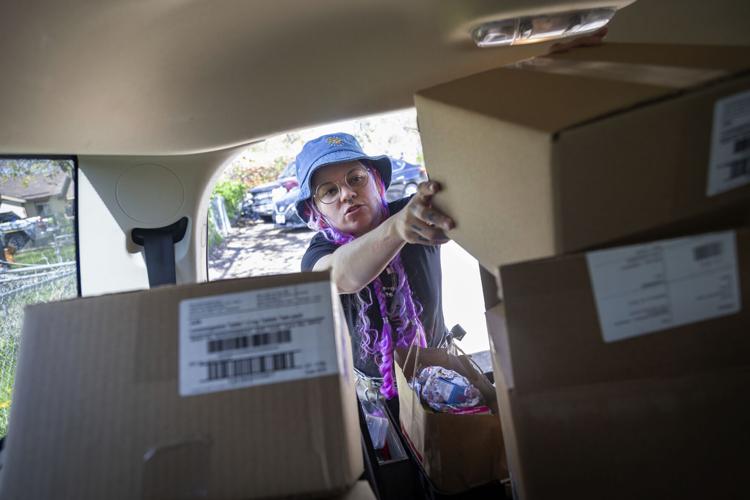
Kimra Luna fills the back of their car with boxes of materials April 12 that will be used to make reproductive health kits to be offered free to local businesses in Boise, Idaho.
Abortion-rights advocates worry Idaho is a harbinger of where more states may be headed.
Here, abortion is banned with very limited exceptions at all stages of pregnancy, and a law signed by the governor but temporarily blocked forbids adults from helping minors leave the state for abortions without parental consent. Recently, the U.S. Supreme Court heard arguments about Idaho's enforcement of its abortion ban in hospital emergencies.
Carol Tobias, president of the National Right to Life Committee, said such laws protect the unborn. While she doesn't know if anything can be done to prevent people from helping others get abortions, she said, "I would certainly wish that they wouldn't do it."
But Luna and others consider their work mutual aid essential to the community.
"I wouldn't be able to live with myself if I just acted scared and didn't do the things that I do," said the single parent of three boys, who uses the pronoun they. "I know I'm put here to do this."

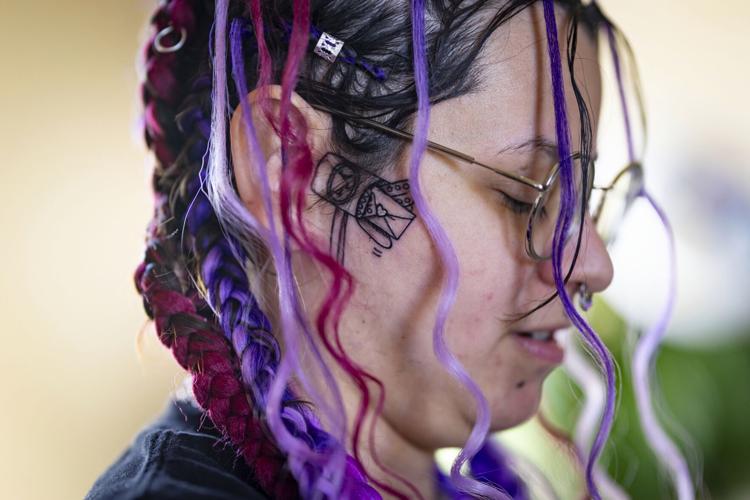
Kimra Luna, sporting a new face tattoo of a mailbox with abortion pills falling out of it, packs abortion aftercare kits April 12 at home in Nampa, Idaho.
Luna helps run Idaho Abortion Rights, launched in 2022 with extra bail money that was raised after they got arrested at a protest.
A longtime activist, they strongly believe abortion pills should be accessible and once brought some to the state Capitol steps to prove residents still could get them online.
Luna is a full-spectrum doula, aiding in births as well as abortions. Most abortion work is remote, providing support, advice, answers to questions and referrals to resources such as abortion funds.
"We've always found a way to make sure people get help no matter what that help is," Luna said of their group.
That also includes caring for people after abortions.
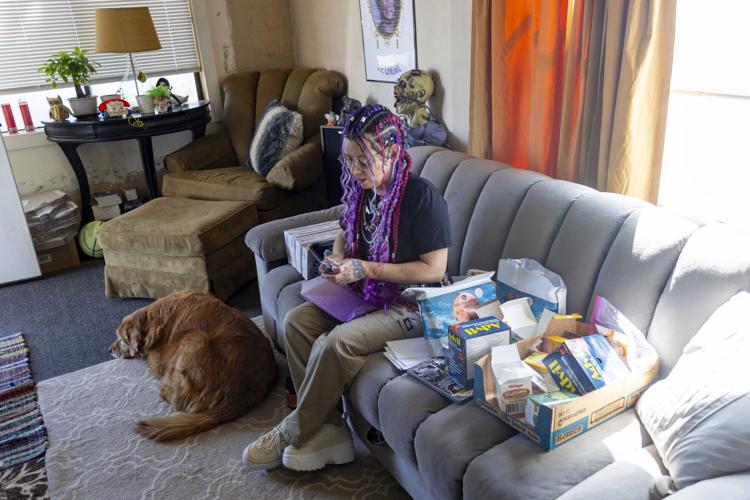
One April morning, Luna assembled aftercare kits on the couch, pink-and-purple braids falling in front of their face as they filled packets with supplies like sanitary pads, Advil, over-the-counter stomach medicines and red raspberry leaf tea.

Kimra Luna packs abortion aftercare kits April 12 at home in Nampa, Idaho, to be mailed to Nebraska, South Dakota and Idaho.
In places where abortion is legal, navigators at clinics provide some of the same sorts of logistical help.
Planned Parenthood of the Rocky Mountains has three navigators for its 21 clinics, one of them virtual, in Colorado, New Mexico and Nevada. They handle about 1,000 calls a month — some from out-of-state patients who drive up to 17 hours for care, said Adrienne Mansanares, the organization's president and CEO.
Abortion opponents try to steer people away from ending their pregnancies and toward centers they say also provide support like pregnancy-related information, parenting classes and baby supplies.
For someone "not sure how she is going to move forward and trying to figure out what resources are available for her if she wants to carry the pregnancy to term, there is support" at about 3,000 locations nationwide, said Tobias of the Right to Life Committee. "That is definitely the better way to go."

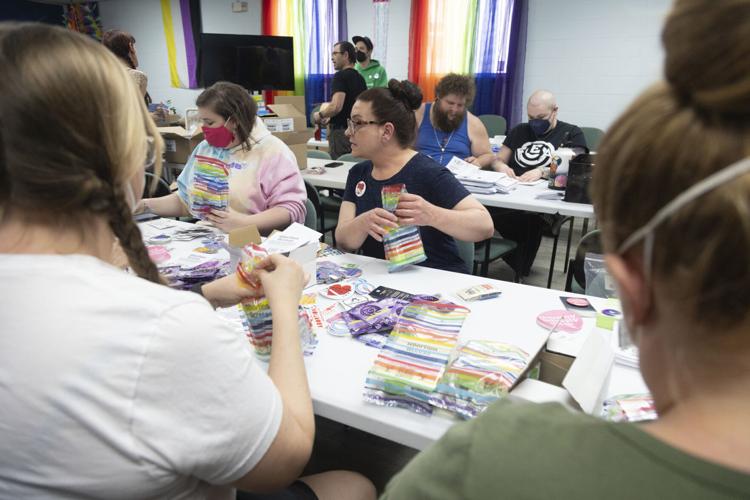
People help assemble reproductive health kits April 12 at The Community Center in Boise, Idaho.
Some people facing unplanned pregnancies find answers online, like DakotaRei Belladonna Frausto, a 19-year-old student at San Antonio College in Texas. They sought an abortion a couple years ago and came across a Facebook group, and eventually decided to start their own private Facebook group where people can share abortion resources and experiences.
In April, about two dozen people gathered at a Boise community center to help Luna assemble boxes containing emergency contraception, condoms and information about accessing abortions.
Stephanie Vaughan, 39, said she had an abortion at 17, when a baby might have kept her from going to college and getting a good job.
Martindale recalled how a girlfriend was able to get an abortion when they were teens. He and his wife, Jen, now devote much of their free time to Idaho Abortion Rights; they keep thousands of packages of emergency contraception on hand to donate.
"It's a community responsibility," said Jen Martindale, 48.

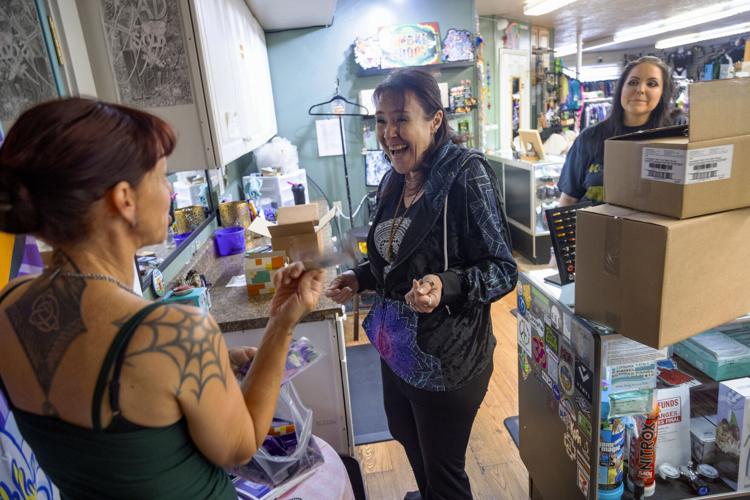
Purple Lotus employees Amber Sichulailuck, center, and Taylor Castillo, right, talk April 13 with Jen Martindale while she deliver boxes of reproductive health materials to the store in Boise, Idaho.
The next morning, the Martindales took reproductive health supplies to local shops that offer them for free. Their first stop was Purple Lotus, a clothing and accessories store.
Worker Taylor Castillo immediately opened a box: "Pregnancy tests? Oh good," she said. "Those have been flying!"
Castillo said she's glad to help. When she suffered a miscarriage in 2021, her doctor prescribed the same pills used in medication abortion. She wonders what would happen if she needed them today.
"Now, everything is on fire," she said. "The good thing is, there are mutual aid programs that are willing to stand up for us."
The Supreme Court fight over an abortion pill: What's next?
Introduction
Updated
U.S. Supreme Court justices on March 26 did not appear ready to limit access to the abortion pill mifepristone, in a case that could have far-reaching implications for millions of American women and for scores of drugs regulated by the Food and Drug Administration.
It's the first abortion-related case the court has taken since a majority of the current justices struck down the constitutional right to abortion in 2022.
A group of anti-abortion doctors had asked the court to restrict access to mifepristone and to limit when in a pregnancy it could be used.
Key moments from the arguments:
What is mifepristone?
Updated
Mifepristone was approved for use by the Food and Drug Administration more than two decades ago. It has been used by more than 5 million women to safely end their pregnancies, and today more than half of women who end a pregnancy rely on the drug, the Justice Department said.
Over the years, the FDA has loosened restrictions on the drug's use, extending from seven to 10 weeks of pregnancy when it can be used, reducing the dosage needed to safely end a pregnancy, eliminating the requirement to visit a doctor in person to get it and allowing pills to be obtained by mail. The FDA also approved a generic version of mifepristone that its manufacturer, Las Vegas-based GenBioPro, says makes up two-thirds of the domestic market.
Mifepristone is one of two pills used in medication abortions, along with misoprostol. Health care providers have said they could switch to misoprostol only if mifepristone is no longer available or is too hard to obtain. Misoprostol is somewhat less effective in ending pregnancies.
Is mifepristone safe?
Updated
Pictured: An abortion-rights activist holds a box of mifepristone pills as demonstrators from both anti-abortion and abortion-rights groups rally March 26, 2024, outside the Supreme Court.
Legal briefs filed with the Supreme Court describe the pill's safety in vastly different terms: Medical professionals call it “among the safest medications” ever approved by the FDA, while the Christian conservative group suing the agency attributes “tens of thousands” of “emergency complications” to the drug.
Earlier this year, a medical journal retracted two studies that claimed to show the harms of mifepristone. The studies were cited in the pivotal Texas court ruling that brought the matter before the Supreme Court. The publisher cited conflicts of interest by the authors and flaws in their research, although the studies' lead author called the retractions a baseless attack.
Mifepristone is typically used with misoprostol in a medication abortion.
There are rare occasions when mifepristone can cause dangerous, excessive bleeding that requires emergency care. Because of that, the FDA imposed strict safety limits on who could prescribe and distribute it — only specially certified physicians and only as part of three mandatory in-person appointments with the patient getting the drug.
The doctors also had to be capable of performing emergency surgery to stop excess bleeding and an abortion procedure if the drug didn't end the pregnancy.
Abortion opponents say the more lax restrictions resulted in many more “emergency complications.” But that argument lumps together women experiencing a range of issues with mifepristone — from the drug not working to people who may simply have questions or concerns but don’t require medical care.
OB-GYNs say a tiny fraction of patients suffer “major” or “serious” adverse events after taking mifepristone.
A legal brief by a group of medical organizations including the American College of Obstetricians and Gynecologists says: “When used in medication abortion, major adverse events — significant infection, excessive blood loss, or hospitalization — occur in less than 0.32% of patients, according to a highly regarded study with more than 50,000 patients.”
The definition that scientists generally use for serious adverse events includes blood transfusions, major surgery, hospital admissions and death, said Ushma Upadhyay, one of the authors of that 2015 study. She added: “The hospital admission is a catch-all for the very serious but more rare events such as major infection.”
The prescribing information included in the packaging for mifepristone tablets lists slightly different statistics for what it calls “serious adverse reactions.” It cites ranges for how frequently various complications occur: 0.03% to 0.5% for transfusion; 0.2% for sepsis and 0.04% to 0.6% for hospitalization related to medication abortions. The ranges reflect findings across various relevant studies, experts said.
How did the case get started?
Updated
A lawsuit over mifepristone was filed in Amarillo, Texas, in late 2022. Alliance Defending Freedom, a conservative Christian legal group, represents the pill's opponents, who say the FDA's approval of mifepristone was flawed.
Why Amarillo? U.S. District Judge Matthew Kacsmaryk (pictured), who was nominated by then-President Donald Trump, is the sole district court judge there, ensuring that all cases filed in the west Texas city land in front of him. Since taking the bench, he has ruled against President Joe Biden's administration on several other issues, including immigration and LGBTQ protections.
On April 7, 2023, Kacsmaryk issued a ruling that would revoke the FDA's approval of mifepristone, but he put the decision on hold to allow an appeal.
Complicating matters, however, on the same day Kacsmaryk issued his order, a court in Washington state issued a separate ruling in a lawsuit brought by liberal states seeking to preserve access to mifepristone. The Washington judge, Spokane-based Thomas O. Rice, whom then-President Barack Obama nominated, ordered the FDA not to do anything that might affect the availability of mifepristone in the suing states. The Biden administration has said it is impossible to follow both judges' directives at the same time.
How did the case get to the Supreme Court?
Updated
The Biden administration argued that the plaintiffs — a group called the Alliance for Hippocratic Medicine — didn't have the right to challenge the FDA's actions on mifepristone.
The doctors who brought the suit argued that they might have to treat emergency room patients who experience serious complications after taking the drug.
But Solicitor General Elizabeth Prelogar told the court that the doctors don't have to prescribe mifepristone and they can abstain from treating patients who have taken the pill if they oppose abortion.
“They don’t prescribe mifepristone,” Prelogar said. "They don’t take mifepristone, obviously. The FDA is not requiring them to do or refrain from doing anything. They aren’t required to treat women who take mifepristone.”
Justice Samuel Alito, however, repeatedly pressed the government on who did have the right to sue over FDA's decisions.
“Is there anybody who can sue and get a judicial ruling on whether what FDA did was lawful?” Alito, who wrote the 2022 ruling that overturned Roe v. Wade, asked.
About the photo: Laura Meyers, CEO of Planned Parenthood Metropolitan Washington DC, speaks during a Planned Parenthood rally in support of abortion access outside the Supreme Court on Saturday, April. 15, 2023, in Washington.
What could happen next?
Updated
The Supreme Court on March 26 seemed likely to preserve access to a medication that was used in nearly two-thirds of all abortions in the U.S. last year, in the court’s first abortion case since conservative justices overturned Roe v. Wade two years ago.
In nearly 90 minutes of arguments, a consensus appeared to emerge that the abortion opponents who challenged the FDA's approval of the medication, mifepristone, and subsequent actions to ease access to it, lack the legal right or standing to sue.
Such a decision would leave in place the current rules that allow patients to receive the drug through the mail, without any need for an in-person visit with a doctor, and to take the medication to induce an abortion through 10 weeks of pregnancy. Should the court take the no-standing route, it would avoid the more politically sensitive aspects of the case.
The high court’s return to the abortion thicket is taking place in a political and regulatory landscape that was reshaped by its abortion decision in 2022 that led many Republican-led states to ban or severely restrict abortion.
Solicitor General Elizabeth Prelogar, the Biden administration’s top Supreme Court lawyer, said the court should dismiss the case and make clear that anti-abortion doctors and organizations don’t “come within 100 miles” of having standing.
Even three justices who were in the majority to overturn Roe posed skeptical questions about standing to the lawyer for the abortion opponents. Justices Amy Coney Barrett, Neil Gorsuch and Brett Kavanaugh are former President Donald Trump’s three Supreme Court appointees.
Another abortion case already is on the docket. In April, the justices will hear arguments over whether a federal law on emergency treatment at hospitals must include abortions, even in states that have otherwise banned them.
A closer look
Updated

