


DUBAI, United Arab Emirates — A tentative ceasefire in the Iran war staggered Thursday under the weight of Israel's intense bombardment of Beirut, Tehran's continued chokehold on the Strait of Hormuz, and uncertainty over whether negotiators can find common ground on a range of other differences.
Hours after the ceasefire was announced — amid disagreement over whether it included a pause in fighting between Israel and Hezbollah — Israel pounded Beirut with airstrikes, resulting in the deadliest day in the country since the war began on Feb. 28.

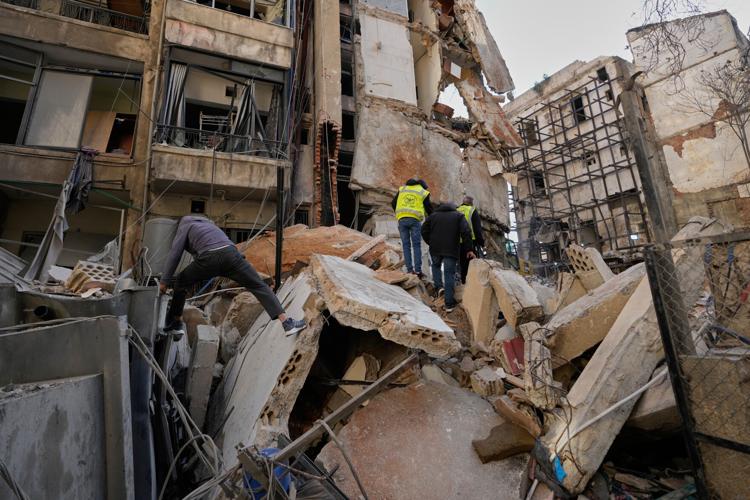
People inspect the rubble of a building destroyed in an Israeli airstrike a day earlier in Beirut, Lebanon, April 9.
Iran and the U.S. — which both declared victory in the wake of the ceasefire announcement — appeared to try to pressure each other. Semiofficial news agencies in Iran suggested forces have mined the Strait of Hormuz, a crucial waterway for the world's oil whose closure has proved Tehran's greatest strategic advantage in the conflict. President Donald Trump, meanwhile, warned that U.S. forces would hit Iran even harder than before if it did not fulfill the agreement.
But what that agreement is remains in deep dispute. Beyond whether Lebanon is included, there are questions over what will happen to Iran's stockpile of enriched uranium, how and when normal traffic will resume through the strait, and what happens to Iran's ability to launch missile attacks in the future.
The chief of Iran's nuclear agency said protecting Tehran's right to enrich uranium is "necessary" for any ceasefire talks with the United States.

Mohammad Eslami, who leads the Atomic Energy Organization of Iran, made the remarks Thursday to journalists, including one from The Associated Press, during commemorations for the late Supreme Leader Ayatollah Ali Khamenei in Tehran.
"It is a part of the necessary (things) that nobody speaks about," Eslami said, referring to the U.S. refusal to acknowledge enrichment as one part of Iran's 10-point plan for a permanent ceasefire.
The U.S. and Iran are due to meet in Pakistan for talks this weekend.

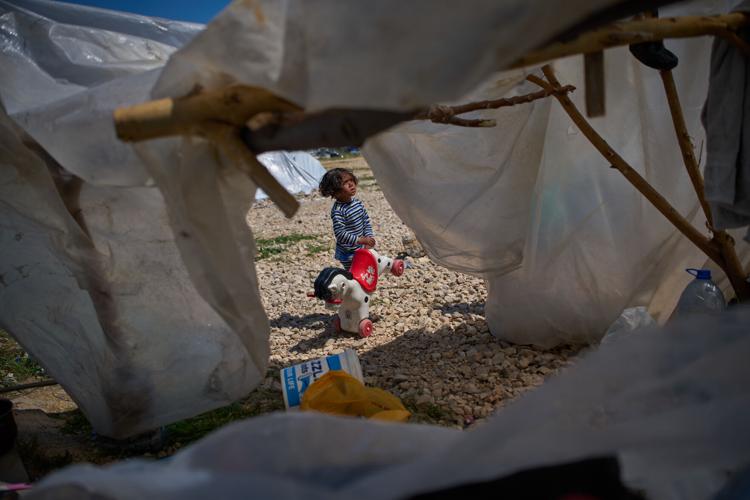
Ali, 4, holds a toy horse next to the tent his family uses as a shelter after fleeing Israeli bombardment in southern Lebanon, in Beirut, Lebanon, April 8.
Israeli strikes on Lebanon threaten the ceasefire
Lebanon's health ministry said at least 203 people were killed and more than 1,000 wounded in widespread Israeli strikes in central Beirut and other areas of Lebanon on Wednesday, when Israel intensified its attacks on the Iran-backed Hezbollah militant group, which joined the war in support of Tehran.
The death toll was the highest for a single day in Lebanon during more than five weeks of renewed war between Israel and Hezbollah.
Israel said Thursday it killed Ali Yusuf Harshi, an aide to Hezbollah leader Naim Kassem. Hezbollah did not immediately respond to a request for comment.
Iranian Foreign Minister Abbas Araghchi has insisted that an end to the war in Lebanon was part of the ceasefire deal, but Israeli Prime Minister Benjamin Netanyahu and Trump said it was not.
On Thursday, Netanyahu said Israel will continue striking Hezbollah "with force, precision and determination."
"Whoever acts against the citizens of Israel will be harmed," Netanyahu wrote on social media.
A New York-based think tank warned the ceasefire "hovers on the verge of collapse."
"Even if Lebanon was formally outside the deal, the scale of Israel's strikes was likely to be viewed as escalatory, nonetheless," the Soufan Center wrote in an analysis. "Israel's strikes can be understood both as an effort to drive a wedge between Iran and its proxies and as a response to being allegedly sidelined in the original ceasefire discussions."
Lebanon's state-run National News Agency reported Thursday that an Israeli strike overnight had killed at least seven people in southern Lebanon. The Israeli military did not immediately acknowledge the strike.

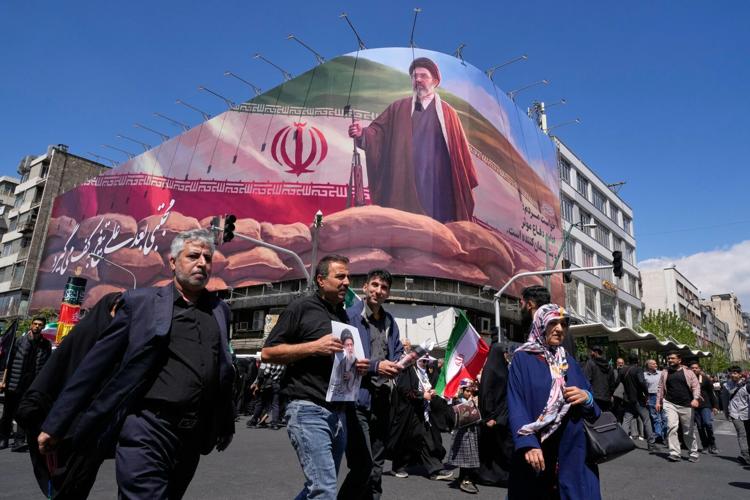
Government supporters walk past a billboard depicting Iran's Supreme Leader Mojtaba Khamenei as they gather to mark the 40th day since the killing of his father, slain Supreme Leader Ayatollah Ali Khamenei, in Tehran, Iran, April 9.
Oil prices remain high amid uncertainty over the Strait of Hormuz
Semiofficial news agencies in Iran published a chart Thursday suggesting the country's paramilitary Revolutionary Guard put sea mines into the strait during the war — a message that may be intended to pressure the U.S.
The chart, released by the ISNA news agency and Tasnim, showed a large circle marked "danger zone" in Farsi over the route ships take through the strait, through which 20% of all traded oil and natural gas once passed.
Only a trickle of ships have passed through the strait since the war began after a few were attacked and Iran threatened to hit any that it deemed connected to the U.S. or Israel. Ships appeared to continue to avoid the strait Wednesday, despite the ceasefire: Data from Kpler showed only four vessels with their trackers on passed through.
The chart suggested ships travel through waters closer to Iran's mainland near Larak Island, a route that some ships were observed taking during the war. It was dated from Feb. 28 until April 9, and it was unclear if the Guard had cleared any mines since then.
Iran's deputy foreign minister, Saeed Khatibzadeh, told the BBC on Thursday that his country will allow ships to pass through the strait in accordance with "international norms and international law" once the United States ends its "aggression" in the Middle East and Israel stops attacking Lebanon.
The strait's de facto closure has caused oil prices to skyrocket — raising, in turn, the cost of gasoline, food and other basics far beyond the Middle East. Oil prices fell on news of the ceasefire Wednesday, but began to climb as uncertainty over the deal grew.
The spot price of Brent crude, the international standard, was around $98 Thursday — up about 35% since the war began.
Trump warned that U.S. warships and troops will remain around Iran "until such time as the REAL AGREEMENT reached is fully complied with."
If it is not, "then the 'Shootin' Starts,' bigger, and better," Trump wrote in a social media message.

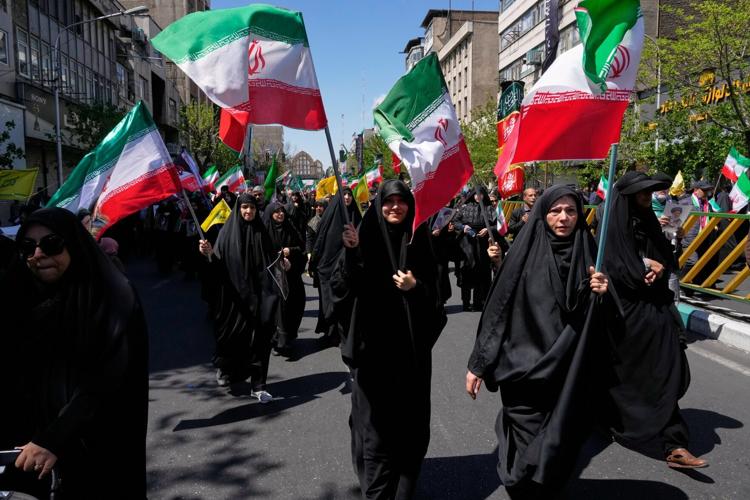
Government supporters gather to mark the 40th day since the death of Supreme Leader Ayatollah Ali Khamenei in Tehran, Iran, April 9.
Peace talks expected in Pakistan
The White House said that Vice President JD Vance would lead the U.S. delegation for talks in Islamabad aimed at ending the war, which are set to start Saturday.
There appear to be many points of disagreement to address, including whether Iran will be allowed to formalize a system of charging ships to use the strait that it has instituted. That would upend decades of precedent treating it as an international waterway that was free to transit.
The fate of Iran's missile and nuclear programs — the elimination of which were major objectives for the U.S. and Israel in going to war — also remained unclear. The U.S. insists Iran must never be able to build nuclear weapons and wants to remove Tehran's stockpile of highly enriched uranium, which could be used to build them, should it choose to pursue the bomb. Iran insists its program is peaceful.
Trump said Wednesday that the U.S. would work with Iran to remove the buried uranium, though Iran did not confirm that. In one version of the deal that Iran published, it said it would be allowed to continue enrichment.
Photos: US, Israel and Iran agree to a 2-week ceasefire

Government supporters chant slogans after the announcement of a two-week ceasefire with the United States and Israel in Tehran, Iran, Wednesday, April 8, 2026. (AP Photo/Francisco Seco)

An Iranian cluster munition missile explodes in the sky over northern Israel, Wednesday, April 8, 2026. (AP Photo/Ariel Schalit)

Iranian pro-government demonstrators burn an Israeli flag during a gathering after the announcement of a two-week ceasefire in the war with the Unites States and Israel, at the Enqelab-e-Eslami, or Islamic Revolution, Square in Tehran, Iran, Wednesday, April 8, 2026. (AP Photo/Vahid Salemi)

Iranian pro-government demonstrators attend a gathering after announcement of a two-week ceasefire in the war with the United States and Israel, at the Enqelab-e-Eslami, or Islamic Revolution, Square, in Tehran, Iran, Wednesday, April 8, 2026. (AP Photo/Vahid Salemi)

Pro-government demonstrators chant slogans as they hold Iranian flags and a poster of the Supreme Leader Ayatollah Mojtaba Khamenei in a gathering after announcement of a two-week ceasefire in the war with the United States and Israel, at the Enqelab-e-Eslami, or Islamic Revolution, Square, in Tehran, Iran, Wednesday, April 8, 2026. (AP Photo/Vahid Salemi)

A woman walks past a mural in Tehran, Iran, Wednesday, April 8, 2026. (AP Photo/Francisco Seco)

A government supporter chants slogans during a gathering after the announcement of a two-week ceasefire with the United States and Israel in Tehran, Iran, Wednesday, April 8, 2026. (AP Photo/Francisco Seco)

A demonstrator holds a picture of Iran's Supreme Leader Mojtaba Khamenei during a gathering after announcement of a two-week ceasefire with the United States and Israel, in Tehran, Iran, Wednesday, April 8, 2026. (AP Photo/Francisco Seco)

People drive their motorbikes past a billboard that shows a graphic depicting Iran's Supreme Leader Ayatollah Mojtaba Khamenei in downtown Tehran, Iran, Monday, April 6, 2026. (AP Photo/Vahid Salemi)

People take cover in a bomb shelter as air raid sirens warn of incoming Iranian missile strikes in Ramat Gan, Israel, Tuesday, April 7, 2026. (AP Photo/Oded Balilty)

Mourners carry the flag-draped bodies of three members of the Gershovich family, killed when an Iranian missile struck their building, during their funeral in Haifa, Israel, Tuesday, April 7, 2026. (AP Photo/Ariel Schalit)

A man takes a selfie while taking cover with three others along a highway as air raid sirens warn of an incoming Iranian missile strike in Tel Aviv, Israel, Tuesday, April 7, 2026. (AP Photo/Ohad Zwigenberg)

Pedestrians walk through Tajrish Bazaar in Tehran, Iran, Tuesday, April 7, 2026. (AP Photo/Francisco Seco)

Employees work inside a bakery near Tajrish Bazaar in Tehran, Iran, Tuesday, April 7, 2026. (AP Photo/Francisco Seco)

A nurse attends to a patient at Shohadaye Tajrish Hospital in Tehran, Iran, Tuesday, April 7, 2026. (AP Photo/Francisco Seco)

