


BERLIN — Almost 80 years after the Holocaust, about 245,000 Jewish survivors still live across more than 90 countries, a new report revealed Tuesday.
Nearly half of them, or 49%, live in Israel; 18% are in Western Europe, 16% in the United States, and 12% in countries of the former Soviet Union, according to a study by the New York-based Conference on Jewish Material Claims Against Germany, also referred to as the Claims Conference.
Before the publication of the demographic report, there were only vague estimates about how many Holocaust survivors are still alive.
Their numbers are quickly dwindling, as most are very old and often of frail health, with a median age of 86. Twenty percent of survivors are older than 90, and more women (61%) than men (39%) are still alive.

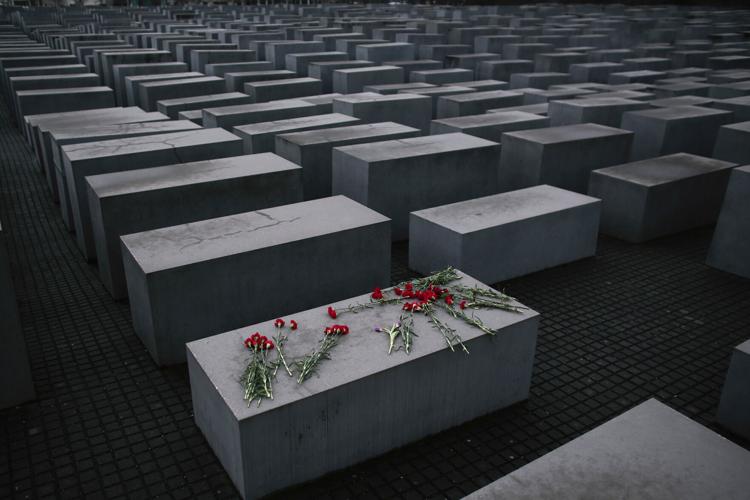
Flowers lie on a concrete slab of the Holocaust Memorial Jan. 27, 2015, to mark the International Holocaust Remembrance Day and commemorate the 70th anniversary of the liberation of the Nazi Auschwitz death camp in Berlin.
The vast majority, or 96% of survivors, are “child survivors” who were born after 1928, says the report “Holocaust Survivors Worldwide. A Demographic Overview’” which is based on figures that were collected up until August.
“The numbers in this report are interesting, but it is also important to look past the numbers to see the individuals they represent,” said Greg Schneider, the Claims Conference’s executive vice president.
“These are Jews who were born into a world that wanted to see them murdered. They endured the atrocities of the Holocaust in their youth and were forced to rebuild an entire life out of the ashes of the camps and ghettos that ended their families and communities.”
Nazis and their collaborators killed 6 million European Jews and people from other minorities during the Holocaust.

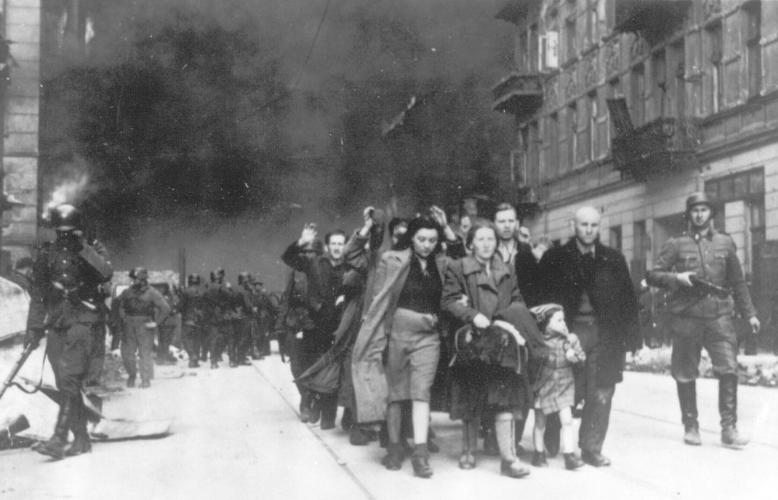
A group of Polish Jews are led away for deportation by German SS soldiers during the destruction of the Warsaw Ghetto by German troops after an uprising in the Jewish quarter on April 19, 1943.
It is not clear how many Jews survived the death camps, the ghettos or somewhere in hiding across Nazi-occupied Europe, but their numbers were a far cry from the prewar Jewish population in Europe.
In Poland, of the 3.3 million Jews living there in 1939, only about 300,000 survived.
About 560,000 Jews lived in Germany in 1933, the year Adolf Hitler came to power. At the end of World War II in 1945, their numbers diminished to about 15,000 — through emigration and extermination.
Germany’s Jewish community grew again after 1990, when more than 215,000 Jewish migrants and their families came from countries of the former Soviet Union, some of them also survivors.
Nowadays, only 14,200 survivors still live in Germany, the demographic report concluded.

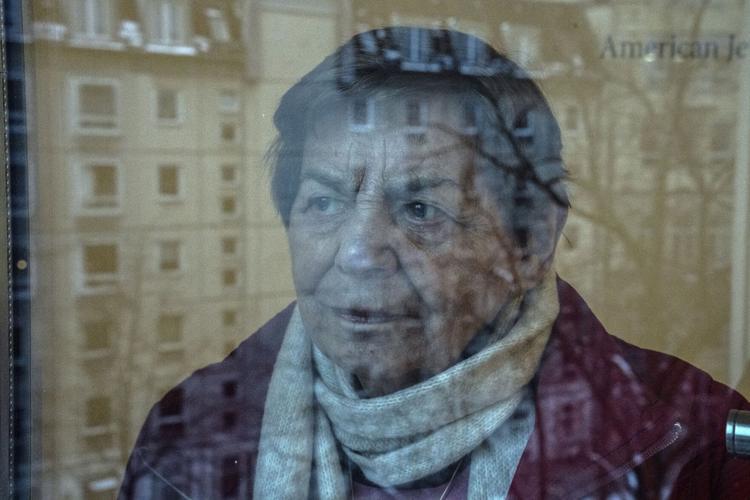
Ruth Winkelmann, 95, a Holocaust survivor, looks out of a window Jan. 17 in Berlin, Germany.
One of them is Ruth Winkelmann, who survived by hiding with her mother and sister in a garden shed on the northern outskirts of Berlin. Her father was killed in the Auschwitz death camp. Her younger sister Esther died of illness, hunger and exhaustion in March 1945, just weeks before the liberation of Berlin by the Soviet Red Army.
Winkelmann, who is 95 and still lives in Berlin, said there hasn’t been a day in her life when she didn’t remember her beloved father.
“It always hurts,” she said. “The pain is there day and night.”
For its new report, the Claims Conference said it defined Holocaust survivors “based on agreements with the German government in assessing eligibility for compensation programs.”
For Germany, that definition includes all Jews who lived in the country from Jan. 30, 1933, when Hitler came to power, to May 1945, when Germany surrendered unconditionally in World War II.
The group handles claims on behalf of Jews who suffered under the Nazis and negotiates compensation with Germany’s finance ministry every year. In June, the Claims Conference said that Germany has agreed to extend another $1.4 billion, (1.29 billion euros), overall for Holocaust survivors around the globe for 2024.
Since 1952, the German government has paid more than $90 billion to individuals for suffering and losses resulting from persecution by the Nazis.
The Claims Conference administers several compensation programs that provide direct payments to survivors globally, provides grants to more than 300 social service agencies worldwide and ensures survivors receive services such as home care, food, medicine, transportation and socialization.
It has also launched several educational projects that illustrate the importance of passing on the Holocaust survivors’ testimonies to younger generations as their numbers become smaller and antisemitism is on the rise again.

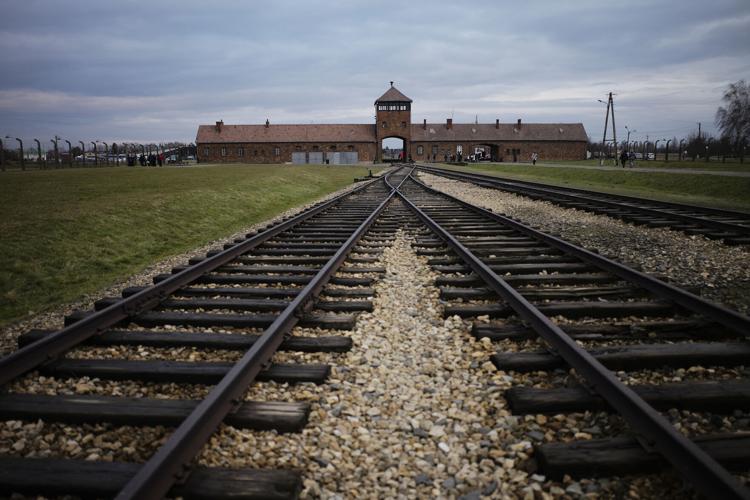
The railway tracks where hundreds of thousands of people arrived to be directed to the gas chambers inside the former Nazi death camp of Auschwitz Birkenau, or Auschwitz II, are pictured Dec. 7, 2019, in Oswiecim, Poland.
“The data we have amassed, not only tells us how many and where survivors are, it clearly indicates that most survivors are at a period of life where their need for care and services is growing,” said Gideon Taylor, the president of the Claims Conference.
“Now is the time to double down on our attention on this waning population. Now is when they need us the most.”
Winkelmann, the Berlin survivor, didn’t talk to anyone for decades about the horrors she endured during the Holocaust, not even her husband.
But in the 1990s, she was one day approached by a stranger who looked at her necklace with a Star of David pendant, asked if she was a Jewish survivor and whether she could talk about her experience to her daughter’s school class.
“When I started talking about the Holocaust for the first time, in front of those students, I couldn’t stop crying,” Winkelmann told The Associated Press last week. “But since then I’ve talked about it so many times, and every time I shed less tears.”
While she said there can never be any closure for the terror she and all the other survivors lived through, Winkelmann has now made it her mission in life to tell her story. Even at 95, she still visits schools across Germany — and has a message for her listeners.
“I tell the children that we all have one God, and although we gave him different names and have different prayers for him, we shouldn’t look at what separates us, but what unites us,” she said.
“And even if we disagree, we should never stop talking to each other.”
Today in history: Jan. 23
1932: Franklin D. Roosevelt
Updated
In 1932, New York Gov. Franklin D. Roosevelt announced his candidacy for the Democratic presidential nomination.
1962: Jackie Robinson
Updated
In 1962, Jackie Robinson was elected to the Baseball Hall of Fame in his first year of eligibility.
1962: Tony Bennett
Updated
In 1962, Tony Bennett recorded “I Left My Heart in San Francisco” in New York for Columbia Records.
1968: USS Pueblo
Updated
In 1968, North Korea seized the U.S. Navy intelligence ship USS Pueblo, commanded by Lloyd “Pete” Bucher, charging its crew with being on a spying mission; one sailor was killed and 82 were taken prisoner. (Cmdr. Bucher and his crew were released the following December after enduring 11 months of brutal captivity at the hands of the North Koreans.)
1973: Richard Nixon
Updated
In 1973, President Richard Nixon announced an accord had been reached to end the Vietnam War, and would be formally signed four days later in Paris.
1977: "Roots"
Updated
In 1977, the TV mini-series “Roots,” based on the Alex Haley novel, began airing on ABC.
2002: John Walker Lindh
Updated
In 2002, John Walker Lindh, a U.S.-born Taliban fighter, was returned to the United States to face criminal charges that he’d conspired to kill fellow Americans. (Lindh was sentenced to 20 years in prison after pleading guilty to providing support for the Taliban; he was released in May 2019 after serving more than 17 years.)
2020: Coronavirus
Updated
In 2020, Chinese state media said the city of Wuhan would be shutting down outbound flights and trains, trying to halt the spread of a new virus that had sickened hundreds of people and killed at least 17. The World Health Organization said the viral illness in China was not yet a global health emergency, though the head of the U.N. health agency added that “it may yet become one.”
2021: Hal Holbrook
Updated
One year ago: Hal Holbrook, the actor who toured the world for more than 50 years as Mark Twain in a one-man show and appeared as “Deep Throat” in “All the President’s Men,” died at 95 in California.
2021: Larry King
Updated
One year ago: Larry King, known for decades of broadcast interviews with world leaders, movie stars and ordinary Joes, died at a Los Angeles hospital at 87.

