


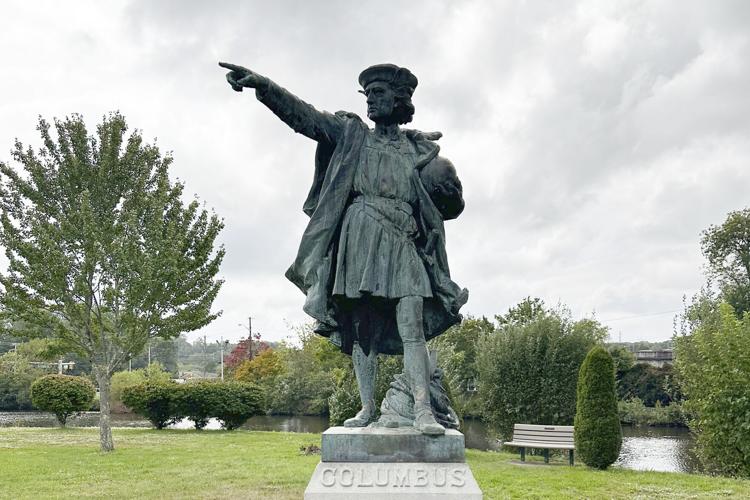
BOSTON — Three years after a Christopher Columbus statue was removed from a square in Providence, Rhode Island, the bronze cast has re-emerged, this time in a park in Johnston, Rhode Island, about 9 miles west of the capital.
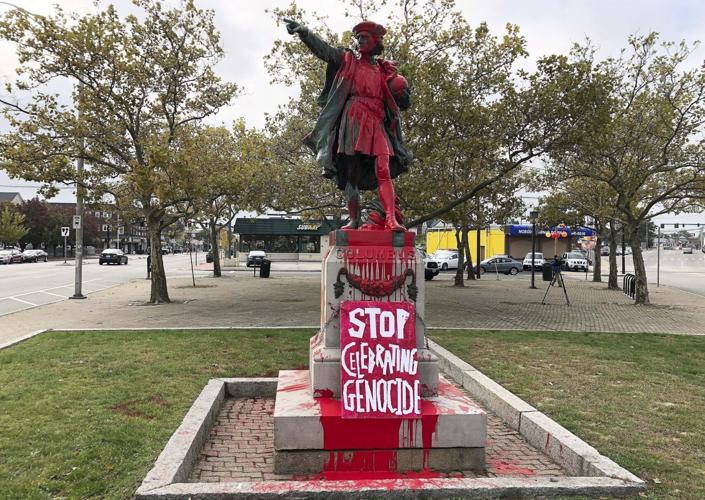
The statue had been targeted by vandals, at one point being splashed with red paint with a sign reading “Stop celebrating genocide” leaning against its pedestal. In 2020, the statue was removed.
Activists say celebrating Columbus ignores the rape, murder and genocide endured by Indigenous people during the European settlement of North America.

A statue of Christopher Columbus stands in a park Sept. 26 in Johnston, R.I., three years after it was removed from a square in Providence, R.I., following protests.
Johnston Mayor Joseph Polisena Jr. said residents of his heavily Italian-American town are pleased to give the statue a new home.
“It’s important and not just for Italian Americans. It’s American history. It’s world history, if you look at it from a historical perspective,” he said.
While not the first European to land in North America — that’s believed to be Leif Erikson — Columbus helped usher in a wave of European exploration and expansion, and ultimately the era of globalization, Polisena said.
After the statue was taken down and placed in storage, it was purchased for about $50,000 by former Providence Mayor Joseph Paolino Jr., who then reached out to see if Johnston would take it, Polisena said.
The statue — which depicts Columbus pointing forward with his right arm while holding a globe in his left — will be formally unveiled Monday.
“I don’t want to see it destroyed. I don’t want to see it melted down,” Polisena said. “People should learn about him, the good and the bad.”
Polisena said he understands the criticism targeted at Columbus, but said it’s unfair to use the standards of 2023 to measure the actions of someone who lived five centuries ago.

A sign reading "stop celebrating genocide" sits at the base of a statue of Christopher Columbus on Oct. 14, 2019, in Providence, R.I., after it was vandalized with red paint.
Not everyone is thrilled with the relocation of the 15th-century explorer’s likeness.
The statue should never have been resurrected after it was taken down, according to Harrison Tuttle, president of Black Lives Matter Rhode Island PAC.
“You don’t have to be Indigenous to understand the harm that Christopher Columbus inflicted,” he said. “To see it go back up is really tone deaf to all the progress we made just three years ago.”
Tuttle said he understands the connection that many of Italian descent feel for Columbus, but said he shouldn’t be the vehicle for the pride Italian-Americans feel for their contributions to the country.
He also said he wished the mayor had spoken with members of the community who were offended by the decision install the statue.
“My grandmother who helped raise me was Italian and I grew up in a majority Italian neighborhood,” he said. “At the same time, there are better ways to celebrate your heritage and culture without celebrating someone who in my opinion is the exact opposite of what Italian culture is.”
Other cities have grappled with the legacy of Columbus statues.
In 2020, Boston’s Christopher Columbus statue located in the city’s largely Italian North End neighborhood was taken down after its head was knocked off.
In 2020, a Columbus statue in Richmond, Virginia, was torn down by protesters, set on fire and thrown into a lake. In 2022, a Columbus statue was removed from the California Capitol rotunda. Also last year, crews removed a plywood box that had been placed over a Philadelphia statue of Christopher Columbus.
Camden, New Jersey, also removed their Columbus statue.
Darrell Waldron, director of the Rhode Island Indian Council said there’s no love lost between Native peoples and the legacy of Columbus.
“I think Columbus opened a Pandora’s box for Indigenous people,” he said. “People who were the victims of rape and murder and genocide were not writing the history.”
At the time that the statue was being removed in Providence, Waldron — the son of a Narragansett father and Wampanoag mother — said he and others hoped that the statue would have been sold off and kept out of public view, with any proceeds going to help fund a Native statue.
“I would love to see a statue of Native women,” he said. “It doesn’t always have to be a man.”
The debate over the statue comes amid a larger debate about what to call the federal holiday that falls on Monday this year.
In 2021, President Joe Biden issued the first-ever presidential proclamation of Indigenous Peoples’ Day, lending a boost to efforts to refocus the federal holiday celebrating Columbus toward an appreciation of Native peoples.
Why cities are celebrating Indigenous Peoples' Day instead of Columbus Day
Christopher Columbus
Updated
Christopher Columbus was a master navigator and admiral whose four transatlantic voyages opened the way for European exploration, exploitation and colonization of the Americas. There is no evidence that he ever landed on the mainland of North America, and 500 years before he arrived, a band of Vikings led by Leif Erikson set foot in North America. Here, a statue of Christopher Columbus stands on a plaza in San Juan, Puerto Rico.
Enslavement and disease
Updated
Protesters point to the impact of the slave trade and the ravages of disease brought by Europeans to the indigenous peoples of North and South America. Some academics estimate that about 20 million native people died in the years after the European invasion of the New World.
Columbus' colony
Updated
In October 1492, Columbus made landfall on what is now the Bahamas and later reached another island that he named Hispaniola. He assumed he had reached the East Indies. The island today is divided into Haiti to the west and the Dominican Republic to the east. Columbus established the first American colony at La Isabela, on the north coast of Hispaniola, in 1494. Spaniards forced men in the villages to work in gold mines and colonial plantations, which kept the Taíno people from planting the crops that fed them. Many were felled by smallpox, measles and other European diseases for which they had no immunity, Smithsonian magazine reports.
Indigenous Peoples’ Day instead
Updated
Several major U.S. cities now celebrate Indigenous Peoples’ Day, including Los Angeles, Seattle and Austin, Texas, and four states also have made the day official. Cincinnati recently became the first major city in Ohio to celebrate Indigenous Peoples’ Day, instead of Columbus Day. New York (pictured) and some other major cities still hold Columbus Day parades.
Canada
Updated
Canada celebrates the culture of its native people with National Indigenous Peoples Day, held in June every year. Canadians recognize and celebrate the unique heritage, diverse cultures and contributions of First Nations, Inuit and Métis people. In this photo Native Americans mark the day in 2015 in Winnipeg.
International day
Updated
The United Nations’ International Day of the World’s Indigenous People is observed on Aug. 9 each year to promote and protect the rights of the world’s indigenous population. Pictured here is the celebration of the day in Mexico City in 2016.
U.S. tribes
Updated
There are more than 500 federally recognized tribes within the United States. The word "Indian" was an invention of Columbus, who thought he had landed in the East Indies. Native Americans in Portland, Ore., are pictured here celebrating at an annual powwow in 2014.
Millions already were here
Updated
Before Columbus’ ships landed in the Bahamas, nomadic ancestors of modern Native Americans trekked over a land bridge from Asia to what is now Alaska, more than 12,000 years ago. By the time European explorers arrived in the 15th century, scholars estimate that more than 50 million people were living in the Americas, according to History.com.

