


AUBURN, N.Y. — A New York food bank was offered a huge donation of fresh fish — but it came with a catch.
LocalCoho, a soon-to-close salmon farm in the small upstate city of Auburn, wanted to give 40,000 pounds of coho salmon to the Food Bank of Central New York, a mother lode of high-quality protein that could feed thousands of families.
But the fish were still alive and swimming in the farm's giant indoor tanks. The organizations would need to figure out how to get about 13,000 salmon from the water and then have them processed into frozen fillets for distribution to regional food pantries.
They'd need to do it fast, before the business closed for good. LocalCoho was to cease operations Friday.

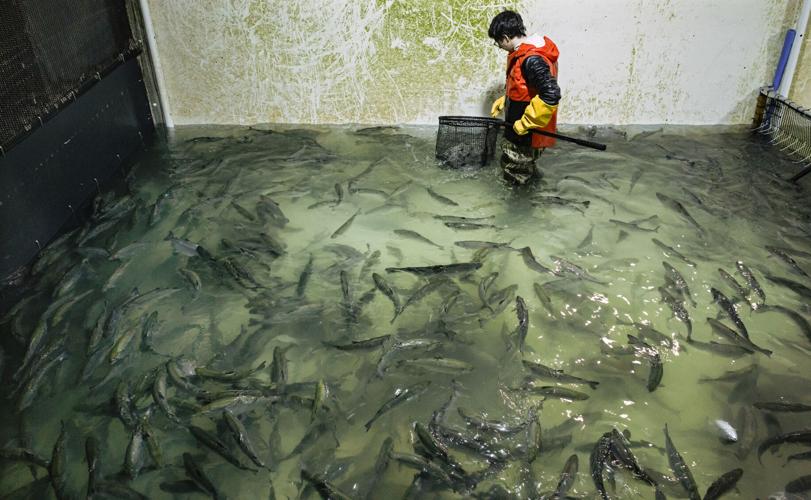
Stephen Zicari, an employee of LocalCoho salmon fish farm, nets fish Jan. 24 from one of the farm's tanks in Auburn, N.Y. The fish was to be donated to a food bank.
Thanks to dozens of food pantry volunteers willing to help staffers scoop up the salmon, the team was able to empty the tanks in a matter of weeks and cold pack tons of fish for shipment to a processor.
"The fact that we only had weeks to execute this really ratcheted up the intensity and the anxiety a little bit," said Brian McManus, the food bank's chief operations officer. "I knew that we had the will. I knew we had the expertise."
Tackling food waste has been a daunting challenge for years both in the U.S. and around the world. More than one-third of the food produced in the U.S. is never eaten and much of it ends up in landfills.

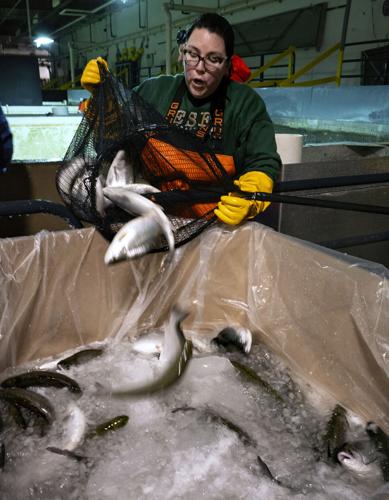
Christina Hudson Kohler of Syracuse, N.Y., who volunteers with the Food Bank of Central New York, counts netted fish Jan. 24 as they are prepared for transport at LocalCoho salmon fish farm in Auburn, N.Y.
On a recent day, workers waded through knee-deep water teeming with salmon to fill their nets. Christina Hudson Kohler was among the volunteers who donned waterproof overalls and gloves to grab the fish-laden nets and empty their contents into cold storage containers.
"It's a little bit different," Kohler said during a break. "In the past, my volunteer work with the food bank has been sorting carrots or peppers, or gleaning out in the field."
LocalCoho, which was a pilot for potential other farms across the U.S., used cutting-edge aquaculture practices to raise coho salmon from eggs to market size in massive pools employing recirculated water. It supplied coho salmon to wholesalers and retailers, including high-end Manhattan sushi restaurants, with the goal of building regional farms across the country.
Coho is coveted for its cleaner taste and better mouthfeel than the more common Atlantic salmon.
Finger Lakes Fish, under the brand name LocalCoho, at first sold its salmon to local wineries a few fish at a time. It then began distributing to the Fulton Fish Market Cooperative in New York City, where it went to some of the city's finest sushi restaurants. In Chicago, customers included a United Airlines lounge at O'Hare International Airport, Soldier Field and the White Sox's home of Rate Field.
"I'll toot our own horn," manager Adam Kramarsyck said. "It was a really great product."

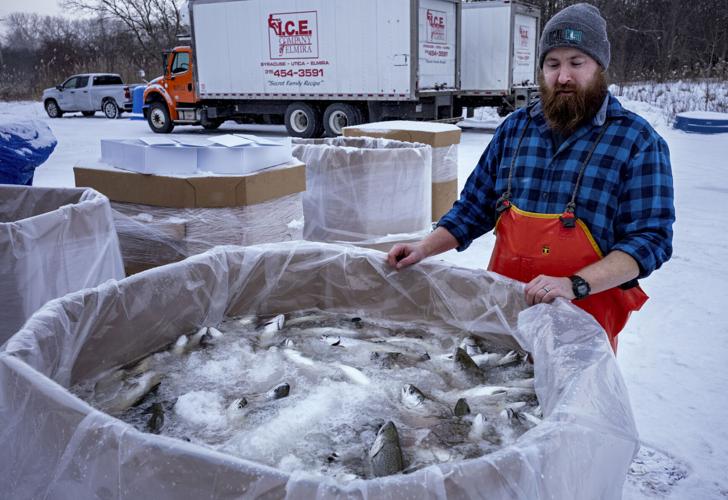
Adam Kramarsyck, farm manager at LocalCoho salmon fish farm in Auburn, N.Y., prepares fish for transport to a processing facility Jan. 24 as a massive donation for the Food Bank of Central New York.
But Kramarsyck told The Citizen it did not grow fast enough to become sustainable. He described the farm as a "really expensive R&D project."
While it expanded, aided by a $500,000 state grant and a major investment by an aquaculture fund, it would have had to continue expanding to the point it could produce 1,200 tons of fish a year to break even. It had reached 200 tons, he said, having just achieved its average fish weight goal with its latest harvest.
Company officials decided last year to wrap things up at the end of this January, Kramarsyck said.
He said they didn't want the fish to go to waste or end up as biofuel. That's when they reached out to see if the fish could be donated as food.
"It's 'lemonade out of lemons,' I guess is the phrase," Kramarsyck said.
LocalCoho could process about 600 fish a week by hand, but there was less than a month to clear the tanks of many times that number of fish.
Enter the food bank.

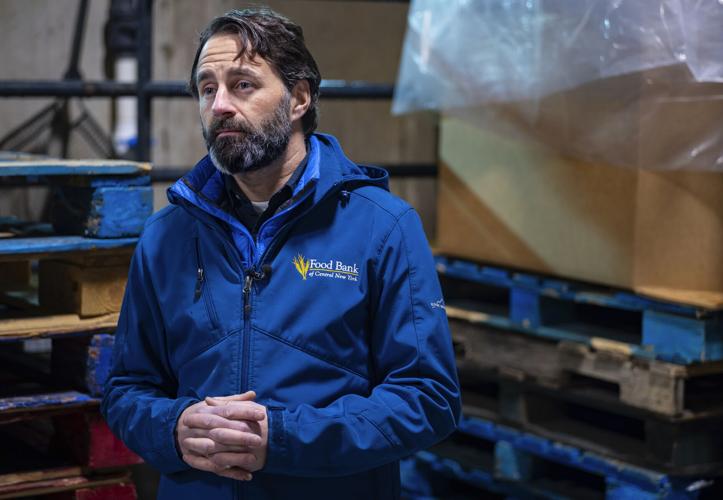
Brian McManus, chief operations officer of the Food Bank of Central New York, comments about a massive donation effort Jan. 24 as he stands near equipment for transporting salmon at Local Coho salmon fish farm in Auburn, N.Y.
McManus was excited by the offer to land so many fish — and nervous about the challenge. While the Syracuse-based operation knew how to distribute canned or frozen seafood, it was not set up to handle fresh fish. How could it turn thousands of fish into frozen fillets in a tight timeframe?
Kramarsyck said it took "tons and tons of logistics."
The food bank enlisted 42 volunteers to help out. A local business with refrigerated trucks, Brown Carbonic, offered to ship the fish for free to a processor an hour away in Rochester. And LocalCoho staff pitched in to get the job done in time.
"A lot of companies going out of business would just be like, 'Take what you can get, we'll do the best we can.' I mean, they're working extra hard," said Andrew Katzer, the food bank's director of procurement.
The salmon was processed and quick-frozen. It will be distributed soon among 243 food pantries, as well as soup kitchens, shelters and other institutions in the food bank's network. Some fish will also go to the Onondaga and Cayuga nations, and volunteers will take some home as well.
All told, the catch was expected to yield more than 26,000 servings of hard-to-source protein for the hungry.
"Protein, animal protein is very, very desirable," McManus said. "We know that people need it for nourishment and it's difficult to get. And so this is going to make a very large impact."
Gallery: Food bank nets 13,000 fresh salmon
Donating Tons of Salmon
Updated
Stephen Zicari, left, and Brad Bednarski, employees of Local Coho salmon fish farm, corral fish Jan. 24 in one of the farm's tanks in Auburn, N.Y.
Donating Tons of Salmon
Updated
Coho salmon slated for donation to the Food Bank of Central New York, swim in a large tank Jan. 24 at Local Coho salmon fish farm in Auburn, N.Y.
Donating Tons of Salmon
Updated
Stephen Zicari, an employee of Local Coho salmon fish farm in Auburn, N.Y., nets fish Jan. 24 in one of the farm's tanks.
Donating Tons of Salmon
Updated
Christina Hudson Kohler of Syracuse, N.Y., who volunteers with the Food Bank of Central New York, counts netted fish Jan. 24 as they are prepared for transport at Local Coho salmon fish farm in Auburn, N.Y.
Donating Tons of Salmon
Updated
Coho salmon that will be soon donated to the Food Bank of Central New York splash about in the icy water of a transport cube Jan. 24 at Local Coho salmon fish farm in Auburn, N.Y.
Donating Tons of Salmon
Updated
Adam Kramarsyck, farm manager at Local Coho salmon fish farm in Auburn, N.Y., prepares fish for transport to a processing facility Jan. 24 as a massive donation is underway for the Food Bank of Central New York.
Donating Tons of Salmon
Updated
Stephen Zicari, left, and Brad Bednarski, employees of Local Coho salmon fish farm, net fish Jan. 24 in one of the farm's tanks in Auburn, N.Y.
Donating Tons of Salmon
Updated
Brad Bednarski, left, and Stephen Zicari, employees of Local Coho salmon fish farm, net fish Jan. 24 in one of the farm's tanks in Auburn, N.Y.

