


Every year, the nations of the world gather to address the impacts and costs of global warming and what can be done to slow it down. Among the negotiations are what the specific goals should be, how they will be met, and who will pay for them.

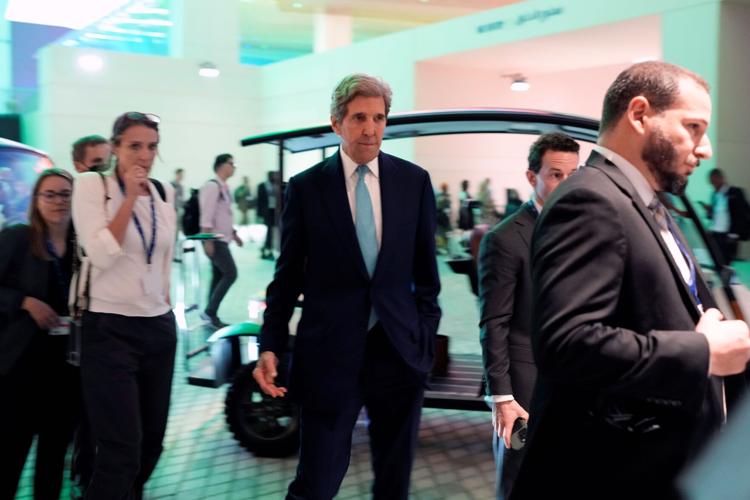
John Kerry, U.S. Special Presidential Envoy for Climate, walks through the venue at the COP28 U.N. Climate Summit on Thursday in Dubai, United Arab Emirates.
Diplomats and policymakers converge and haggle. Inevitably, at the conclusion of these meetings, there are those who are happy with the results and those who are frustrated.
First developed in the 1990s, the United Nations Framework Convention on Climate Change (UNFCCC) organizes these meetings, which have become colloquially known as the COP — the Conference of the Parties. In this case, COP 28.
This is the same series of meetings that yielded the Paris Agreement of 2015, which aims to hold planetary warming below 3.6°F (2°C) of pre-industrial (late 19th century) levels, with additional efforts to keep the warming within 2.7°F (1.5°C) of that level.
Several independent agencies have confirmed that Earth has already warmed about 1.2°C since then, with the vast majority of that warming coming in the past 50 years. Adding urgency to this year’s meeting have been the exceptionally warm oceans over the past several months, which will help make 2023 the warmest year on record globally since at least 1850.
As a result, much of the discussion this year will focus on how to rapidly reduce fossil fuel use globally, as the carbon dioxide produced by these fuels is the primary cause of the observed warming over the past several decades. Time is increasingly critical if any of the established goals are to be met, as the Paris-based International Energy Agency indicated earlier this year that the scaling up of renewable energy technologies must continue to drive down fossil fuel demand 80 percent within the next 30 years.
An ongoing discussion is the financial costs, especially to nations with fewer resources to adapt or alleviate the impacts of the warming climate — whether those impacts come in the form of more frequent and intense heat waves in already hot climates or disappearing land in coastal nations where sea level rise is accelerating.
Last year’s meeting brought an agreement to develop a fund to help countries with the fewest resources recover from the worsening impacts, but the details of this loss and damage fund and how it would be managed is another one of the contentious points that will arise at this meeting.

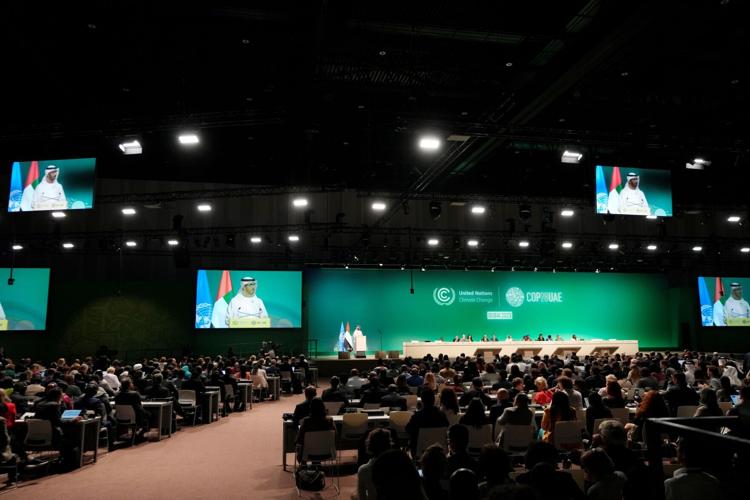
COP28 President Sultan al-Jaber addresses the assembly during the opening session at the COP28 U.N. Climate Summit on Thursday in Dubai, United Arab Emirates.
Superimposed on all of these negotiations is the choice of Dubai as a site for the meeting, a city within the United Arab Emirates that is synonymous with oil wealth. Adding to the complexity was a report from the BBC this week indicating that the UAE was planning to use its role as host of the meeting to develop new oil and methane gas deals with 15 other countries.
Not surprisingly, these questions of money, energy and power have led to diplomatic contortions in the lead-up to the meeting, with some countries suggesting a rapid phaseout and others a gradual phase down.
The scope of the meeting attracts additional non-governmental organizations, large and small, from all continents. In all, more than 70,000 people are expected at COP 28, which continues until Dec. 12.
Whatever comes out of this meeting will add one more point on a curve leading to a climate that is likely somewhere between 3 and 6 degrees warmer within the next three generations. That may not sound like much, but consider the reverse. During the peak of the last ice age 20,000 years ago, the global temperature was only 10 degrees colder than today, when glaciers reached as far south as modern-day Chicago and Boston.
In the end, every annual negotiation and every tenth of a degree of warming matters, as they will drive the long-term intensity and impacts of more frequent heat waves, more intense rainfall and higher sea levels for decades — if not centuries — to come.
Sean Sublette is the chief meteorologist for the Richmond Times-Dispatch in Virginia.

