

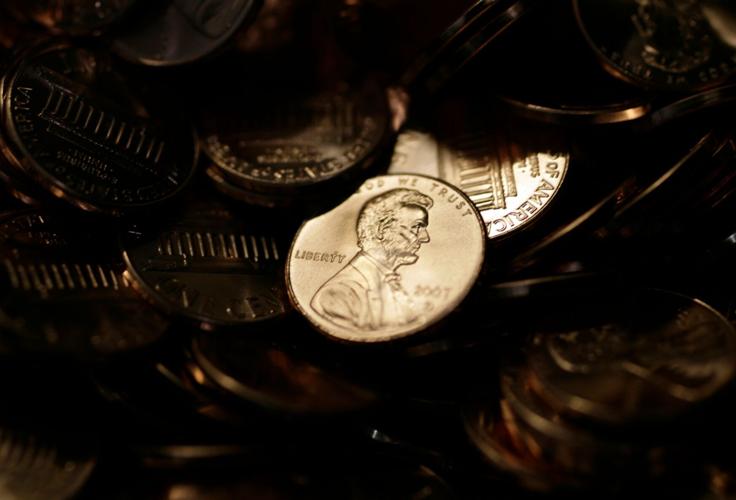
NEW YORK — The United States is running out of pennies.
President Donald Trump's decision to stop producing the penny is starting to have real implications for the nation's commerce. Merchants in regions of the country ran out of pennies and are unable to produce exact change. Meanwhile, banks are unable to order fresh pennies and are rationing the one-cent coins for their customers.
One convenience store chain, Sheetz, briefly ran a promotion offering a free soda to customers who bring in 100 pennies. Another retailer says the lack of pennies will end up costing it millions this year, because of the need to round down to avoid lawsuits.
"It's a chunk of change," said Dylan Jeon, senior director of government relations with the National Retail Federation.
The penny problem started in late summer and is only getting worse as the country heads into the holiday shopping season.
To be sure, not one retailer or bank called for the penny to stick around. Pennies, especially in bulk, are heavy and more often than not used exclusively to give customers change.
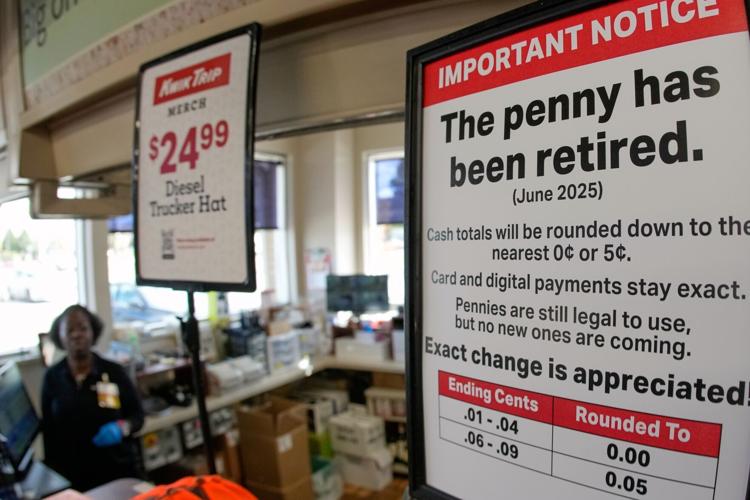
Still, the abrupt decision to get rid of the penny came with no guidance from the federal government. Many stores were left pleading for Americans to pay in exact change.
"We have been advocating abolition of the penny for 30 years. But this is not the way we wanted it to go," said Jeff Lenard with the National Association of Convenience Stores.
Trump announced Feb. 9 that the U.S. would no longer mint pennies, citing the high costs. Pennies and nickels have been more expensive to produce than they are worth for years, despite the U.S. Mint's efforts to reduce costs. The Mint spent 3.7 cents to make a penny in 2024, according to its most recent annual report, and it spends 13.8 cents to make a nickel.
The Treasury Department said in May that it would place its last order of copper-zinc planchets — the blank metal disks that are minted into coins. The last pennies were minted in June and, by August, those were distributed to banks and armored vehicle service companies.
Troy Richards, president at Louisiana-based Guaranty Bank & Trust Co., said he's had to scramble to have enough pennies on hand for his customers since August.
"We got an email announcement from the Federal Reserve that penny shipments would be curtailed," he said. "Little did we know that those shipments were already over for us."
Richards said the $1,800 in pennies the bank had were gone in two weeks. His branches keep small amounts of pennies for customers who need to cash checks, but that's it.
The U.S. Mint issued 3.23 billion pennies in 2024, the last full year of production, more than double that of the second-most minted coin in the country: the quarter. The problem with pennies is they are issued, given as change and rarely recirculated back into the economy. Americans store their pennies in jars or use them for decoration. This required the Mint to produce significant sums of pennies each year.
The Mint is profitable for the U.S. government through its production of other circulating coins as well as coin proof and commemorative sets that appeal to numismatic collectors. In 2024, it made $182 million in seigniorage, which is its equivalent of profit.
The government is expected to save $56 million by not minting pennies, according to the Treasury Department.
A logistical issue also hampered pennies from circulating.
The distribution of coins is handled by the Federal Reserve system. Several companies, mostly armored carrier companies, operate coin terminals where banks can withdraw and deposit coins. About a third of these 170 coin terminals are now closed to both penny deposits as well as penny withdrawals.
Bank lobbyists say these terminals being closed to penny deposits is exacerbating the penny shortage, because parts of the country that may have surplus pennies are unable to get the coins to parts of country with shortages.
"As a result of the U.S. Department of the Treasury's decision to end production of the penny, coin distribution locations accepting penny deposits and fulfilling orders will vary over time as (penny) inventory is depleted," a Federal Reserve spokeswoman said.
In some states and cities, it is illegal to round up a transaction to the nearest nickel or dime because doing so would run afoul of laws that are supposed to place cash customers and debit and credit card customers on an equal playing field when it comes to item costs.
So, to avoid lawsuits, retailers round down. That extra change can add up over tens of thousands of transactions. A spokesman for Kwik Trip, the Midwest convenience store chain, says it rounds down every cash transaction to the nearest nickel. That's expected to cost the company roughly $3 million this year. Some retailers ask customers to give their change to local or affiliated charities at the cash register, in an effort to avoid pennies as well.
The Common Cents Act bill pending in Congress calls for cash transactions to be rounded to the nearest nickel, up or down. While the proposal is palatable to businesses, rounding up could be costly for consumers.
The Treasury Department did not respond to a request for comment on whether it had any guidance for retailers or banks regarding the penny shortage or circulation issues.
The U.S. is not the first country to transition away from small denomination coins or discontinue out-of-date coins, but those governments wound down the use of their out-of-date coins over a period of time.

