

The Federal Aviation Administration on Friday halved the number of flights that U.S. airlines must cut from their schedules at 40 airports as the country's aviation system recovers from a shortage of air traffic controllers during the record government shutdown.
The agency said airlines will have to cancel only 3% of their flights beginning at 6 a.m. Saturday instead of 6%.
Citing safety concerns, the FAA first ordered flights reduced at the busy airports on Nov. 7 as absences mounted at air traffic facilities and airport towers. Controllers were among the federal employees who were required to work while going unpaid during the shutdown.

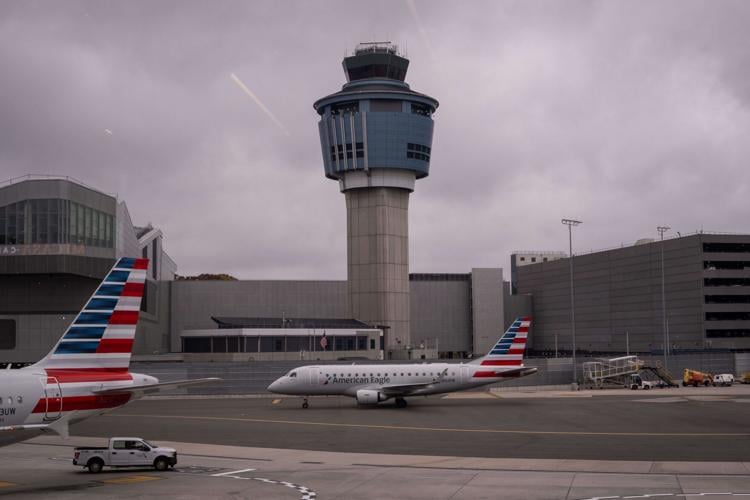
An American Eagle plane moves past the FAA Air Traffic Control tower at LaGuardia Airport (LGA) in the Queens borough of New York, Sunday, Nov. 9, 2025. (AP Photo/Adam Gray)
The rollback comes amid improved staffing levels after the 43-day shutdown ended Wednesday night, the FAA and Department of Transportation said, adding that they will continue to monitor the situation throughout the weekend and evaluate when normal operations can resume.
The number of cancellations peaked last Sunday at nearly 3,000 flights, about 10% of the ones scheduled, as a result of the FAA order combined with continued controller shortages and bad weather in parts of the country. But the numbers started to improve as the week went on and more controllers returned to work amid news of a possible shutdown deal in Congress, prompting the FAA to pause plans for further rate increases.

Before the FAA released its updated guidance Friday, airlines already seemed to be anticipating a change.
By Friday evening, the flight-tracking site FlightAware showed just 159 cancellations for Saturday. United Airlines, which had posted several days' worth of cancellations online in advance over the past week, didn't list any cancellations after Friday.
Transportation Secretary Sean Duffy repeatedly said safety metrics must improve before the order is lifted entirely.
The unprecedented order started with 4% cuts that later grew to 6%, leading to the cancellation of more than 11,800 flights between Nov. 7 and Friday. The FAA originally had a 10% target.
Duffy hasn't shared the specific safety data that prompted the cuts, but he cited reports during the shutdown of planes getting too close in the air, more runway incursions and pilot concerns about controllers' responses.

How long it will take for the aviation system to stabilize is unclear.
The flight restrictions upended airline operations in just a matter of days. Many planes were rerouted and aren't where they're supposed to be. Airlines for America, the trade group of U.S. airlines, warned there could be residual effects for days.
Some experts predicted the problems could linger longer. But airline executives were optimistic that flying could quickly rebound ahead of the busy Thanksgiving travel week once the FAA order to cut flights is lifted.
In an appearance on "CBS Mornings" after the shutdown ended, Delta Air Lines CEO Ed Bastian predicted a return to normalcy "a lot faster than people think."
"And normal for us is an incredibly safe, incredibly reliable, great experience," he said. "Thanksgiving is going to be a great holiday period of travel."
The nationwide shortage of controllers isn't new, but the shutdown put a spotlight on the problem and likely made it worse.
Duffy said that by the end of the shutdown, 15 to 20 controllers were retiring daily and some younger controllers were leaving the profession.

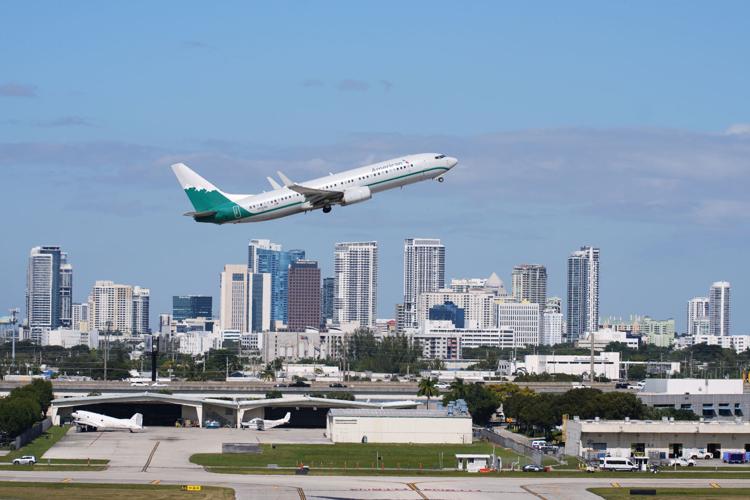
An American Airlines aircraft takes off Thursday from Fort Lauderdale-Hollywood International Airport in Fort Lauderdale, Fla.
Air traffic controllers get 70% of back pay from the shutdown
Duffy said air traffic controllers received 70% of their back pay Friday for working during the shutdown.
A number of controllers called out of work during the shutdown as they dealt with the financial pressure from going without pay for so long.
Some controllers got side jobs to help make ends meet. That led to delays and other flight disruptions when the FAA ran short of controllers at airport towers and other radar facilities.
Controller staffing improved significantly this week as the shutdown drew to a close. Duffy said earlier in the week that controllers would receive the rest of their back pay in the next few paychecks.
Duffy and President Donald Trump also proposed that controllers who didn’t miss a shift during the shutdown should receive $10,000 bonuses, but the details of exactly who might get those checks haven’t been released.

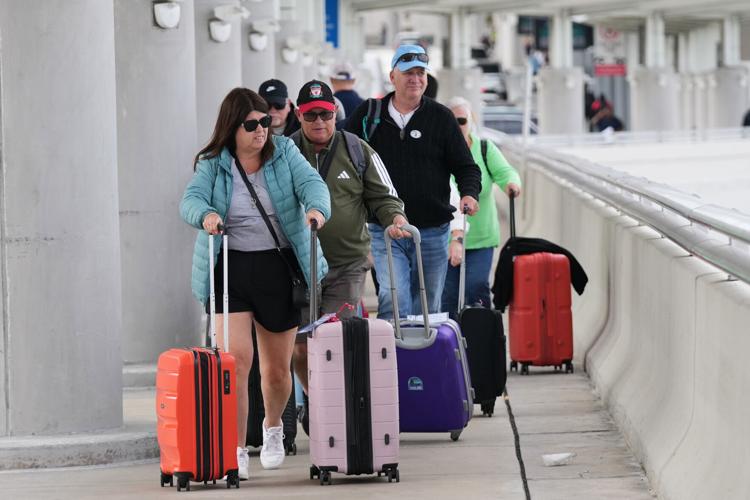
Travelers walk to the terminal Thursday at Fort Lauderdale-Hollywood International Airport in Fort Lauderdale, Fla.
House Democrats press the FAA and DOT for answers on flight cuts
Democratic members of the House Committee on Transportation and Infrastructure asked federal officials for an explanation of the decision to cut up to 10% of flights at 40 major airports during the shutdown, along with details on staffing levels and how airports were chosen.
“It appears that the administration made this decision without adequate coordination with key aviation stakeholders,” Friday’s letter to Duffy and FAA Administrator Bryan Bedford said.
The group requested a briefing and written response by Nov. 20.
The FAA on Wednesday froze reductions at 6%, shortly before a deal was reached to end the shutdown. Requests for comment were sent to the department and FAA.
Monthlong government shutdown in photos: Disruptions, delays and divisions

Volunteer Betty McNeely, right, helps a man bag food items Oct. 28 at Project Feed, an emergency food pantry in Portland, Maine. With no endgame in sight, the U.S. government shutdown is expected to roll on for the unforeseeable future, injecting more uncertainty into an already precarious economy.

Brock Brooks, a disable Marine Corps veteran, cries Oct. 30 while describing the impending SNAP shutdowns while waiting in line to enter the food pantry service at Calvary Episcopal Church in Louisville, Ky. Funding for the Supplemental Nutrition Assistance Program, or SNAP, lapsed Saturday.

Volunteers prepare emergency food packages Oct. 28 at the Tarrant Area Food Bank in Fort Worth, Texas.

Tammy Norton, a furloughed federal employee of 16 years who currently works for the Internal Revenue Service, reacts with emotion Oct. 28 as she talks about running through her limited savings to support her family during the government shutdown, at a food distribution center for federal employees affected by the government shutdown in Dania Beach, Fla. The monthlong government shutdown halted routine federal operations, furloughed about 750,000 federal employees and left others working without pay.

Volunteer Joel Hernandez helps load a vehicle Oct. 27 during a food distribution targeting federal employee households affected by the federal shutdown as well as SNAP recipients in San Antonio.

A food and supplies bank is set up Oct. 17 at Harry Reid International Airport in Las Vegas, Nv.

House Minority Leader Hakeem Jeffries, D-N.Y., disputes a reporter's question Oct. 24 as he enters his office at the Capitol in Washington on day 24 of the government shutdown.

The Capitol is seen at nightfall Oct. 22, day 22 of a government shutdown, in Washington.

Sen. John Barrasso, R-Wyo., the Senate GOP whip, left, and Speaker of the House Mike Johnson, R-La., arrive for a news conference with top Republicans on the government shutdown Oct. 1 at the Capitol in Washington.

Air Traffic Controllers stand Oct. 28 outside Detroit Metropolitan Wayne County Airport in Romulus, Mich., distributing leaflets explaining how the federal government shutdown is affecting air travel. Airports have been scrambling with flight disruptions.

Travelers sit together and wait Oct. 2 at the Baltimore/Washington International Thurgood Marshall Airport in Baltimore.

TSA agent Sashene McLean, holding her 1-year-old daughter, comes from work to collect a donation of produce, meat and yogurt Oct. 28 at a food distribution center in Dania Beach, Fla., organized to assist federal employees missing paychecks during the government shutdown.

Senate Majority Leader John Thune, R-S.D., speaks to reporters Sept. 30 at the U.S. Capitol in Washington as the U.S. government was on the brink of the first federal government shutdown in almost seven years.

Speaker of the House Mike Johnson, R-La., and GOP leaders, from left, Rep. Lisa McClain, R-Mich., and Majority Whip Tom Emmer, R-Minn., blame the government shutdown on Democrats during an Oct. 2 news conference at the Capitol in Washington. Americans, meanwhile, are divided on who’s to blame.

Senate Minority Leader Chuck Schumer, D-N.Y., attends a Sept. 30 news conference about the government shutdown on Capitol Hill in Washington. Democrats seek an extension of expiring tax credits that helped millions of people afford health insurance, while Republicans say they won’t negotiate until the government is reopened.

