

NEW YORK — Former President Donald Trump called for parents to elect and fire school principals. Florida Gov. Ron DeSantis banned instruction on sexual orientation and gender identity in kindergarten through third grade. And Nikki Haley, the former U.N. ambassador, is among the Republicans taking aim at critical race theory.

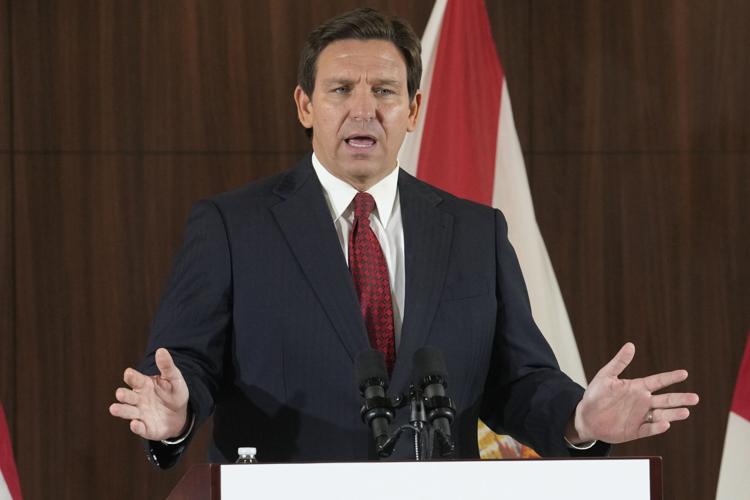
Florida Gov. Ron DeSantis speaks Jan. 26 at a news conference in Miami.
In the opening stages of the 2024 GOP presidential race, the "parents' rights" movement and lessons for schoolchildren are emerging as flashpoints.
The focus on issues related to racism, sexuality and education is a way for potential White House hopefuls to distinguish themselves in a crowded field, suggesting new and deeper ways for government to shape what happens in classrooms.
But the effort have prompted criticism from LGBTQ advocacy groups, teachers' unions, some parents and student activists and those worried about efforts to avoid lessons about systemic racism. Democrats cast the efforts as race-baiting and improperly injecting politics into schools.
In Florida, DeSantis made an aggressive push against what he calls "woke" policies.
He gained national attention last year for signing the so-called Don't Say Gay bill into law, barring instruction on sexual orientation and gender identity for young elementary schoolers, as well as material deemed not age-appropriate, which critics argue is vague and could stifle classroom discussions. He also signed the "Stop WOKE" act in 2022, a law that restricted teaching that members of one race are inherently racist or should feel guilt about past actions by other people of the same race, among other things.
DeSantis also extended his political influence to school board races, endorsing candidates last year in what had been nonpartisan contests and flipping at least three boards from a liberal majority to a conservative majority.
More recently, he blocked high schools from teaching a new Advanced Placement course on African American studies, contending it was a violation of a state law and historically inaccurate. Beyond K-12 schools, he appointed six conservative trustees to the board of a small liberal arts college and announced plans to restrict state colleges from having programs on critical race theory and diversity, equity and inclusion.
Critical race theory, which DeSantis has called "pernicious," was developed by scholars in the 1970s and 1980s in response to what they viewed as a lack of racial progress following the civil rights legislation of the 1960s. It centers on the idea that racism is systemic in the nation's institutions, which function to maintain the dominance of white people in society.
Trump staked out his own positions, releasing a nearly 5-minute video outlining what his campaign called a "Plan to Save American Education and Give Power Back to Parents."

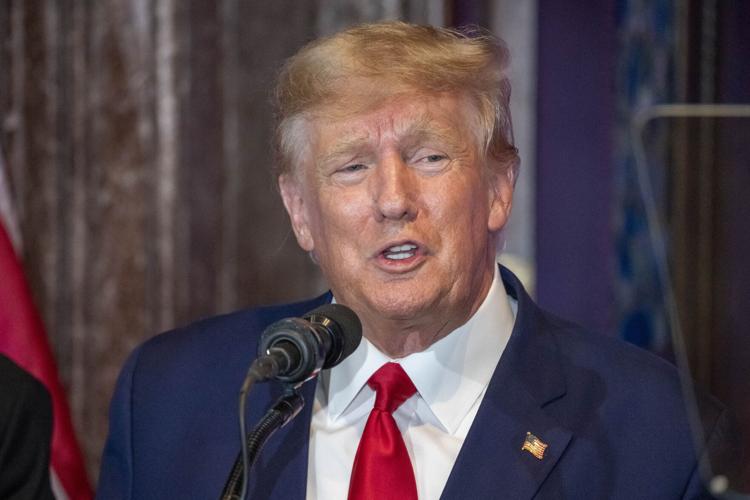
Former President Donald Trump speaks Jan. 28 at a campaign event at the South Carolina Statehouse in Columbia, S.C.
Declaring that "public schools have been taken over by the radical left maniacs" and warning about "pink-haired communists teaching our kids," Trump pledged, if elected president again, that he would cut federal money for any school or program promoting "critical race theory, gender ideology or other inappropriate racial, sexual or political content on to our children."
Trump said he planned to create a national organization that would certify teachers "who embrace patriotic values, support our way of life and understand that their job is not to indoctrinate children" and would set up favorable treatment for states and school districts that adopt reforms such as allowing parents to directly elect and fire school principals.
Former Vice President Mike Pence is using a group he formed to rally conservatives against transgender-affirming policies in schools. The group plans to run ads, hold rallies and canvass in early voting state Iowa as a federal appeals court is set to consider a case involving an Iowa school district's policy to support transgender students.
In the U.S., public education is run by states and largely paid for by state and local taxpayers. The federal government does not certify teachers or regulate how schools hire staff and doesn't control curriculum standards. But Congress or the Department of Education can incentivize certain education practices by tying them to federal money.
The more recent divisive shift to social issues in schools is an outgrowth of Glenn Youngkin's successful bid in 2021 to become the first Republican in more than a decade to be elected as Virginia's governor. Youngkin campaigned on parental rights. He appealed to parents frustrated over school closures during the COVID-19 pandemic and said he would ban the teaching of critical race theory in public schools.
His administration began rewriting the state's model policies for the treatment of transgender students, issuing guidance for school divisions that would roll back some accommodations and tighten parental notification requirements.
Half of voters in 2022 said their K-8 schools were teaching too much about gender identity issues, according to AP VoteCast, a national survey of the electorate. Only about one-quarter said schools teach too little on the subject.
About 4 in 10 voters said too little is taught on racism in the U.S., while about one-third said schools were teaching too much on related issues.
These were the top 10 books people wanted removed from schools and libraries in 2021
1. 'Gender Queer' by Maia Kobabe
Updated
Reasons for challenge, according to the ALA: Banned, challenged, and restricted for LGBTQIA+ content and because it was considered to have sexually explicit images.
Find it on Amazon.
2. 'Lawn Boy' by Jonathan Evison
Updated
Reasons: Banned and challenged for LGBTQIA+ content and because it was considered to be sexually explicit.
Find it on Amazon.
3. 'All Boys Aren’t Blue' by George M. Johnson
Updated
Reasons: Banned and challenged for LGBTQIA+ content and profanity and because it was considered to be sexually explicit.
Find it on Amazon.
4. 'Out of Darkness' by Ashley Hope Perez
Updated
Reasons: Banned, challenged, and restricted for depictions of abuse and because it was considered to be sexually explicit.
Find it on Amazon.
5. 'The Hate U Give' by Angie Thomas
Updated
Reasons: Banned and challenged for profanity and violence and because it was thought to promote an anti-police message and indoctrination of a social agenda
Find it on Amazon.
6. 'The Absolutely True Diary of a Part-Time Indian' by Sherman Alexie
Updated
Reasons: Banned and challenged for profanity, sexual references, and use of a derogatory term.
Find it on Amazon.
7. 'Me and Earl and the Dying Girl' by Jesse Andrews
Updated
Reasons: Banned and challenged because it was considered sexually explicit and degrading to women.
Find it on Amazon.
8. 'The Bluest Eye' by Toni Morrison
Updated
Reasons: Banned and challenged because it depicts child sexual abuse and was considered sexually explicit.
Find it on Amazon.
9. 'This Book is Gay' by Juno Dawson
Updated
Reasons: Banned, challenged, relocated, and restricted for providing sex education and LGBTQIA+ content.
Find it on Amazon.
10. 'Beyond Magenta' by Susan Kuklin
Updated
Reasons: Banned and challenged for LGBTQIA+ content and because it was considered to be sexually explicit.
Find it on Amazon.

