


WASHINGTON — Iranian-backed Houthi rebels entered the month-old war by claiming two missile launches at Israel on Saturday, as U.S. Central Command announced a Navy ship carrying about 2,500 Marines arrived in the Middle East.
Meanwhile, Pakistan said regional powers planned to meet Sunday on how to end the war, while Iran expressed skepticism about the diplomatic efforts.
The Houthis’ entry could further hurt global shipping if they again target vessels in the Bab el-Mandeb Strait off the Red Sea.
The war upended global air travel, disrupted oil exports and caused fuel prices to soar. Iran’s stranglehold on the Strait of Hormuz, a strategic waterway, exacerbated the economic fallout. U.S. President Donald Trump gave Iran until April 6 to reopen the strait.
There could be limited relief in sight after Iran agreed Friday to allow humanitarian aid and agricultural shipments through the strait after a request from the United Nations.
Witnesses in Tehran reported heavy strikes late Saturday. Israel's military earlier said it targeted Iran's naval weapons production facilities, and said it would finish attacking essential weapons production sites within “a few days." The U.S. said it struck more than 11,000 Iranian targets in the war.
Iran fired missiles toward Israel, and Israeli rescue service Magen David Adom said 11 people were lightly wounded in a town near Jerusalem.

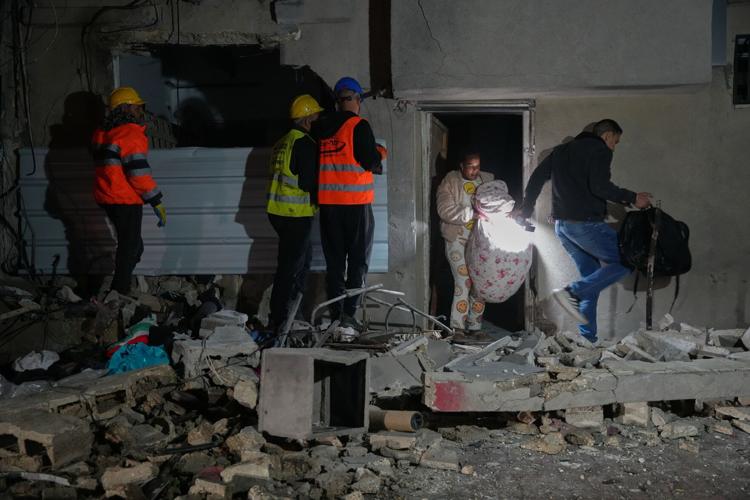
Residents carry personal belongings early Saturday as they leave a building damaged in a missile strike in Tel Aviv, Israel.
Houthi involvement could further complicate the war
The Iranian-backed Houthi rebels targeted multiple sites in southern Israel to coincide with attacks from Iran and Hezbollah militants in Lebanon, Brig. Gen. Yahya Saree, a military spokesman for Yemen’s Houthis, said in a prerecorded statement aired by the group’s Al-Masirah satellite television.
The second launch came hours after the Houthis’ first missile attack against Israel in the war. Israel said it intercepted the first missile but did not immediately comment on whether it intercepted projectiles in the second attack.
If the Houthis increase attacks on commercial shipping, as they have in the past, it would further push up oil prices and destabilize “all of maritime security,” said Ahmed Nagi, a senior Yemen analyst at the International Crisis Group. “The impact would not be limited to the energy market.”
Countries scrambled for alternative routes to the Strait of Hormuz. Bab el-Mandeb, at the southern tip of the Arabian Peninsula, is crucial for vessels heading to the Suez Canal through the Red Sea and Saudi Arabia sent millions of barrels of crude oil a day through it because the Strait of Hormuz is effectively closed.
About 12% of the world’s trade typically passes through Bab el-Mandeb and about 10% of global maritime trade — including 40% of container ship traffic — passes through the Suez Canal each year.
Houthi rebels attacked more than 100 merchant vessels with missiles and drones, sinking two vessels, between November 2023 and January 2025, saying it was attacking in solidarity with Palestinians in Gaza during the war there between Israel and Hamas.
The Houthis' involvement in the current conflict also would complicate the deployment of the USS Gerald R. Ford, the aircraft carrier that arrived in Croatia on Saturday for repairs. Sending the carrier to the Red Sea could draw attacks similar to those experienced by the USS Dwight D. Eisenhower in 2024 and the USS Harry S. Truman in 2025.
The Houthis have held Yemen’s capital, Sanaa, since 2014. Saudi Arabia launched a war against the Houthis on behalf of Yemen’s exiled government in 2015, and the rebels stayed out of the current conflict due to their uneasy ceasefire with Saudi Arabia.

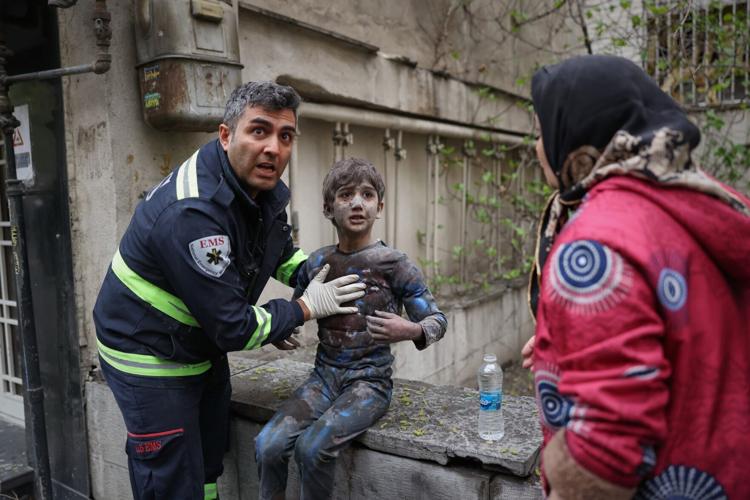
A first responder assists an injured boy Saturday after a strike hit a residential building in Tehran, Iran, amid the U.S.-Israeli military campaign.
Attempts at diplomacy as US sends more troops to the region
Central Command said in addition to the Marines, the amphibious assault ship USS Tripoli also brings transport and strike fighter aircraft, as well as amphibious assault assets to the region. The USS Boxer and two other ships, along with another Marine Expeditionary Unit, also were ordered to the the Mideast from San Diego.
Additionally, at least 1,000 paratroopers from the 82nd Airborne, trained to land in hostile territory to secure key positions and airfields, were ordered to the region.
Secretary of State Marco Rubio said Friday the United States can meet its objectives "without any ground troops." But he also said Trump "has to be prepared for multiple contingencies" and American forces are available "to give the president maximum optionality and maximum, opportunity to adjust to contingencies should they emerge."
More than two dozen U.S. troops were wounded in Iranian attacks on Saudi Arabia’s Prince Sultan Air Base in the past week, according to two people briefed on the matter who spoke on the condition of anonymity because they were not authorized to comment publicly. Iran fired six ballistic missiles and 29 drones at the base Friday, injuring at least 15 troops, including five seriously, they said.
The Saudi base came under come attack twice earlier in week, including an incident that injured 14 U.S. troops, according to the people.
The base — about 60 miles from the Saudi capital, Riyadh — is run by the Royal Saudi Air Force but also used by U.S. troops. The installation was targeted almost since the beginning of the war, which Saturday reached the one-month mark. The latest attacks on the base happened after Trump claimed talks on ending the war were going "very well"; Iran said it did not engage in any negotiations.
Army Sgt. Benjamin N. Pennington, 26, was wounded during a March 1 attack on the base and died days later. He is one of the 13 U.S. service members who were killed in the war. The Pentagon did not immediately respond to an email seeking comment Saturday regarding the American casualties at the Saudi base.

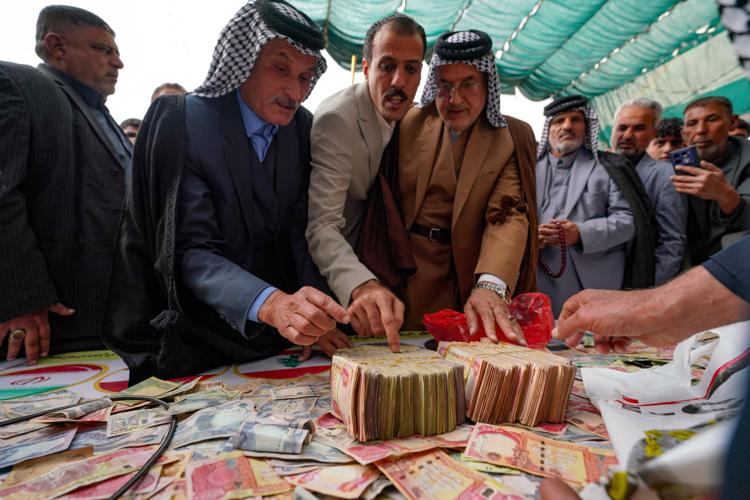
People donate money Friday in Babylon, Iraq, after Grand Ayatollah Ali al-Sistani called for support for Iran and Lebanon during the war with the U.S. and Israel.
Central Command said Friday that more than 300 service members were wounded so far in the war. Most returned to duty, while 30 remained out of action and 10 were considered seriously wounded.
Pakistan said Saturday that Saudi Arabia, Turkey and Egypt will send top diplomats to Islamabad for a two-day visit for “in-depth discussions on a range of issues, including efforts to de-escalate tensions in the region.”
Pakistan’s Prime Minister Shehbaz Sharif said he and Iranian President Masoud Pezeshkian held “extensive discussions” on regional hostilities and efforts to end the war.
But the Iranian foreign minister, Abbas Araghchi, told his Turkish counterpart by phone that Tehran was skeptical about recent diplomatic efforts. Iranian state-run media said Araghchi accused the United States of making “unreasonable demands” and exhibiting “contradictory actions.”
Trump envoy Steve Witkoff previously said Washington delivered a 15-point “action list” to Iran for a possible ceasefire, with a proposal to restrict Iran’s nuclear program — the issue at the heart of tensions with the U.S and Israel — and reopen the Strait of Hormuz. Tehran rejected the proposal and presented a five-point proposal that included reparations and recognition of its sovereignty over the waterway.
A month into the US-Israel war on Iran, millions are displaced, cities destroyed, regional fronts expand, and a global energy shock grows
Death toll climbs
Iranian authorities say more than 1,900 people were killed so far in the Islamic Republic, while 19 were reported dead in Israel.
In Lebanon, where Israel started an invasion in the south, officials said more than 1,100 people were killed since the start of the war.
In Iraq, where Iranian-supported militia groups entered the conflict, 80 members of the security forces were killed.
In Gulf states, 20 people were killed, along with four others in the occupied West Bank.
____
Magdy reported from Cairo and Madhani from Washington. Associated Press writer Konstantin Toropin in Washington, Cara Anna in Lowville, New York, and Munir Ahmed in Islamabad contributed to this report.
Photos from the Mideast in the 4th week of the Iran war

A man takes cover as air raid sirens sound, warning of rockets launched from Lebanon toward Israel, in Kiryat Shmona, northern Israel, Monday, March 23, 2026. (AP Photo/Ariel Schalit)

Israeli security forces and rescue team respond at the site of an Iranian missile strike in Tel Aviv, Israel, Tuesday, March 24, 2026. (AP Photo/Ohad Zwigenberg)

Relatives grieve in Baghdad, Iraq, Tuesday, March 24, 2026, during a funeral of members of the Popular Mobilization Forces who were killed in a U.S. airstrike in Anbar, Iraq. (AP Photo/Hadi Mizban)

Israeli soldiers secure the site where an Iranian missile wreckage landed in the West Bank village of Kifl Haris Tuesday, March 24, 2026. (AP Photo/Majdi Mohammed)

An Israeli soldier jumps from a tank in northern Israel near the border with Lebanon, Saturday, March 21, 2026. (AP Photo/Ariel Schalit)

Israeli security forces and rescue teams work at the site struck by an Iranian missile in Arad, southern Israel, Sunday, March 22, 2026. (AP Photo/Ohad Zwigenberg)

Israeli security forces survey the site that was struck by an Iranian missile in Dimona, southern Israel, Sunday, March 22, 2026. (AP Photo/Ariel Schalit)

Smoke and flames rise from an Israeli airstrike that hit the Qasmiyeh Bridge near the coastal city of Tyre, Lebanon, Sunday, March 22, 2026. (AP Photo/Mohammad Zaatari)

Rescue workers and first responders work at a residential building hit in an earlier U.S.-Israeli strike in Tehran, Iran, Monday, March 23, 2026. (AP Photo/Vahid Salemi)

Children play beside a fragment of an Iranian ballistic missile that landed in a schoolyard in the Israeli settlement of Peduel in the West Bank Monday, March 23, 2026. (AP Photo/Ohad Zwigenberg)

People follow a truck carrying the flag draped coffins of Gen. Ali Mohammad Naeini, a spokesperson for Iran’s paramilitary Revolutionary Guard and one of his comrades Amir Hossein Bidi , during their funeral procession in Tehran, Iran, Saturday, March 21, 2026. (AP Photo/Vahid Salemi)

Iranian worshippers perform Eid al-Fitr prayers marking the end of the holy fasting month of Ramadan as one of them wears an Iranian flag at the Imam Khomeini Grand Mosque in Tehran, Iran, Saturday, March 21, 2026. (AP Photo/Vahid Salemi)

A displaced woman who fled Israeli airstrikes in southern Lebanon, carries her belonging as she moves to a better spot to shelter from the rain, past an Arabic anti-war poster that reads, "Sacrificing for whom? Lebanon does not need war," in Beirut, Saturday, March 21, 2026.(AP Photo/Hussein Malla)

Iranian Kurdish Mariam crosses the Haji Omeran border crossing on foot between Iran and the autonomous Kurdistan Region of Iraq (KRI), Iraq, Sunday, March 15, 2026, as the border remains open. (AP Photo/Leo Correa)

A man cleans debris from his apartment damaged when a nearby police station was hit Friday in a U.S.-Israeli strike in Tehran, Iran, Sunday, March 15, 2026. (AP Photo/Vahid Salemi)

The shattered structure of a police station is seen after it was hit Friday in a U.S.-Israeli strike in Tehran, Iran, Sunday, March 15, 2026. (AP Photo/Vahid Salemi)

A FlyDubai plane is parked at Dubai International Airport as smoke rises in the background after a drone struck a fuel tank early morning, forcing the temporary suspension of flights, in Dubai, United Arab Emirates, Monday, March 16, 2026. (AP Photo)

A member of the armed wing of the Kurdish-Iranian opposition group Organization of Iranian Kurdistan Struggle, known as Khabat, stands in front of a shrapnel pockmarked wall that allegedly was damaged in strike by Iranian-backed militias in Iraq last week at a military base on the outskirts of Irbil, Iraq, Monday, March 16, 2026. (AP Photo/Leo Correa)

Israeli security forces inspect a house in east Jerusalem where a fragment of an Iranian missile crashed onto the rooftop, Monday, March 16, 2026. (AP Photo/Mahmoud Illean)

Israeli soldiers operate next to their mobile artillery unit on the border with Lebanon in northern Israel, Monday, March 16, 2026. (AP Photo/Ariel Schalit)

Nofar Eliash holds her dog as she takes shelter with others while air raid sirens warn of incoming Iranian and Hezbollah missile strikes in Kiryat Shmona, northern Israel, Monday, March 16, 2026. (AP Photo/Ariel Schalit)

A man runs past a bulldozer clearing debris from a building damaged in an Israeli airstrike in Dahiyeh, Beirut's southern suburbs, Lebanon, Tuesday, March 17, 2026. (AP Photo/Hassan Ammar)

Residents inspect a house damaged yesterday by a projectiles launched from Lebanon in Nahariya, northern Israel, Tuesday, March 17, 2026. (AP Photo/Ariel Schalit)

Israeli air defense system fires to intercept missiles during an Iranian attack over Tel Aviv, Israel, early Sunday, March 15, 2026. (AP Photo/Ohad Zwigenberg)

Volunteers clean debris from a residential building damaged when a nearby police station was hit Friday in a U.S.-Israeli strike in Tehran, Iran, Sunday, March 15, 2026. (AP Photo/Vahid Salemi)

People walk past tents sheltering people displaced by Israeli airstrikes at a public space along the Beirut waterfront at sunset in Beirut, Lebanon, Sunday, March 15, 2026. (AP Photo/Hassan Ammar)

Fire and plumes of smoke rise after a drone struck a fuel tank forcing the temporary suspension of flights. near Dubai International Airport, in United Arab Emirates, early Monday, March 16, 2026. (AP Photo)

