


WASHINGTON — The Senate gave final passage to an annual military policy bill Wednesday that will authorize $901 billion in defense programs while pressuring Defense Secretary Pete Hegseth to provide lawmakers with video of strikes on alleged drug boats in international water near Venezuela.
The annual National Defense Authorization Act, which raises troop pay by 3.8%, gained bipartisan backing as it moved through Congress. It passed the Senate on a 77-20 vote before lawmakers planned to leave Washington for a holiday break. Two Republicans — Sens. Rand Paul and Mike Lee — and 18 Democrats voted against the bill.
The White House indicated that it is in line with President Donald Trump's national security priorities. However, the legislation, which ran more than 3,000 pages, revealed some points of friction between Congress and the Pentagon as the Trump administration reorients its focus away from security in Europe and toward Central and South America.

Defense Secretary Pete Hegseth arrives to brief members of Congress on military strikes near Venezuela, Dec. 16, at the Capitol in Washington.
The bill pushes back on recent moves by the Pentagon. It demands more information on boat strikes in the Caribbean, requires that the U.S. keep its troop levels in Europe at current levels and sends some military aid to Ukraine.
However, House Republicans rejected a separate pair of Democratic-backed resolutions Wednesday that would have put a check on President Donald Trump’s power to use military force against drug cartels and the nation of Venezuela.
The legislation would have forced the Trump administration to seek authorization from Congress before continuing attacks against cartels that it deems to be terrorist organizations in the Western Hemisphere or launching an attack on Venezuela itself.
Rep. Gregory Meeks, the top Democrat on the House Foreign Affairs Committee, argued that Trump's aggressions in the region were really because “the president is coveting Venezuelan oil.”
The Trump administration hasn't sought congressional authorization for its recent actions in the Caribbean, arguing instead that it can destroy drug-carrying boats just as it would handle terrorist threats against the U.S.

But overall, the defense bill represents a compromise between the parties. It implements many of Trump's executive orders and proposals on eliminating diversity and inclusion efforts in the military and grants emergency military powers at the U.S. border with Mexico.
It also enhances congressional oversight of the Department of Defense, repeals several years-old war authorizations and seeks to overhaul how the Pentagon purchases weapons as the U.S. tries to outpace China in developing the next generation of military technology.
The sprawling bill faced objections from both Democratic and Republican leadership on the Senate Commerce Committee. The legislation allows military aircraft to obtain a waiver to operate without broadcasting their precise location, as an Army helicopter did before a midair collision with an airliner in Washington, D.C. in January that killed 67 people.
"The special carve-out was exactly what caused the January 29th crash that claimed 67 lives," Sen. Ted Cruz, the Republican chair of the Senate Commerce Committee, said at a news conference this week.
Just hours after passing the massive defense bill, the Senate approved a bipartisan bill that will require all aircraft use ADS-B technology — or Automatic Dependent Surveillance–Broadcast technology — to broadcast their locations.
It is not clear when the ROTOR act that Cruz and Democratic Sen. Maria Cantwell both support will be taken up by the House and whether changes will be made.
Boat strike videos
Republicans and Democrats agreed to language in the defense bill that threatened to withhold a quarter of Hegseth's travel budget until he provided unedited video of the strikes, as well as the orders authorizing them, to the House and Senate Committees on Armed Services.
Hegseth was on Capitol Hill Tuesday ahead of the bill's passage to brief lawmakers on the U.S. military campaign in international water near Venezuela. The briefing elicited contrasting responses from many lawmakers, with Republicans largely backing the campaign and Democrats expressing concern about it and saying they hadn't received enough information.
The committees are investigating a Sept. 2 strike — the first of the campaign — that killed two people who survived an initial attack on their boat.
The Navy admiral who ordered the "double-tap" strike, Adm. Frank Bradley, also appeared before the committees shortly before the vote Wednesday in a classified briefing that also included video of the strike in question.
Several Republican senators emerged from the meeting backing Hegseth and his decision not to release the video publicly, but other GOP lawmakers stayed silent on their opinion of the strike.
Democrats called for part of the video to be released publicly and for every member of Congress to have access to the full footage.

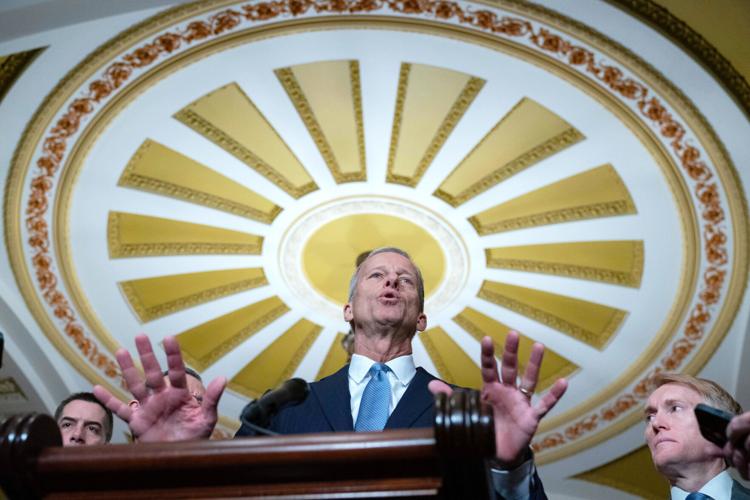
Senate Majority Leader John Thune, R-S.D., speaks to reporters following the weekly policy luncheons at the Capitol, Dec. 16, in Washington.
Congressional oversight
Lawmakers were caught by surprise by the Trump administration several times in the last year, including by a move to pause intelligence sharing with Ukraine and a decision to reduce U.S. troop presence in NATO countries in eastern Europe.
The defense legislation requires Congress be kept in the loop on decisions like that going forward.
The Pentagon is also required, under the legislation, to keep at least 76,000 troops and major equipment stationed in Europe unless NATO allies are consulted and there is a determination that such a withdrawal is in U.S. interests. A similar requirement also keeps the number of U.S. troops stationed in South Korea at 28,500.

