


WASHINGTON — President Donald Trump defended his energy and health in an interview with The Wall Street Journal and disclosed that he had a CT scan, not an MRI scan, during an October examination about which he and the White House delayed offering details.
Trump, in the interview, said he regretted undergoing the advanced imaging on his heart and abdomen during an October visit to Walter Reed National Military Medical Center because it raised public questions about his health. His physician said in a memo the White House released in December that he had "advanced imaging" as a preventive screening for men his age.
Trump initially described it as an MRI but said he didn't know what part of his body he had scanned. A CT scan is a quicker form of diagnostic imaging than an MRI but offers less detail about differences in tissue.

President Donald Trump speaks Wednesday at a New Year's Eve celebration at his Mar-a-Lago club in Palm Beach, Fla.
The president's doctor, Navy Capt. Sean Barbabella, said in a statement released Thursday by the White House that Trump underwent the exam in October because he planned to be at Walter Reed to meet people working there. Trump already underwent an annual physical in April.
"President Trump agreed to meet with the staff and soldiers at Walter Reed Medical Hospital in October. In order to make the most of the President's time at the hospital, we recommended he undergo another routine physical evaluation to ensure continued optimal health," Barbabella said.
Barbabella said he asked the president to undergo either a CT scan or MRI "to definitively rule out any cardiovascular issues" and the results were "perfectly normal and revealed absolutely no abnormalities."
White House press secretary Karoline Leavitt said in a statement Thursday that the president's doctors and the White House "always maintained the President received advanced imaging" but said "additional details on the imaging have been disclosed by the President himself" because he "has nothing to hide."

"In retrospect, it's too bad I took it because it gave them a little ammunition," Trump said in the interview with The Wall Street Journal published Thursday. "I would have been a lot better off if they didn't, because the fact that I took it said, 'Oh gee, is something wrong?' Well, nothing's wrong."
The 79-year-old became the oldest person to take the oath of office when he was sworn in as president last year and has been sensitive to questions about his health, particularly as he repeatedly questioned his predecessor Joe Biden's fitness for office.
Biden, who turned 82 in the last year of his presidency, was dogged by scrutiny of his age and mental acuity at the end of his tenure and during his abandoned attempt to seek reelection.
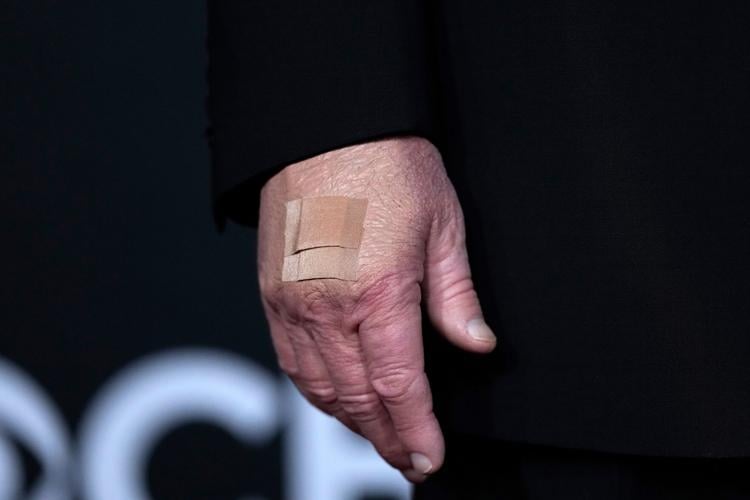
But questions also swirled around Trump's health this year as he's been seen with bruising on the back of his right hand that was conspicuous despite makeup on top, along with noticeable swelling at his ankles.


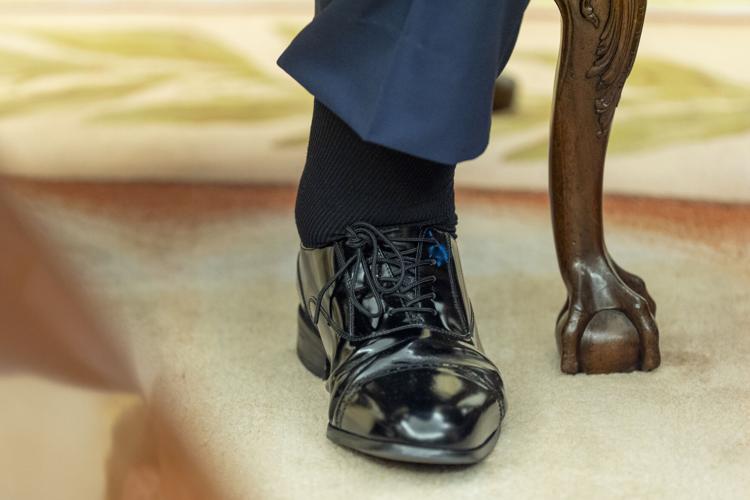
The left foot and swollen ankle of President Donald Trump are pictured as he sits with Bahrain's Crown Prince Salman bin Hamad Al Khalifa in the Oval Office of the White House, Wednesday, July 16, 2025, in Washington. (AP Photo/Alex Brandon)
The White House this summer said the president was diagnosed with chronic venous insufficiency, a common condition among older adults. The condition happens when veins in the legs can't properly carry blood back to the heart and it pools in the lower legs.
In the interview, Trump said he briefly tried wearing compression socks to address the swelling but stopped because he didn't like them.

A bandage is seen on the hand of President Donald Trump while he walks the red carpet before the 48th Kennedy Center Honors, Sunday, Dec. 7, 2025, at the John F. Kennedy Center for the Performing Arts in Washington. (AP Photo/Julia Demaree Nikhinson)
The bruising on Trump's hand, according to Leavitt, is from "frequent handshaking and the use of aspirin," which Trump takes regularly to reduce the risk of heart attack and stroke.
He said he takes more aspirin than his doctors recommend but he resisted taking less because he's been taking it for 25 years and is "a little superstitious." Trump takes 325 milligrams of aspirin daily, according to Barbabella.
"They say aspirin is good for thinning out the blood, and I don't want thick blood pouring through my heart," Trump said. "I want nice, thin blood pouring through my heart. Does that make sense?"

Trump, in the interview, denied he fell asleep during White House meetings when cameras caught him with his eyes closed, instead insisting he was resting his eyes or blinking.
"I'll just close. It's very relaxing to me," he said. "Sometimes they'll take a picture of me blinking, blinking, and they'll catch me with the blink."
He said he's never slept much at night, a habit he also described during his first term, and starts his day early in the White House residence before moving to the Oval Office about 10 a.m. and working until 7 p.m. or 8 p.m.
The president dismissed questions about his hearing, saying he only struggled to hear "when there's a lot of people talking," and said he has plenty of energy, which he credited to his genes.
"Genetics are very important," he said. "And I have very good genetics."
White House East Wing demolished as Trump moves forward with ballroom construction, photos show

This satellite image shows the White House in Washington on Sept. 26, 2025, with the East Wing intact before demolition began.

This satellite image shows the East Wing mostly demolished Thursday, Oct. 23, 2025, in Washington.

White House press secretary Karoline Leavitt holds up a historic photo showing construction of the East Terrace of the White House in 1902 as she speaks about planned construction of a new ballroom following the demolition of the White House East Wing, during a news briefing Thursday, Oct. 23, 2025, at the White House in Washington.

Work continues Tuesday, Oct. 21, 2025, on demolition of part of the East Wing of the White House in Washington.

People watch from outside a security fence Wednesday, Oct. 22, 2025, as demolition continues on the East Wing of the White House in Washington.

Demolition work is seen Wednesday, Oct. 22, 2025, on the East Wing of the White House in Washington.

Demolition continues Wednesday, Oct. 22, 2025, on the East Wing of the White House in Washington.

President Donald Trump holds a rendering of the planned White House ballroom Wednesday, Oct. 22, 2025, in the Oval Office of the White House in Washington.

President Donald Trump holds another rendering of the planned White House ballroom Wednesday, Oct. 22, 2025, in the Oval Office.

A model of the White House and the new ballroom, right, is seen on a table Wednesday, Oct. 22, 2025, as President Donald Trump meets with NATO Secretary General Mark Rutte in the Oval Office of the White House in Washington.

President Donald Trump holds a rendering of the interior of the new White House ballroom Wednesday, Oct. 22, 2025, in the Oval Office of the White House in Washington.

Demolition continues Wednesday, Oct. 22, 2025, on the East Wing of the White House in Washington, before construction of the ballroom.

Water is sprayed on debris to help with dust control Wednesday, Oct. 22, 2025, amid demolition work on the East Wing of the White House in Washington.

Demolition of the East Wing of the White House continues Wednesday, Oct. 22, 2025, in Washington, before construction of a new ballroom.

Construction crews demolish the East Wing of the White House, Thursday, Oct. 23, 2025, in Washington.

Construction crews demolish the East Wing of the White House on Thursday, Oct. 23, 2025, in Washington.

Construction workers atop the U.S. Treasury, bottom right, watch Thursday, Oct. 23, 2025, as work continues on a largely demolished part of the East Wing of the White House in Washington.

Construction workers atop the U.S. Treasury, bottom left, watch as work continues Thursday, Oct. 23, 2025, on a largely demolished part of the East Wing of the White House in Washington.

Work continues Thursday, Oct. 23, 2025, on a largely demolished part of the East Wing of the White House in Washington.

A worker walks through debris Thursday, Oct. 23, 2025, at a largely demolished part of the East Wing of the White House in Washington.

