


WASHINGTON — Dozens of reporters turned in access badges Wednesday and exited the Pentagon rather than agree to government-imposed restrictions on their work, pushing journalists who cover the American military further from the seat of its power.
News outlets were nearly unanimous in rejecting new rules imposed by Defense Secretary Pete Hegseth that would leave journalists vulnerable to expulsion if they sought to report on information — classified or otherwise — that was not approved by Hegseth for release. The U.S. government called the new rules “common sense.”

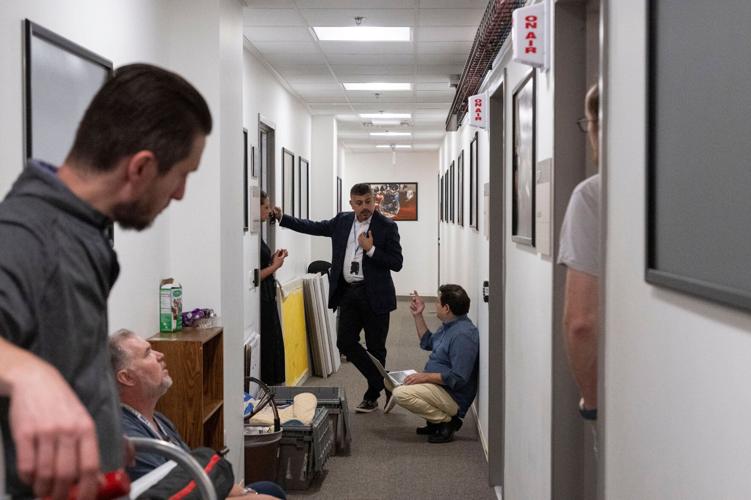
Members of the media pack up their belongings Wednesday in the press area of the Pentagon in Washington.
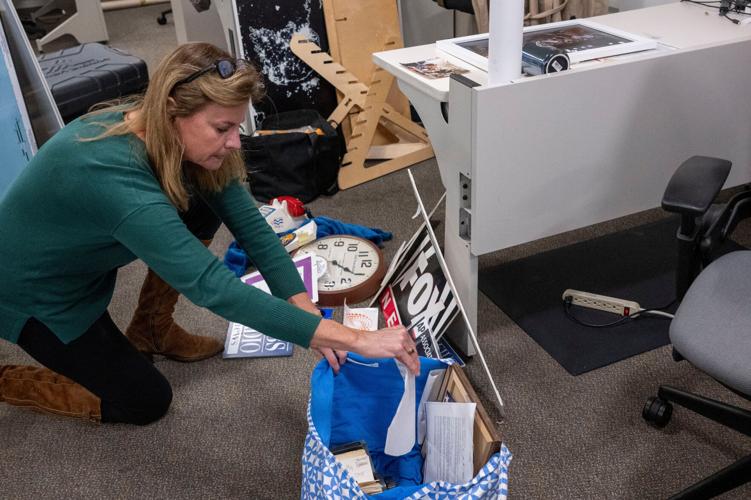
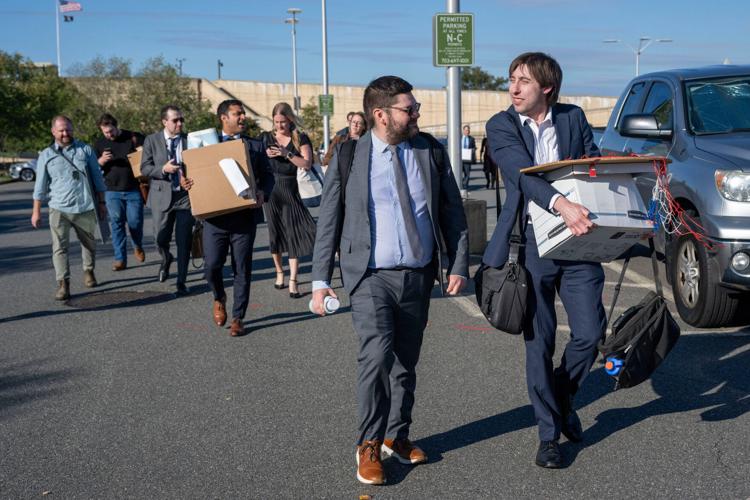
Many of the reporters waited to leave together at a 4 p.m. deadline set by the Defense Department to get out of the building. As the hour approached, boxes of documents lined a Pentagon corridor and reporters carried chairs, a copying machine, books and old photos to the parking lot from suddenly abandoned workspaces. Shortly after 4, about 40 to 50 journalists left together after handing in badges.
“It’s sad, but I’m also really proud of the press corps that we stuck together,” said Nancy Youssef, a reporter for The Atlantic who has had a desk at the Pentagon since 2007. She took a map of the Middle East out to her car.
It is unclear what practical impact the new rules will have, though news organizations vowed they’d continue robust coverage of the military no matter the vantage point.
President Donald Trump has been involved in court fights against The New York Times, CBS News, ABC News, the Wall Street Journal and The Associated Press in the past year.

Washington Post reporter Tara Copp saves the name plaques from various news organizations Wednesday as she and members of the media pack up their belongings in the press area in the Pentagon in Washington.
Trump supports the new rules
Speaking to reporters Tuesday at the White House, Trump backed his defense secretary’s new rules. “I think he finds the press to be very disruptive in terms of world peace,” Trump said. “The press is very dishonest.”
Even before issuing his new press policy, Hegseth, a former Fox News Channel host, systematically choked off the flow of information. He’s held only two formal news briefings, banned reporters from accessing many parts of the sprawling Pentagon without an escort and and launched investigations into leaks to the media.

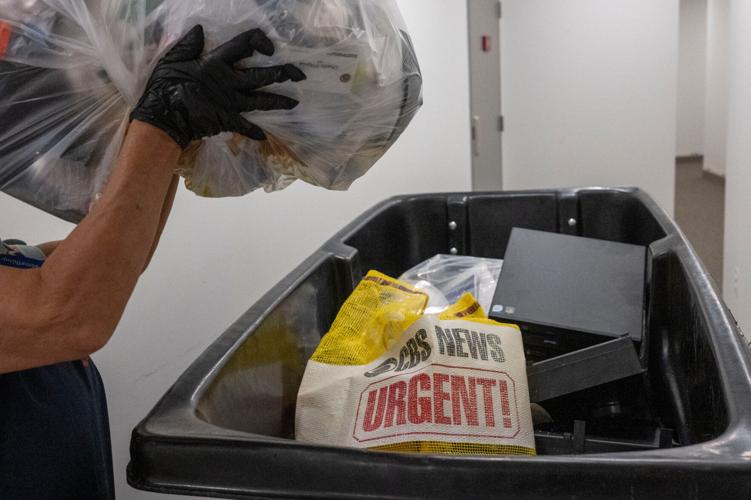
A cleaning person throws a bag of trash in a dumpster Wednesday as members of the media pack up their belongings in the press area of the Pentagon in Washington.
He called his new rules “common sense” and said the requirement that journalists sign a document outlining the rules means they acknowledge the new rules, not necessarily agree to them. Journalists see that a distinction without a difference.
“What they’re really doing, they want to spoon-feed information to the journalist, and that would be their story. That’s not journalism,” said Jack Keane, a retired U.S. Army general and Fox News analyst, said on Hegseth’s former network.
When he served, Keane said he required new brigadier generals to take a class on the role of the media in a democracy so they wouldn’t be intimidated and also see reporters as a conduit to the American public. “There were times when stories were done that made me flinch a little bit,” he said. “But that’s usually because we had done something that wasn’t as good as we should have done it.”
Youssef said it made no sense to sign on to rules that said reporters should not solicit military officials for information. “To agree to not solicit information is to agree to not be a journalist,” she said. “Our whole goal is soliciting information.”

Members of the Pentagon press corps carry their belongings out of the Pentagon after turning in their press credentials Wednesday in Washington.
Reporting on US military affairs will continue — from a greater distance
Several reporters posted on social media when they turned in their press badges.
“It’s such a tiny thing, but I was really proud to see my picture up on the wall of Pentagon correspondents,” wrote Heather Mongillo, a reporter for USNINews, which covers the Navy. “Today, I’ll had in my badge. The reporting will continue.”
Mongillo, Youssef and others emphasized that they’ll continue to do their jobs no matter where their desks are. Some sources will continue to speak with them, although they say some in the military have been chilled by threats from Pentagon leadership.

In an essay, NPR reporter Tom Bowman noted the many times he’d been tipped off by people he knew from the Pentagon and while embedded in the military about what was happening, even if it contradicted official lines put out by leadership. Many understand the media’s role.
“They knew the American public deserved to know what’s going on,” Bowman wrote. “With no reporters able to ask questions, it seems the Pentagon leadership will continue to rely on slick social media posts, carefully orchestrated short videos and interviews with partisan commentators and podcasters. No one should think that’s good enough.”

The Pentagon Press Association, which has 101 members representing 56 news outlets, spoke out against the rules. Organizations from across the media spectrum, from legacy organizations like The Associated Press and The New York Times to conservative outlets like Fox and Newsmax, told their reporters to leave instead of signing the new rules.
Only the conservative One America News Network signed on. Its management likely believes it will have greater access to Trump administration officials by showing its support, Gabrielle Cuccia, a former Pentagon reporter who was fired by OANN earlier this year for writing an online column criticizing Hegseth’s media policies, told the AP in an interview.
Read more:


What photos show about the U.S. government shutdown

Stairs lead to the Capitol Visitors Center with just days to go before federal money runs out with the end of the fiscal year, in Washington, Wednesday, Sept. 24, 2025. (AP Photo/J. Scott Applewhite)

President Donald Trump walks from Marine One after arriving on the South Lawn of the White House, Tuesday, Sept. 30, 2025, in Washington. (AP Photo/Alex Brandon)

House Minority Leader Hakeem Jeffries, D-N.Y., center, flanked by Rep. Pete Aguilar, D-Calif., left, and Rep. Katherine Clark, D-Mass., arrives to speak on the steps of the Capitol to insist that Republicans include an extension of expiring health care benefits as part of a government funding compromise, in Washington, Tuesday, Sept. 30, 2025. (AP Photo/J. Scott Applewhite)

The sun sets behind the Capitol and Washington Monument, as a vote fails in the Senate which is expected to lead to a government shutdown, Tuesday, Sept. 30, 2025, as seen from inside the Capitol, in Washington. (AP Photo/Jacquelyn Martin)

Visitors tour the Capitol Rotunda as the government lurches toward a shutdown at midnight if the Senate does not pass a House measure that would extend federal funding for seven weeks, at the Capitol in Washington, Tuesday, Sept. 30, 2025. (AP Photo/J. Scott Applewhite)

Senate Majority Leader John Thune, R-S.D., speaks to reporters Tuesday, Sept. 30, 2025, at the U.S. Capitol in Washington, as the U.S. government is on the brink of the first federal government shutdown in almost seven years.. (AP Photo/Jacquelyn Martin)

Senate Minority Leader Chuck Schumer of N.Y., listens as he speaks to reporters Tuesday, Sept. 30, 2025, at the U.S. Capitol in Washington. (AP Photo/Jacquelyn Martin)

Kaitlin and Kurt Wilhelm, of Sandusky, Ohio, foreground, and others gather on the rocky coast to watch the sunrise, Wednesday, Oct. 1, 2025, in Acadia National Park, Maine. (AP Photo/Robert F. Bukaty)

A visitor walks at the Lincoln Memorial at sunrise on Wednesday, Oct. 1, 2025, in Washington. (AP Photo/Mark Schiefelbein)

American flags fly in front of the U.S. Capitol at sunrise, Wednesday, Oct. 1, 2025, in Washington. (AP Photo/Julia Demaree Nikhinson)

The U.S. Capitol is seen at sunrise as cars drive on Pennsylvania Ave. during rush hour traffic, Wednesday, Oct. 1, 2025, in Washington. (AP Photo/Julia Demaree Nikhinson)

Tourist view Independence Hall from outside a barricade in Philadelphia, Wednesday, Oct. 1, 2025. (AP Photo/Matt Rourke)

Rep. Alexandria Ocasio-Cortez, D-N.Y., gives a tour of the Capitol to a group of students from New York after their previously-scheduled tour was canceled due to the government shutdown on Wednesday, Oct. 1, 2025, in Washington. (AP Photo/Mark Schiefelbein)

Sen. John Barrasso, R-Wyo., the Senate GOP whip, left, and Speaker of the House Mike Johnson, R-La., right, arrive for a news conference with top Republicans on the government shutdown, at the Capitol in Washington, Wednesday, Oct. 1, 2025. (AP Photo/J. Scott Applewhite)

A sign alerting visitors that the Royal Palm Visitor Center is closed hangs in a display case reflecting the landscape, inside Florida's Everglades National Park, Wednesday, Oct. 1, 2025. (AP Photo/Rebecca Blackwell)

A sign announces that the U.S. Capitol Visitor Center is closed, on the first day of a partial government shutdown, Wednesday, Oct. 1, 2025, in Washington. (AP Photo/Julia Demaree Nikhinson)

People take photos with a sign announcing that the Library of Congress is closed, on the first day of a partial government shutdown, Wednesday, Oct. 1, 2025, in Washington. (AP Photo/Julia Demaree Nikhinson)

People look through fence to get a glance at the Statue of Liberty in New York, Wednesday, Oct. 1, 2025. (AP Photo/Seth Wenig)

A tourist stops to read the sign announcing that the Washington Monument is closed on the first day of a partial government shutdown, Wednesday, Oct. 1, 2025, inWashington.(AP Photo/Pablo Martinez Monsivais)

Christy Lock and Curt Rohrman, from Houston get a phone call informing them their tickets for a tram ride to the top of Gateway Arch are cancelled due to the federal government shutdown and that they will be receiving a refund on Wednesday, Oct. 1, 2025 in St. Louis. (David Carson/St. Louis Post-Dispatch via AP)

National Park Service law enforcement ranger Greg Freeman opens a locked gate closing vehicle access to the Shark Valley section of Florida's Everglades National Park, as he drives into the park, Wednesday, Oct. 1, 2025. (AP Photo/Rebecca Blackwell)

People look at the Golden Gate Bridge outside the Fort Point National Historic Site, which is closed due to a government shutdown, Wednesday, Oct. 1, 2025, in San Francisco. (AP Photo/Godofredo A. Vásquez)

House Minority Leader Hakeem Jeffries, of N.Y., walks to a press conference on Capitol Hill on Wednesday, Oct. 1, 2025, in Washington. (AP Photo/Mark Schiefelbein)

Layne Morrison, left, of Washington, and Courtney Creek, of Silver Spring, Md., who were let go from their jobs with the Education Department and a USAID funded grant respectively, hold signs about the looming government shutdown, Tuesday, Sept. 30, 2025, on Capitol Hill in Washington, during a rally with former federal employees. (AP Photo/Jacquelyn Martin)

