




WASHINGTON — Talks intensified Tuesday toward a potential end to the government shutdown as the federal closure was on track to become the longest ever, disrupting the lives of millions of Americans.
But tensions also rose as senators from both major parties quietly negotiated the contours of an emerging deal. With a nod from their leadership, the senators seek a way to reopen the government, put the normal federal funding process back on track and devise some sort of resolution for expiring health insurance subsidies that are spiking premium costs from coast to coast.
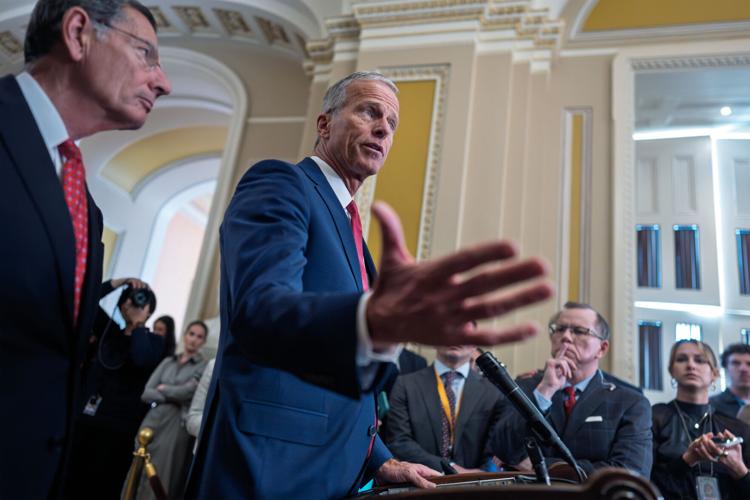
"Enough is enough," said Senate Majority Leader John Thune, R-S.D., as he opened the deadlocked chamber.

Senate Majority Leader John Thune, R-S.D., joined at left by Sen. John Barrasso, R-Wyo., talks with reporters Tuesday at the Capitol in Washington.
Day 35 of the federal government shutdown tied the record for the longest; that will be broken Wednesday.
SNAP benefits were interrupted for millions of Americans who depend on federal food aid and hundreds of thousands of federal employees were furloughed or are working without pay.
Transportation Secretary Sean Duffy predicted there could be chaos in the skies next week if air traffic controllers miss another paycheck. Labor unions put pressure on lawmakers to reopen the government.
President Donald Trump stayed largely on the sidelines, refusing to negotiate over the demands for health care funds until government reopens, and Democrats are wary of making any deal with Republicans unless it has approval from the White House.

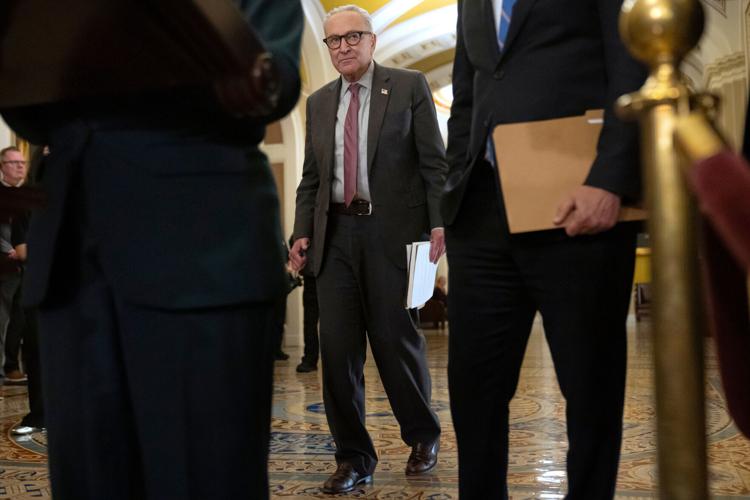
Senate Minority Leader Chuck Schumer, D-N.Y., stands as his Senate colleagues speak with reporters Tuesday on Capitol Hill in Washington.
Democratic senators emerged stone-faced from a two-hour discussion at the Capitol.
"We're exploring all the options," Senate Democratic Leader Chuck Schumer said afterward.
Trump abruptly invited senators from his own Republican Party for a private breakfast meeting Wednesday.
Another test vote Tuesday in the Senate failed as Democrats rejected a temporary government funding bill.
"These people are worth fighting for," said Sen. Chris Murphy, D-Conn., about those experiencing rising health care costs.
Unlike the shutdown during Trump's first term, when he fought Congress in 2018-19 for funds to build the U.S.-Mexico border wall, the president has been relatively quiet.

Volunteers fill food boxes Tuesday at Second Harvest Food Bank in Nashville, Tenn.
Trump threatens food aid
On Tuesday, Trump issued a fresh threat, warning he would halt food aid under the Supplemental Nutrition Assistance Program unless Democrats agree to reopen the government.
SNAP benefits "will be given only when the Radical Left Democrats open up government, which they can easily do, and not before!" Trump said on social media.
Two judges on Friday ordered the administration to release the SNAP contingency funds.
White House press secretary Karoline Leavitt claimed later that the administration continues to pay out SNAP funding in line with court orders.
But Democrats in the House and the Senate warned that Trump cannot be trusted to follow the law or keep his word.
"What message do you think it means when the president says, 'I'm not going to release those funds'?" Rep. Debbie Dingell, D-Mich., asked. Democrats demanded the House reopen for negotiations.

Birds fly around the Capitol dome Tuesday in Washington.
Potential deal
Central to any endgame will be a series of agreements that would need to be upheld not only by the Senate, but also the House, and the White House, which is not at all certain in Washington where Republicans have full control of the government.
First of all, senators from both parties, particularly the powerful members of the Appropriations Committee, are pushing to ensure the normal government funding process can be put back on track.
Sen. Susan Collins, R-Maine, the chair of the Senate Appropriations Committee, and Sen. Mike Rounds, R-S.D., along with several Democrats, including Sens. Jeanne Shaheen and Maggie Hassan of New Hampshire and Chris Coons of Delaware, are among those working behind the scenes.
"The pace of talks have increased," said Sen. Gary Peters, D-Mich., who has been involved in conversations.
Among the goals is guaranteeing upcoming votes on a smaller package of bills where there is already widespread bipartisan agreement to fund various aspects of governments, like agricultural programs and military construction projects at bases.
"I certainly think that that three-bill package is primed to do a lot of good things for the American people," said Sen. Katie Britt, R-Ala., who has also been in talks.
More difficult, a substantial number of senators also want some resolution to the standoff over the funding for the Affordable Care Act subsidies that are set to expire at year's end.

President Donald Trump speaks to reporters Sunday aboard Air Force One on his way back to the White House from a weekend trip at his Mar-a-Lago estate in Palm Beach, Fla.
White House
The White House says its position remains unchanged and that Democrats must vote to fund the government until talks over health care can begin.
With insurance premium notices being sent, millions of Americans are experiencing sticker shock on skyrocketing prices. The loss of federal subsidies, which come in the form of tax credits, are expected to leave many people unable to buy health insurance.
Republicans are reluctant to fund the health care program, also known as Obamacare. Thune promised Democrats a future vote on their preferred proposal as part of any deal to reopen government.
That's not enough for some senators, who see the health care deadlock as part of their broader concerns with Trump's direction for the country.
“Trump is a schoolyard bully,” said Sen. Bernie Sanders, the Independent from Vermont, in an op-ed. “Anyone who thinks surrendering to him now will lead to better outcomes and cooperation in the future does not understand how a power-hungry demagogue operates.”
With the Senate, which is split 53-47, having tried and failed more than a dozen times to advance the House-passed bill over a filibuster by Democrats, that measure is out of date. It would have funded government to Nov. 21.
Trump has demanded senators nuke the filibuster, the Senate rule that requires a 60-vote threshold to advance most legislation, which preserves minority rights in the chamber. GOP senators panned that demand.

