


Since the Nov. 26 shooting of two National Guard members in the nation's capital by a suspect who is an Afghan national, the Trump administration announced a flurry of policies aimed at making it harder for some foreigners to enter or stay in the country.
The administration said it was pausing asylum decisions, reexamining green card applications for people from countries "of concern" and halting visas for Afghans who assisted the U.S. war effort.
The stepped up effort to restrict immigration has been harshly criticized by refugee advocates and those who work with Afghans, saying it amounts to collective punishment. Critics are also saying it is a waste of government resources to reopen cases that have already been processed.

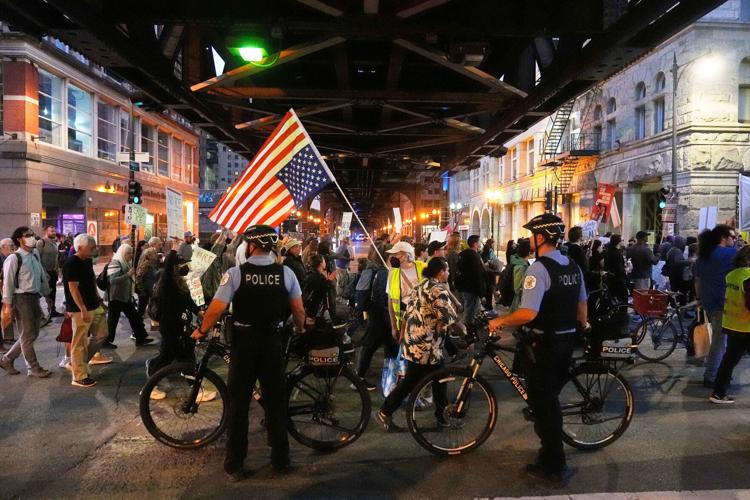
Police officers block a street as demonstrators march at a protest opposing "Operation Midway Blitz" and the presence of ICE, Sept. 9, in Chicago.
The Trump administration says the new policies are necessary to ensure that those entering the country — or are already here — do not pose a security threat.
Here's a look at the major changes announced over roughly a week:
All asylum decisions suspended

Director of U.S. Citizenship and Immigration Services Joseph Edlow says the agency is conducting a "full scale, rigorous reexamination" of green-card holders from countries "of concern."
Director of U.S. Citizenship and Immigration Services Joseph Edlow said on the social platform X that asylum decisions will be paused "until we can ensure that every alien is vetted and screened to the maximum degree possible."
Besides the post, no formal guidance has been put forward, so details remain scarce about the planned pause.
People seeking asylum must show to U.S. officials a threat of persecution if they were sent back to their home country. If they're granted asylum, they're allowed to stay in the U.S. and eventually apply for a green card and then citizenship.
The Afghan suspect in the National Guard shooting was granted asylum earlier this year, according to advocate group #AfghanEvac.

The right to apply for asylum was already restricted by the Trump administration. In January, President Donald Trump issued an executive order essentially halting asylum for people who came into the country through the southern border. Those cases generally go through immigration courts which are overseen by the Justice Department.
USCIS oversees the asylum process for foreigners the government isn't trying to remove via immigration courts. While Trump's January order didn't affect those cases, Edlow's social media post suggests they will now come under additional scrutiny.
Caseloads have been rising for asylum applications. USCIS said there are currently 1.4 million pending asylum cases at the agency. In 2022, it was 241,280, according to the Office of Homeland Security Statistics. Separately there are about 2.4 million pending asylum applications in front of the Justice Department's immigration courts.
A focus on countries 'of concern'
On Nov. 27, Edlow said his agency was conducting a "full scale, rigorous reexamination" of every green card for people he said come from "every country of concern."
"American safety is non negotiable," Edlow said.
The agency said in a press release that same day that it was issuing new guidance that could make it tougher for people from 19 countries the administration considers "high-risk," including Afghanistan, when they apply for green cards or to stay in the U.S. longer.
The administration already banned travel to the U.S. for citizens from 12 of those countries and restricted access for people from seven others.
No visas for Afghans
On Nov. 26, USCIS said it would be suspending all "immigration requests relating to Afghan nationals." That would affect Afghans already living in the U.S. who are applying for green cards or work permits or permission to bring family members to the U.S.
Separately, Secretary of State Marco Rubio announced late Nov. 28 on X that the State Department temporarily stopped issuing visas for people traveling on Afghan passports.
The Trump administration already severely limited travel and immigration from Afghanistan. The one avenue that had remained open was the Special Immigrant Visa program. Created by Congress, it allowed Afghans who closely supported the U.S. war effort in Afghanistan and faced retribution because of their work to emigrate to America.
According to #AfghanEvac, about 180,000 Afghans were in the process of applying for the SIV program.
Reviewing other refugees
Even before the shooting of two National Guard members, the Trump administration was planning a sweeping review of tens of thousands of immigrants who entered the U.S. during the Biden administration as part of the U.S. Refugee Assistance Program.
That program, first launched in 1980, oversees the process by which people fleeing persecution can come to the U.S. Refugees are distinct from people seeking asylum. They apply and wait outside the U.S. to be admitted while asylum-seekers do so once they reach the U.S.
Trump suspended the refugee program the day he took office and only a trickle of refugees have been admitted since.
On Nov. 21, Edlow said in a memo obtained by The Associated Press that the administration was going to review all refugees admitted to the U.S. during the Biden administration — nearly 200,000 refugees.
Advocates say refugees already undergo rigorous vetting.

Noem hints at updated travel ban
Homeland Security Secretary Kristi Noem suggested in a Dec. 1 post on X that more changes could be in the offing.
Noting that she had just met with Trump, Noem said she was recommending a "full travel ban" on countries she said were flooding the U.S. "with killers, leeches and entitlement junkies."
Noem did not specifically name any countries and no timeline was given. The Department of Homeland Security said in an email, "We will be announcing the list soon."

