


WASHINGTON — The Senate's first weekend session since the beginning of the shutdown yielded few signs of progress Saturday as Senate Majority Leader John Thune's wish for a quick vote never materialized.
The impasse that lasted 39 days is taking an increasing toll on the country as federal workers go unpaid and food aid benefits were delayed for millions of Americans.

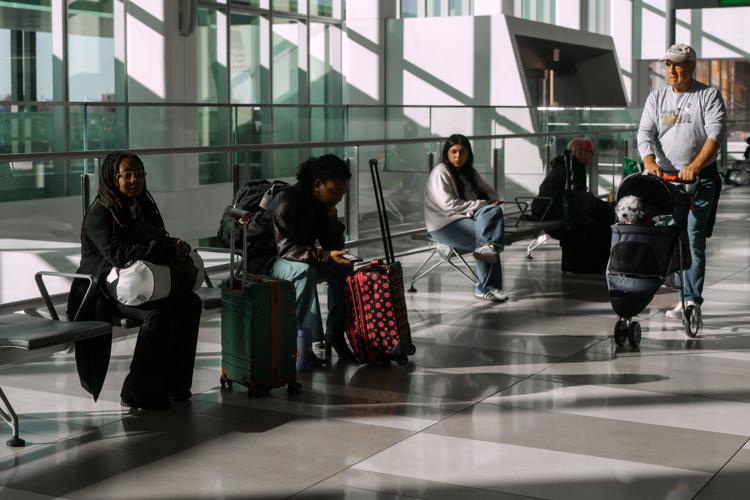
Travelers wait Saturday at LaGuardia International Airport in New York.
A shutdown slowdown at 40 of the nation’s busiest airports was in its second day, as U.S. airlines again canceled more than 1,000 flights after the Federal Aviation Administration’s order to reduce air traffic. More than 1,000 flights also were canceled the prior day, according to FlightAware, a website that tracks air travel disruptions.
Friday night, Supreme Court Justice Ketanji Brown Jackson temporarily paused a judicial order that demanded the Trump administration fully fund the Supplemental Nutrition Assistance Program during the shutdown, to allow time for an appeals court to decide whether to issue a more lasting halt.
The high court's order didn't stop payment distribution in at least some states, where hundreds of thousands of recipients are now able to buy food for their families. However, millions more people who depend on SNAP are still in limbo. The program serves 1 in 8 Americans.

Saturday's session got off to a rough start when President Donald Trump made clear he is unlikely to compromise any time soon with Democrats who seek a one-year extension of Affordable Care Act tax credits. He said on social media that it is "the worst Healthcare anywhere in the world" and suggested Congress send money directly to people to buy insurance.
Thune said Trump's proposal would not be part of a solution to ending the shutdown, but added "it is a discussion that the president and all of us want to have." Republican senators who spoke on the Senate floor Saturday generally echoed Trump's assessment.

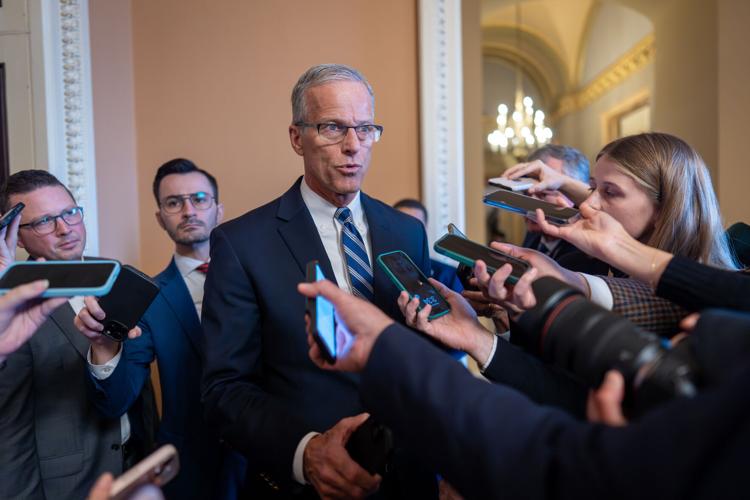
Speaking to reporters, Senate Majority Leader John Thune, R-S.D., responds Friday to Senate Democratic Leader Chuck Schumer's offer to reopen the government if Republicans extend expiring health care subsidies for one year, at the Capitol in Washington.
"I guarantee you every day we keep this system in place is a great day for the health care insurance companies who have been making out literally like bandits every day under Obamacare," said Sen. Lindsey Graham, R-S.C.
Sen. Ron Wyden, D-Ore., said he welcomed Republicans to the fight when it came to insurance companies, "but that shouldn't come at the cost of kicking millions off of their health care in January."
Senate Republican leaders signaled an openness to an emerging proposal from a small group of moderate Democrats to end the shutdown in exchange for a later vote on the "Obamacare" subsidies, which make coverage more affordable. For those enrolled in Affordable Care Act exchanges, premiums on average are expected to more than double next year if Congress allows the enhanced subsidies to lapse.
Sen. Jeanne Shaheen, D-N.H., who is leading the talks among moderates, said Friday evening that Democrats "need another path forward" after Republicans rejected an offer from Democratic leader Chuck Schumer of New York to reopen the government and extend the subsidies for a year. "We're working on it," she said.
Moderates continue to negotiate
Shaheen and others, negotiating among themselves and with some rank-and-file Republicans, have discussed bills that would pay for parts of the government — food aid, veterans programs and the legislative branch, among other things — and extend funding for everything else until December or January. The agreement would only come with the promise of a future health care vote, rather than a guarantee of extended subsidies.
It was unclear whether enough Democrats would support such a plan. Even with a deal, Trump appears unlikely to support an extension of the health benefits. House Speaker Mike Johnson, R-La., also said this past week that he would not commit to a health vote.
Republican leaders only need five additional votes to fund the government, and the group involved in the talks ranged from 10 to 12 Democratic senators.
Some Republicans said they are open to extending the COVID-19-era tax credits as premiums could skyrocket for millions of people, but they want new limits on who can receive the subsidies. They lined up Saturday to take to the Senate floor and argue that subsidies for the plans should be routed through individuals.
"We're going to replace this broken system with something that is actually better for the consumer," Graham said.

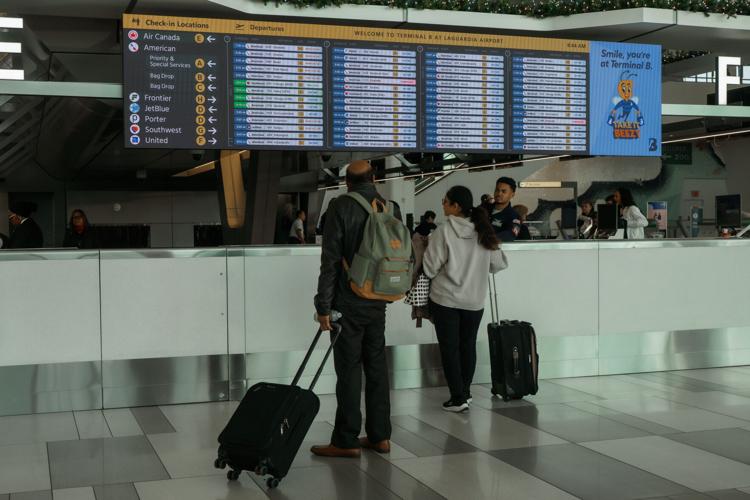
Travelers check the flight schedule Saturday at LaGuardia International Airport in New York.
Republicans eye new package of bills

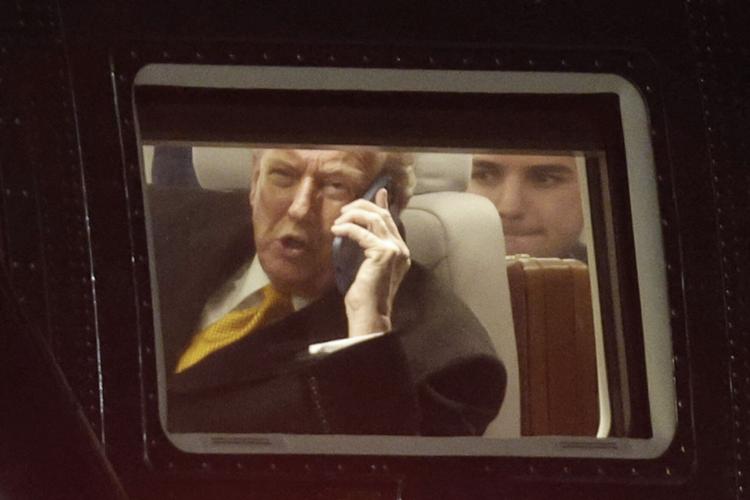
President Donald Trump talks on his phone in Marine One upon his arrival Friday at Joint Base Andrews, Md., while en route to his Mar-a-Lago estate in Palm Beach, Fla.
Trump wants Republicans to end the shutdown quickly and scrap the filibuster, which requires 60 Senate votes for most legislation, so they can bypass Democrats. Vice President JD Vance, a former Ohio senator, endorsed the idea in an online post Saturday, saying Republicans who want to keep the filibuster are "wrong."
Republicans rejected Trump's call, and Thune is eyeing a bipartisan package that mirrors the proposal the moderate Democrats have been sketching out. What Thune, who refused to negotiate, might promise on health care is unknown.
The package would replace the House-passed legislation that the Democrats rejected 14 times since the shutdown began Oct. 1. The current bill would only extend government funding until Nov. 21.
A test vote on new legislation could come in the next few days if Thune decides to move forward.
Schumer continued to argue Saturday that Republicans should accept a one-year extension of the subsidies before negotiating the future of the tax credits.
"Doing nothing is derelict because people will go bankrupt, people will lose insurance, people will get sicker," he said in a floor speech. "That's what will happen if this Congress fails to act."
Monthlong government shutdown in photos: Disruptions, delays and divisions

Volunteer Betty McNeely, right, helps a man bag food items Oct. 28 at Project Feed, an emergency food pantry in Portland, Maine. With no endgame in sight, the U.S. government shutdown is expected to roll on for the unforeseeable future, injecting more uncertainty into an already precarious economy.

Brock Brooks, a disable Marine Corps veteran, cries Oct. 30 while describing the impending SNAP shutdowns while waiting in line to enter the food pantry service at Calvary Episcopal Church in Louisville, Ky. Funding for the Supplemental Nutrition Assistance Program, or SNAP, lapsed Saturday.

Volunteers prepare emergency food packages Oct. 28 at the Tarrant Area Food Bank in Fort Worth, Texas.

Tammy Norton, a furloughed federal employee of 16 years who currently works for the Internal Revenue Service, reacts with emotion Oct. 28 as she talks about running through her limited savings to support her family during the government shutdown, at a food distribution center for federal employees affected by the government shutdown in Dania Beach, Fla. The monthlong government shutdown halted routine federal operations, furloughed about 750,000 federal employees and left others working without pay.

Volunteer Joel Hernandez helps load a vehicle Oct. 27 during a food distribution targeting federal employee households affected by the federal shutdown as well as SNAP recipients in San Antonio.

A food and supplies bank is set up Oct. 17 at Harry Reid International Airport in Las Vegas, Nv.

House Minority Leader Hakeem Jeffries, D-N.Y., disputes a reporter's question Oct. 24 as he enters his office at the Capitol in Washington on day 24 of the government shutdown.

The Capitol is seen at nightfall Oct. 22, day 22 of a government shutdown, in Washington.

Sen. John Barrasso, R-Wyo., the Senate GOP whip, left, and Speaker of the House Mike Johnson, R-La., arrive for a news conference with top Republicans on the government shutdown Oct. 1 at the Capitol in Washington.

Air Traffic Controllers stand Oct. 28 outside Detroit Metropolitan Wayne County Airport in Romulus, Mich., distributing leaflets explaining how the federal government shutdown is affecting air travel. Airports have been scrambling with flight disruptions.

Travelers sit together and wait Oct. 2 at the Baltimore/Washington International Thurgood Marshall Airport in Baltimore.

TSA agent Sashene McLean, holding her 1-year-old daughter, comes from work to collect a donation of produce, meat and yogurt Oct. 28 at a food distribution center in Dania Beach, Fla., organized to assist federal employees missing paychecks during the government shutdown.

Senate Majority Leader John Thune, R-S.D., speaks to reporters Sept. 30 at the U.S. Capitol in Washington as the U.S. government was on the brink of the first federal government shutdown in almost seven years.

Speaker of the House Mike Johnson, R-La., and GOP leaders, from left, Rep. Lisa McClain, R-Mich., and Majority Whip Tom Emmer, R-Minn., blame the government shutdown on Democrats during an Oct. 2 news conference at the Capitol in Washington. Americans, meanwhile, are divided on who’s to blame.

Senate Minority Leader Chuck Schumer, D-N.Y., attends a Sept. 30 news conference about the government shutdown on Capitol Hill in Washington. Democrats seek an extension of expiring tax credits that helped millions of people afford health insurance, while Republicans say they won’t negotiate until the government is reopened.

