


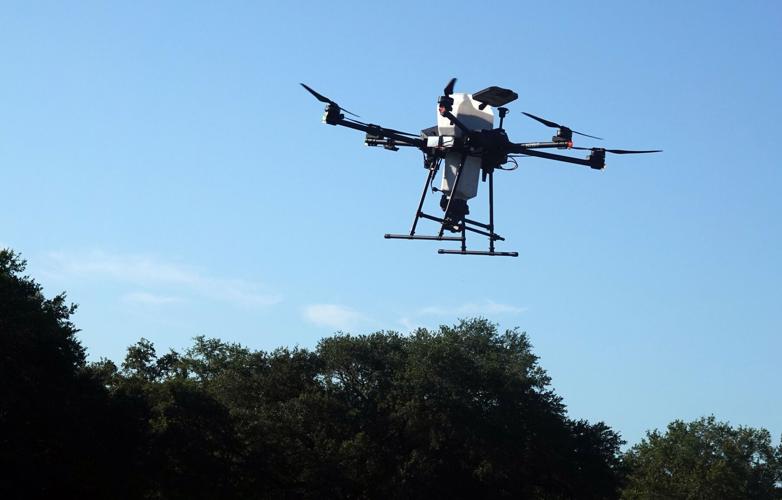
FORT LAUDERDALE, Fla. — From vast parks to wetlands to conservation areas, Broward County is now using a drone to spray for mosquitoes in hard-to-reach places.
The drone hits the air with a payload of about 15 pounds of spray, enough to cover 3 acres at a time. “It’s a huge difference,” says Cody Cash, an employee for Daytona Beach-based Leading Edge Aerial Technologies, which rents Broward the drone.

A drone flying for Broward County mosquito control is seen June 4 at Tree Tops Park in Davie, Fla.
Until now, crews could spend days covering a single territory that’s inaccessible by truck, wading in mud, armed with a machete to get past bushy trees.
“These poor guys who have to go in there,” lamented Anh Ton, director of Broward’s Highway & Bridge Maintenance Division, part of the county’s Public Works Department, which oversees mosquito control.
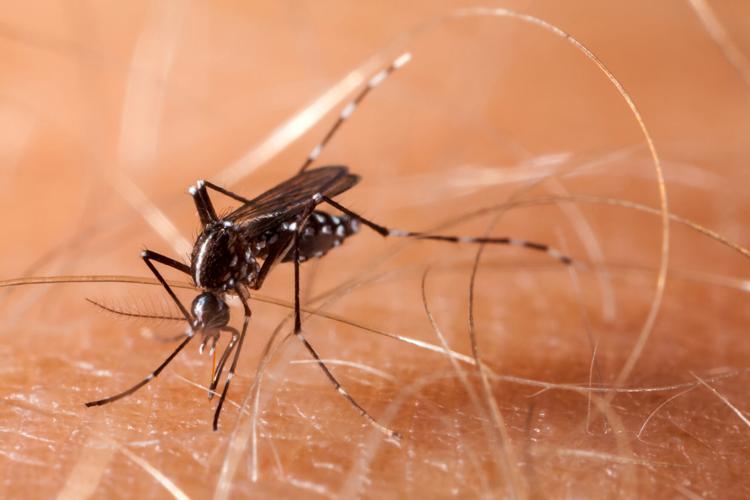
Now, the drone is traveling to where the breed of mosquitoes called Aedes (a Greek word that means unpleasant) aegypti lay their eggs. It’s the predominant type of mosquito in South Florida and a vector of several viruses, including yellow fever virus, dengue virus, chikungunya and Zika virus.

The U.S. Centers for Disease Control and Prevention call mosquitoes the “world’s deadliest animal” because the diseases they transmit are responsible for more than 700,000 deaths worldwide every year.
In 2024, there have been seven cases of locally acquired dengue; one case was in Pasco County and the other six in Miami-Dade, according to the Florida Department of Health’s most recent weekly report.
Broward County started using drones more than two years ago for surveillance only, to pinpoint where the spraying needed to happen, Ton said. County engineers experimented with mosquito traps and vacant parkland and dropped spray from the sky. “We had been thinking about this for quite awhile,” Ton said.
The pilot worked with a “significant reduction after the drone” strike. But in 2023, the drone use went beyond surveillance to begin spraying.
The county rents the spraying-abled drone for about $3,000 a month.
The drones are a good middle ground between people on land and using helicopters and planes — both of which are invasive in neighborhoods.
His company has more than 15 clients in Florida and California, and serves dozens more for small-scale herbicide operations.
He recently helped with a mission over a section of Tree Tops Park in Davie. About 100 acres could be treated in four hours by drone, Cash said, versus a “guy would be out there for two to four days depending on wetness level.”
A drone can fly for about three minutes — it’s path plotted with the surveillance drone — and then returns, the battery switched, the product reloaded, and “off it goes again,” Ton said.
The county is targeting standing water, which is the breeding ground for the mosquitoes.
The use of the drone has been one of the most recent ways to battle the mosquitoes.
County engineers unveiled an invention last year: a 3,000-pound system to reduce liquid mosquito larvicide spray into particles to reach the “perfect droplet size” to help them go farther.
The county previously spent about $7 million over a June-to-October mosquito season to spray countywide, since the mosquito needs water to breed and multiply. That new machine, carried on a truck, cuts that cost in half, although the season has been extended from April to November in the past decade, as temperatures rise and mosquito reproduction increases.
Ton said the cases of mosquito-created dengue in Miami-Dade worry him.
“We know it’s coming and we know it’s coming our way and the best way to prevent dengue is to reduce the mosquito population.”
The truth about mosquitoes — and what you may be doing wrong
Is it really a bad year for mosquitoes?
Updated
"For lot of people, it feels like this year is a lot worse," Carlson said, who says on average the levels are similar to those seen in 2019 and 2020. "Last year, there were almost no mosquitoes for pretty much the duration of the entire summer because of the drought."
That said, some areas are experiencing above-average mosquito populations this year because of heavier rain or higher water levels, he added. So if you live in a part of the state that has been wetter than usual, it could be that the mosquitoes are indeed back with a vengeance.
Is my suffering worse than yours?
Updated
My dad used to console me by saying mosquitoes couldn't resist my "sweet blood." Carlson says people like me have "won the genetic lottery." Fact is, some people are more attractive to mosquitoes because of their underlying biology — the amounts of carbon dioxide they emit or the natural scents they carry, for example.
Some of it can be activity-based, Aliota adds. If you're huffing and puffing on a strenuous hike, you might feel them coming for you. Potential bummer alert for your July 4th gathering: Alcohol consumption can also stimulate mosquito attraction.
They also detect us by body heat. So if your body temperature naturally runs warmer than the average person, consider yourself desirable.
"That's why if you're ever around a pregnant woman in the summertime, she tends to get more mosquito bites than anybody else," Carlson said.
So the solution is clear: Invite a pregnant friend to your barbecue.
What works?
Updated
If you're just sitting in the backyard or are hosting a patio get-together, one of the most effective things you can do is plug in an oscillating fan to keep the air moving, Aliota said. The wind can help keep mosquitoes from finding you and your guests.
And don't forget the bug spray. "I am a strong believer of using DEET," said Aliota, though for kids he recommends using a spray with picaridin.
Permethrin is another treatment that can be applied directly to clothing and gear rather than directly to the skin. Before sending my kid to a weeklong camp in the woods, I sprayed his socks, pants, shoes and shirts to keep him a little safer from mosquitoes and ticks.
To provide a spatial repellent to cover an outdoor area such as a deck or patio, both Aliota and Carlson said they were intrigued by Thermacell, which diffuses a synthetic version of a substance found in chrysanthemum flowers. "I've seen some evidence that suggests they work pretty well," Aliota said. "I was actually looking to buy some."
Should I eat garlic?
Updated
"I think you'd have to eat a lot of garlic to have any kind of repellent effect," Aliota said.
Same goes for those citronella candles — or planting citronella, said Carlson. "Your yard has to be entirely made out of citronella plants for it to have any impact."
What about mosquito traps?
Updated
These gadgets promise to lure mosquitoes by mimicking human breath and then killing them by drowning, electrocution or other means. Some have been studied and shown to be effective, but Carlson recommends staying away from these products because they may invite even more mosquitoes to your area and won't succeed in killing them all.
He also advises that people use caution when purchasing foggers that can be applied to your yard. These products can knock down mosquitoes for a number of hours, but may kill more than mosquitoes — such as pollinators and other insects beneficial to the environment. Consider hiring a licensed professional who is trained to apply proper dosages.
Choose wardrobe items wisely
Updated
Trust me, black leggings will only invite an attack on your posterior. A mosquito is drawn to dark clothing, and stretchy, tight fabric will not prevent its long proboscis from piercing your skin. Best to opt for a lighter color, as well. Remember the three L's, Carlson advises: "Light, loose and long sleeves."
Kathy Beadle, a field operations supervisor with the Metropolitan Mosquito Control District, checked for floodwater mosquito larvae.
Silver linings
Updated
Sometimes it's easy to lose sight of the fact that in other parts of the world, "mosquitoes are Public Health Enemy No. 1," said Aliota.
Even in the Midwest, cases of West Nile Virus pop up every summer. But our cold winters are good for something, he adds. The species that transmit the pathogens that cause dengue or Zika virus aren't established in our state.
What's the 2022 mosquito forecast?
Updated
"Predicting what the rest of the summer is going to be like for mosquitoes is essentially like predicting the weather," Aliota said. "It's somewhat unreliable, and it can vary depending on the mosquito species."
Although more than 50 mosquito species are found in the Midwest, the ones that are most likely biting you in your yard are aedes vexans. They lay their eggs in tree holes or other containers that collect water and thrive when there are intermittent thunderstorms. This species is the most likely to peak at this time of year.

