


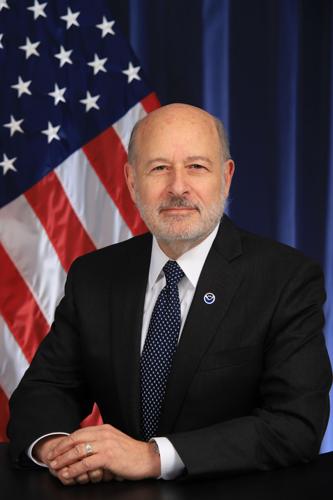
From protection fish stocks to discovery of new medicines, NOAA Administrator and oceanographer Rick Spinrad talks about the importance of the oceans.

Spinrad
If 2023 becomes the hottest year on record globally, it will be because of the oceans. The much warmer water in the Atlantic Ocean this summer, combined with the periodic warming of the central and eastern Pacific — known as El Niño — have sent ocean temperatures to levels unprecedented in human civilization.
For people living hundreds of miles from the coastline, the oceans may be out of sight and out of mind. But as they cover 70 percent of Earth’s surface, what happens in the oceans is significant.
Rick Spinrad, an oceanographer and current Administrator of NOAA — the National Oceanic and Atmospheric Administration — emphasizes some foundational principles that connect oceanography and meteorology.
“The weather patterns are affected by how energy and heat are distributed by the ocean. The moisture, the winds, the temperatures are all controlled by ocean processes, ” Spinrad said.
At a more fundamental level, every other breath you take is from the oceans.
“That’s the rule of thumb,” he said. “There’s a large volume of phytoplankton — the plants of the sea — that basically absorb carbon dioxide and put oxygen back into the atmosphere.”
Satellite instruments reveal the yearly cycle of plant life on the land and in the water. On land, the images represent the density of plant growth.
Reviewing the data through time reveals the annual cycle, as the seasons are reversed between the northern and southern hemispheres.
“If you look at the satellite images, you can see the Earth basically breathing — the pulsing between the northern and southern hemispheres,” Spinrad said.
NOAA’s most visible agency is the National Weather Service, but the National Ocean Service continues to explore the deep, as new discoveries continue to yield benefits for those of us back on land.
Compounds in a specific type of cone snail have been effective in treating nerve pain. Substances in a Caribbean sponge have yielded the first marine cancer drug developed to treat leukemia and lymphoma. Materials within a deep ocean sponge have been used to treat breast cancer.
He is energized to find out what else might be out there.
“By some estimates, there are as many as one million species of organisms in the sea that are still as yet undiscovered,” Spinrad said.
Coral bleaching and sea level rise are among the most visible impacts of the warming climate, but NOAA is also working to understand how fish and other sea life is adapting. Or more realistically, relocating.

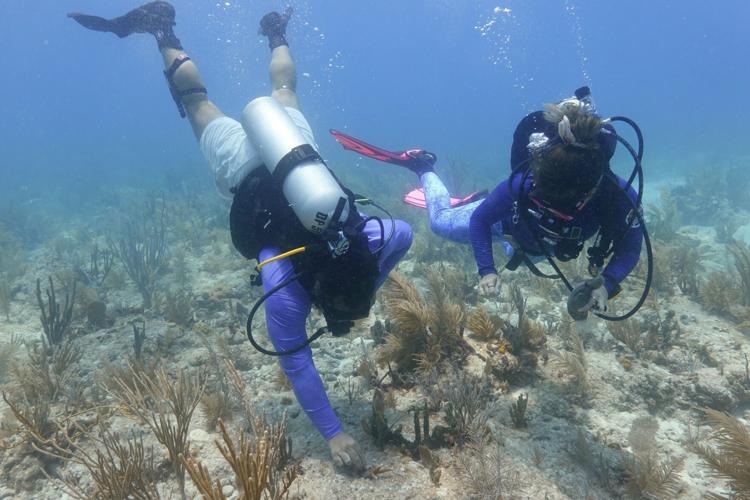
Divers cement coral fragments from a coral nursery into the reef Aug. 4 near Key Biscayne, Fla. Ocean researchers said coral reefs were losing their color weeks earlier than normal because of record ocean temperatures.
“I was in Nome, Alaska last year, where they’re no longer seeing as many salmon and pollock and crab. Now they’re starting to get Pacific Cod — where they’ve never seen Pacific Cod before,” Spinrad said.
New technologies have allowed NOAA to help identify and track fish populations so they can sustainably be accessed for commercial and recreational fishing.
Spinrad is impressed with the new techniques.
“The ability to sample water — and know what was in that water over the last 12 hours by the DNA that is left in the water — from the skin cells and other materials that fish leave in the water — phenomenal," he said. "We know that many of the species: the pollock, the haddock, the salmon are moving into different waters. We will be able to predict where those stocks will be in the next five years, 10 years, 20 years.”

Spinrad emphasized the need to protect the waters so the fish will be around for generations, discussing what it means for a recreational fisherman: “We call it maximum sustainable yield — our ability to understand how many fish are there, where are they, and how can we ensure that he can catch the fish he wants, but there will be plenty in the sea for his kids, grandkids to catch in the future.”
Although most of NOAA’s work is done to prepare and adapt to the warming climate, the agency works to ensure that marine life is minimally impacted as renewable energy sources — such as offshore wind turbines — are built and commissioned.
“We are required by law via the Marine Mammal Protection Act and the Endangered Species Act to ensure there is no harm done,” he said.
Spinrad is keenly aware of the movement of the North Atlantic Right Whales and an offshore wind farm being developed 27 miles off the coast of Virginia Beach.
“None of the activities associated with offshore wind development are attributable to any of the impacts we are seeing on whales off the East Coast right now,” he said.
The work continues to understand and protect the oceans, especially in a time when they are changing rapidly.
Sean Sublette is the chief meteorologist for the Richmond Times-Dispatch in Virginia.
It's the podcast many of you have likely been waiting for, the 2023-2024 winter outlook! With fall leaves changing throughout the country and days getting shorter in a hurry, it's time to talk about what winter is looking like. Mostly mild or unusually cold? Mainly dry or extra snowy? And how will it vary across the country? Ken Elliott, Senior Meteorologist at WeatherWorks, Inc in New Jersey, breaks down what to expect in the Northeast (21:28), Southeast (25:23), Midwest (29:55) and West (35:17). Plus, he offers his thoughts on whether parts of the country will see a White Christmas. We want to hear from you! Have a question for the meteorologists? Call 609-272-7099 and leave a message. You might hear your question and get an answer on a future episode! You can also email questions or comments to podcasts@lee.net. About the Across the Sky podcast The weekly weather podcast is hosted on a rotation by the Lee Weather team: Matt Holiner of Lee Enterprises' Midwest group in Chicago, Kirsten Lang of the Tulsa World in Oklahoma, Joe Martucci of the Press of Atlantic City, N.J., and Sean Sublette of the Richmond Times-Dispatch in Virginia.
Photos: Record-breaking heat scorches communities around the world

A man rides a bike on a small road on the outskirts of Frankfurt, Germany, as the sun rises on Friday, July 7, 2023. (AP Photo/Michael Probst)

The San Antonio Fire spreads uphill west of Petaluma, Ca., Friday, June 30, 2023. California is in the middle of a heat wave during the long Fourth of July weekend. (Kent Porter/The Press Democrat via AP)

A man does a flip while cooling off in the Dnieper River in Kyiv, Ukraine, Thursday, July 6, 2023. The planet's temperature spiked on Tuesday to its hottest day in decades and likely centuries. (AP Photo/Jae C. Hong)

Lucas Harrington, age 7, cools off in a mister at Kauffman Stadium as temperatures approach 100 degrees fahrenheit before a baseball game between the Kansas City Royals and the Cleveland Guardians, Wednesday, June 28, 2023, in Kansas City, Mo. (AP Photo/Charlie Riedel)

With the city skyline and Burj Khalifa, world's tallest building in background, people enjoy swimming in Dubai, United Arab Emirates, Wednesday, July 5, 2023. (AP Photo/Kamran Jebreili)

Tourists take shelter with umbrellas as another one enjoys an ice cream during a hot summer day at the Rome's Spanish Steps Thursday, July 6, 2023. (AP Photo/Alessandra Tarantino)

A security guard wearing an electric fan on his neck wipes his sweat on a hot day in Beijing, Monday, July 3, 2023. (AP Photo/Andy Wong, File)

A boy uses a national flag to shield from the sun as visitors line up to enter the Forbidden City on a sweltering day in Beijing, Friday, July 7, 2023. (AP Photo/Andy Wong)

Tourists sips cold water as they shelter from a hot sunny afternoon near the Rome's Colosseum, Wednesday, July 5, 2023. (AP Photo/Gregorio Borgia)

Zoologist Kris Marshall uses a water canon to help an elephant keep cool from the heat at the Dallas Zoo in Dallas, Friday, June 30, 2023. (AP Photo/LM Otero)

An Indian man stands at the door of his house as waves caused by high tide hits the huts on the shore of the Arabian Sea in Mumbai, India, Thursday, July 6, 2023. (AP Photo/Rafiq Maqbool)

A woman sprays her children with a water hose during a heat wave outside his home in the al Fadhil neighborhood in Baghdad, Iraq, Thursday, July, 6, 2023. (AP Photo/Hadi Mizban)

A man dives into the water from a platform at the Tranco reservoir near Beas de Segura, Jaen, in southern Spain, Thursday, July 6, 2023. (AP Photo/Paul White)

Youngster dive into the Bosphorus next to Karakoy ferry terminal on a hot summer day in Istanbul, Turkey, Thursday, July 6, 2023. (AP Photo/Francisco Seco)

A woman carries her dog through a water fountain on the Halifax waterfront in Halifax, Nova Scotia, Thursday, July 6, 2023. (Darren Calabrese/The Canadian Press via AP)

Los Angeles Dodgers third baseman Yonny Hernandez warms up before a baseball game against the Kansas City Royals Friday, June 30, 2023, in Kansas City, Mo. (AP Photo/Charlie Riedel)

Visitors wear sun hats and carry umbrellas as they leave the Forbidden City on a hot day in Beijing, Thursday, June 29, 2023. (AP Photo/Andy Wong)

Construction worker Fernando Padilla wipes his face as he works in the heat, Friday, June 30, 2023 in Nashville, Tenn. (AP Photo/George Walker IV)

A man uses an umbrella to shield him from the afternoon sun in Manila, Philippines on Thursday, July 6, 2023. (AP Photo/Aaron Favila)

People enjoy high tide waves on the Arabian Sea coast in Mumbai, India, Thursday, July 6, 2023.(AP Photo/Rajanish Kakade)

A Kashmiri man cools off at a stream on a hot summer day on the outskirts of Srinagar, Indian controlled Kashmir, Tuesday, July 4, 2023. (AP Photo/Mukhtar Khan)

A woman uses a fan to cool a child as they sit on a bench at Qianmen pedestrian shopping street on a hot day in Beijing, Thursday, June 29, 2023. (AP Photo/Andy Wong)

