


Since the invention of weather radar, anecdotes have swirled about how a thunderstorm changes as it approaches and moves across a city. The stories involve a storm suddenly splitting and reforming downwind of a city or, in a related way, suggest that a thunderstorm is producing more rain immediately downwind of a city.
These concepts have long been a source of interest to people studying mesoscale meteorology, which covers weather systems that are between a few miles to several dozen miles in size. These include sea breezes, tropical rain bands and thunderstorm complexes.

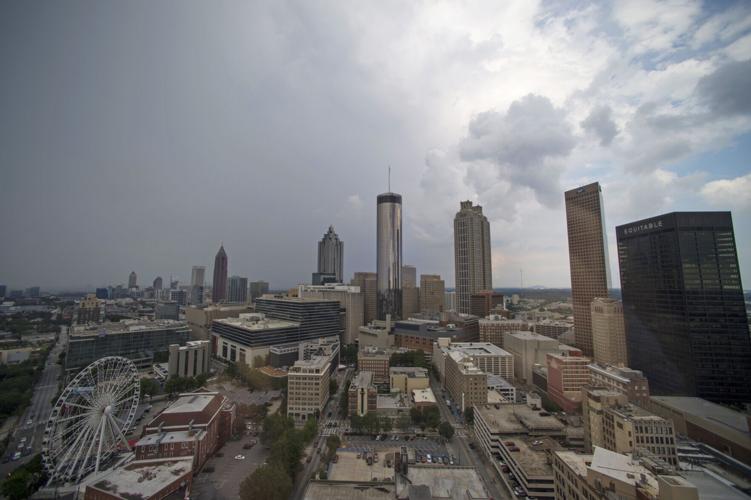
The Atlanta skyline is seen as thunderstorms move through July 24, 2017. Two scientists used Atlanta as their prototype city when studying the impact of urban areas on thunderstorms.
Gathering data to understand the behavior of storms at the mesoscale level has historically been challenging. For many years, the surface observation network, radars and satellite imagery were all too coarse to catch those smaller scale wind patterns and circulations.

But observation technologies are getting better, and computers are getting faster, allowing the scientific community to investigate these weather phenomena more closely. Using those tools at the University of Georgia, Marshall Shepherd and Jordan McLeod are among those looking for answers.

McLeod
Cities are hotter than the surrounding rural and suburban areas, as energy from the sun heats up asphalt, concrete and bricks much more than the trees, grasses and vegetation in those surrounding areas. As a result, a small-scale heat dome can develop over a city during the day, extending up to a mile above the ground. The localized hot spot affects wind patterns within a city and between the city and its surrounding areas.
Applying that understanding to their investigation, they found a particular set of circumstances that occasionally enhances summertime thunderstorm rainfall immediately downwind of a city: weak westerly winds about 10,000 feet above the ground, unusually humid air through a deep level of the atmosphere, and ground-level winds that are slightly converging. This enhancement is known as the urban rainfall effect.
The effect is not a dominant one, but it is perceptible. Using Atlanta as their prototype city, their analyses indicate that the urban rainfall effect is detectable in about 8 percent of the summer days they studied.
McLeod, now a meteorology instructor at the University of South Alabama, has done some preliminary studies around other large cities in the Southeast.

“We noticed a similar footprint, over and downwind of the metropolitan areas — an enhancement of convective rainfall during the summer season,” McLeod said.
For now, it appears that the impact is generally confined to the summer, when there are not many other large scale atmospheric motions to drive the weather.
“It kind of operates in the background. It’s not an overwhelming signal on most days — it kind of sneaks up on you,” McLeod said.

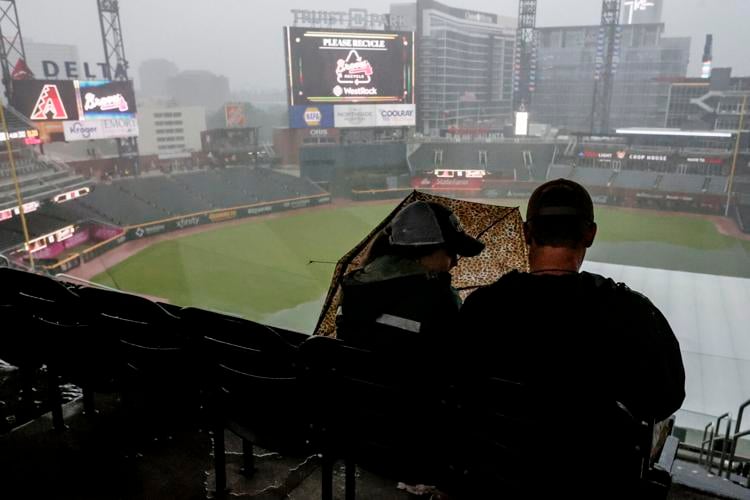
People sit out a thunderstorm before a baseball game between the Atlanta Braves and the Arizona Diamondbacks on July 30, 2022, in Atlanta.
The additional amount of rain from the urban rainfall effect is still difficult to quantify precisely, as the variability in the data signal is small. Nonetheless, it is significant and large enough to measure.
In addition to enhancing the rainfall downwind of storms, these conditions can also lead to thunderstorms originating right over a city or, in some cases, modify a storm as it approaches a city. There is increasing evidence that a storm can split — or at least weaken — as it approaches a city, although the precise reason why requires much more study.
“Sometimes, if the conditions are just right, a storm will split around the city and reform downwind. That’s another way we see amplifications of rainfall downwind of a city,” McLeod said.

Sean Sublette is the chief meteorologist for the Richmond Times-Dispatch in Virginia.
These dramatic before-and-after photos show how storms filled California's reservoirs

A car crosses Enterprise Bridge over Lake Oroville's dry banks on May 23, 2021, left, and the same location on March 26, 2023, in Butte County, Calif.
Read the full story at the end of the gallery.

Houseboats rest in a channel at Lake Oroville State Recreation Area on March 26, 2023, left, and the same location on Aug. 14, 2021, in Butte County, Calif.

A car crosses Enterprise Bridge over Lake Oroville on March 26, 2023, left, and the same location on May 23, 2021, in Butte County, Calif.

A dock floats in the Browns Ravine Cove area of Folsom Lake, March 26, 2023, left, and the same location on dry land on May 22, 2021, in Folsom, Calif.

Docks float in the Browns Ravine Cove area of Folsom Lake on March 26, 2023, left, and the same location on May 22, 2021, boat docks sit on dry land in Folsom, Calif., on May 22, 2021.

A trailer stands at a property that was scorched in the 2020 North Complex Fire above Lake Oroville on March 26, 2023, and the same location on May 23, 2021, in Oroville, Calif.

BEFORE: A vehicle is parked on a newly revealed piece of land due to receding waters at the drought-stricken Folsom Lake in Granite Bay, Calif., on Saturday, May 22, 2021.

AFTER: In an aerial view, a boat floats in the Granite Bay area of Folsom Lake, in Granite Bay, Calif., on Sunday, March 26, 2023.

BEFORE: A boat crosses Lake Oroville below trees scorched in the 2020 North Complex Fire on May 23, 2021, in Oroville, Calif.

AFTER: A boat crosses Lake Oroville on Sunday, March 26, 2023, in Butte County, Calif.

BEFORE: Dry hillsides surround Lake Oroville on May 22, 2021, in Oroville, Calif.

AFTER: The Oroville Dam, top right, holds back water at Lake Oroville on Saturday, March 25, 2023, in Butte County, Calif.

BEFORE: Houseboats float on Lake Oroville on Oct. 25, 2021, in Oroville, Calif.

AFTER: Houseboats float near Lake Oroville's Bidwell Bar Bridge at on Sunday, March 26 2023, in Butte County, Calif.

BEFORE: Empty boat dock sit on dry land at the Browns Ravine Cove area of drought-stricken Folsom Lake in Folsom, Calif., on May 22, 2021.

AFTER: A sign stands in the Browns Ravine Cove area of Folsom Lake, in Folsom, Calif., on Sunday, March 26, 2023.

BEFORE: Houseboats rest in a channel at Lake Oroville State Recreation Area in Butte County, Calif., on Aug. 14, 2021. Months of winter storms have replenished California's key reservoirs after three years of punishing drought.

AFTER: Houseboats float at Lake Oroville State Recreation Area on Sunday, March 26, 2023, in Butte County, Calif. Months of winter storms have replenished California's key reservoirs after three years of punishing drought.

BEFORE: A car crosses Enterprise Bridge over Lake Oroville's dry banks on May 23, 2021, in Oroville, Calif. Months of winter storms have replenished California's key reservoirs after three years of punishing drought.

AFTER: A car crosses Enterprise Bridge over Lake Oroville on Sunday, March 26, 2023, in Butte County, Calif. Months of winter storms have replenished California's key reservoirs after three years of punishing drought.

BEFORE: Boat docks sit on dry land at the Browns Ravine Cove area of drought-stricken Folsom Lake, in Folsom, Calif., on May 22, 2021. Months of winter storms have replenished California's key reservoirs after three years of punishing drought.

AFTER: Docks float in the Browns Ravine Cove area of Folsom Lake in Folsom, Calif., on Sunday, March 26, 2023. Months of winter storms have replenished California's key reservoirs after three years of punishing drought.

BEFORE: A car crosses Enterprise Bridge over Lake Oroville's dry banks on May 23, 2021, in Oroville, Calif.

AFTER: A car crosses Enterprise Bridge over Lake Oroville on Sunday, March 26, 2023, in Butte County, Calif.

BEFORE: An empty boat dock sits on dry land at the Browns Ravine Cove area of drought-stricken Folsom Lake, in Folsom, Calif., on May 22, 2021.

AFTER: A dock floats in the Browns Ravine Cove area of Folsom Lake in Folsom, Calif., on Sunday, March 26, 2023.

BEFORE: People walk near boat docks as they sit on dry land at the Browns Ravine Cove area of drought-stricken Folsom Lake in Folsom, Calif., on May 22, 2021.

AFTER: Docks float in the Browns Ravine Cove area of Folsom Lake in Folsom, Calif., Sunday, March 26, 2023.

BEFORE: A home scorched in the 2020 North Complex Fire rests above Lake Oroville on May 23, 2021, in Oroville, Calif.

AFTER: A trailer stands at a property scorched in the 2020 North Complex Fire above Lake Oroville on Sunday, March 26, 2023, in Butte County, Calif.
Dramatic photos show how storms filled California reservoirs
FOLSOM, Calif. (AP) — Water levels fell so low in key reservoirs during the depth of California's drought that boat docks sat on dry, cracked land and cars drove into the center of what should have been Folsom Lake.
Those scenes are no more after a series of powerful storms dumped record amounts of rain and snow across California, replenishing reservoirs and bringing an end — mostly — to the state's three-year drought.
Now, 12 of California's 17 major reservoirs are filled above their historical averages for the start of spring. That includes Folsom Lake, which controls water flows along the American River, as well as Lake Oroville, the state's second largest reservoir and home to the nation's tallest dam.
It's a stunning turnaround of water availability in the nation's most populous state. Late last year nearly all of California was in drought, including at extreme and exceptional levels. Wells ran dry, farmers fallowed fields and cities restricted watering grass.
The water picture changed dramatically starting in December, when the first of a dozen " atmospheric rivers " hit, causing widespread flooding and damaging homes and infrastructure, and dumping as many as 700 inches (17.8 meters) of snow in the Sierra Nevada mountains.
"California went from the three driest years on record to the three wettest weeks on record when we were catapulted into our rainy season in January," said Karla Nemeth, director of California Department of Water Resources. "So, hydrologically, California is no longer in a drought except for very small portions of the state."
All the rain and snow, while drought-busting, may bring new challenges. Some reservoirs are so full that water is being released to make room for storm runoff and snowmelt that could cause flooding this spring and summer, a new problem for weary water managers and emergency responders.
The storms have created one of the biggest snowpacks on record in the Sierra Nevada mountains. The snowpack's water content is 239% of its normal average and nearly triple in the southern Sierra, according to state data. Now as the weather warms up, water managers are preparing for all that snow to melt, unleashing a torrent of water that's expected to cause flooding in the Sierra foothills and Central Valley.
"We know there will be flooding as a result of the snowmelt," Nemeth said. "There's just too much snowmelt to be accommodated in our rivers and channels and keeping things between levees."
Managers are now releasing water from the Oroville Dam spillway, which was rebuilt after it broke apart during heavy rains in February 2017 and forced the evacuation of more than 180,000 people downstream along the Feather River.
The reservoir is 16% above its historic average. That's compared to 2021, when water levels dropped so low that its hydroelectric dams stopped generating power.
That year the Bidwell Canyon and Lime Saddle marinas had to pull most recreational boats out of Lake Oroville and shut down their boat rental business because water levels were too low and it was too hard to get to the marinas, said Jared Rael, who manages the marinas.
In late March, the water at Lake Oroville rose to 859 feet (262 meters) above sea level, about 230 feet (70 meters) higher than its low point in 2021, according to state data.
"The public is going to benefit with the water being higher. Everything is easier to get to. They can just jump on the lake and have fun," Rael said. "Right now we have tons of water. We have a high lake with a bunch of snowpack. We're going to have a great year."
The abundant precipitation has prompted Gov. Gavin Newsom to lift some of the state's water restrictions and stop asking people to voluntarily reduce their water use by 15%.
Newsom has not declared the drought over because there are still water shortages along the California-Oregon border and parts of Southern California that rely on the struggling Colorado River.
Cities and irrigation districts that provide water to farms will receive a big boost in water supplies from the State Water Project and Central Valley Project, networks of reservoirs and canals that supply water across California. Some farmers are using the stormwater to replenish underground aquifers that had become depleted after years of pumping and drought left wells dry.
State officials are warning residents not to let the current abundance let them revert to wasting water. In the era of climate change, one extremely wet year could be followed by several dry years, returning the state to drought.
"Given weather whiplash, we know the return of dry conditions and the intensity of the dry conditions that are likely to return means we have to be using water more efficiently," Nemeth said. "We have to be adopting conservation as a way of life."

