


Race-conscious affirmative action in college admissions could soon be a thing of the past. At least that’s the impression many observers got after listening to oral arguments about the practice before the U.S Supreme Court.
Scholars writing for The Conversation U.S. have taken a closer look at affirmative action and how it has been seen and used in the realm of higher education.
1. Even some supporters don’t know how it works

The Supreme Court is deciding a case on whether, and how, universities may consider an applicant's race when making admissions decisions. (AP Photo/Jose Luis Magana, File)
When OiYan Poon, a race and education scholar at Colorado State University, traveled across the nation to ask Asian Americans what they knew about affirmative action, they found that even people who were part of organizations that publicly supported or opposed it didn’t quite understand how affirmative action works.
For instance, “30 out of 36 presented outdated myths” about affirmative action, she wrote. “These 30 included 13 affirmative action supporters and 17 opponents,” who talked about ideas such as “‘racial quotas,’ which were declared unconstitutional in [1978]. They also thought it involved ‘racial bonus points’ for Black and Latino applicants,” Poon found.
In fact, Poon wrote, “race-conscious admissions is now practiced through holistic review of individual applicants. Such individualized review is meant to recognize, in a limited way, how race and racism might have shaped each applicant’s perspectives and educational opportunities.”
Read more: How do colleges use affirmative action? Even some activists don't understand
2. Banning affirmative action has clear effects
 Some researchers say graduation is less likely for Black, Hispanic and Native American students when affirmative action is outlawed. Andy Sacks via Getty Images
It’s possible to predict what could happen if the Supreme Court rules against affirmative action. As Natasha Warikoo, a Tufts University professor who studies racial equity in education, pointed out: “Since nine states already have bans on affirmative action, it’s easy to know what will happen if affirmative action is outlawed. Studies of college enrollment in those states show that enrollment of Black, Hispanic and Native American undergraduate students will decline in the long term.”
“Undergraduate enrollment is not the only area of higher education that will be affected. A ban on affirmative action will ultimately lead to fewer graduate degrees earned by Black, Hispanic and Native American students,” she wrote.
Read more: Affirmative action bans make selective colleges less diverse – a national ban will do the same
3. The difference is big
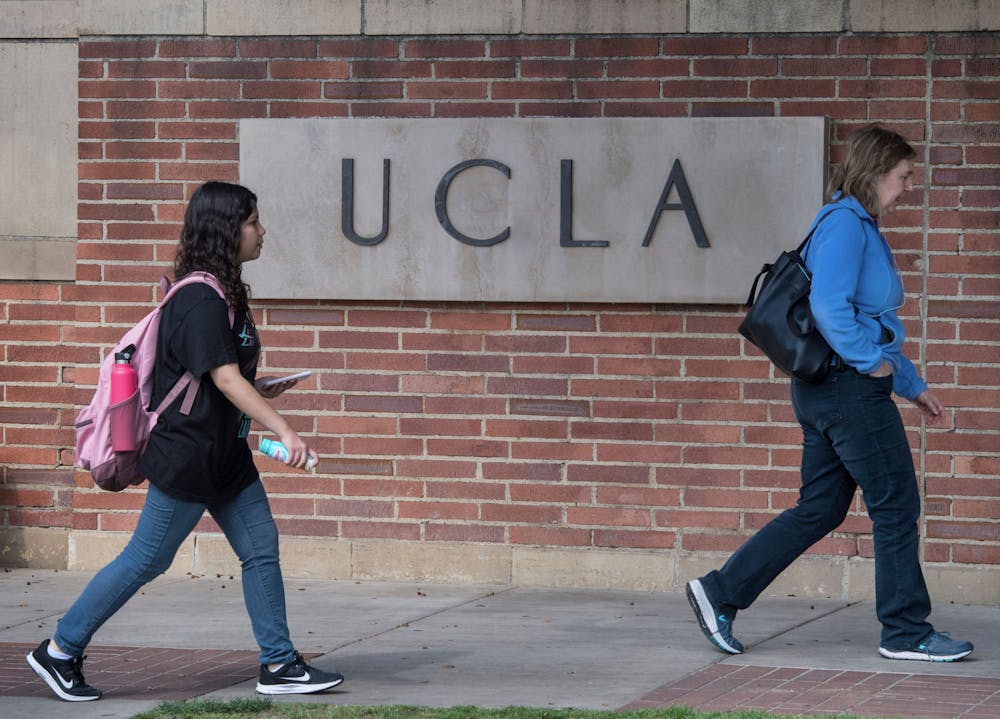 Public universities in California cannot consider race in admissions. Mark Ralston/Getty Images
Vinay Harpalani, a scholar of discrimination at the University of New Mexico, delivered some numbers: After California banned affirmative action at its state universities, “[t]he enrollment of Black, Latino and Native American students dropped dramatically in the University of California system. For example, at UCLA, the percentage of underrepresented minorities dropped from 28% to 14% between 1995 and 1998. There was a similar drop at UC Berkeley.”
In more recent years, he reported, “The enrollment numbers have recovered, largely due to increased Latino enrollment. Currently at UCLA, 22% of the undergraduate student body is Latino and 3% is Black. But it is also important to note that the number of Latino high school graduates has more than tripled since 1997.”
Read more: What the California vote to keep the ban on affirmative action means for higher education
4. A military case for affirmative action
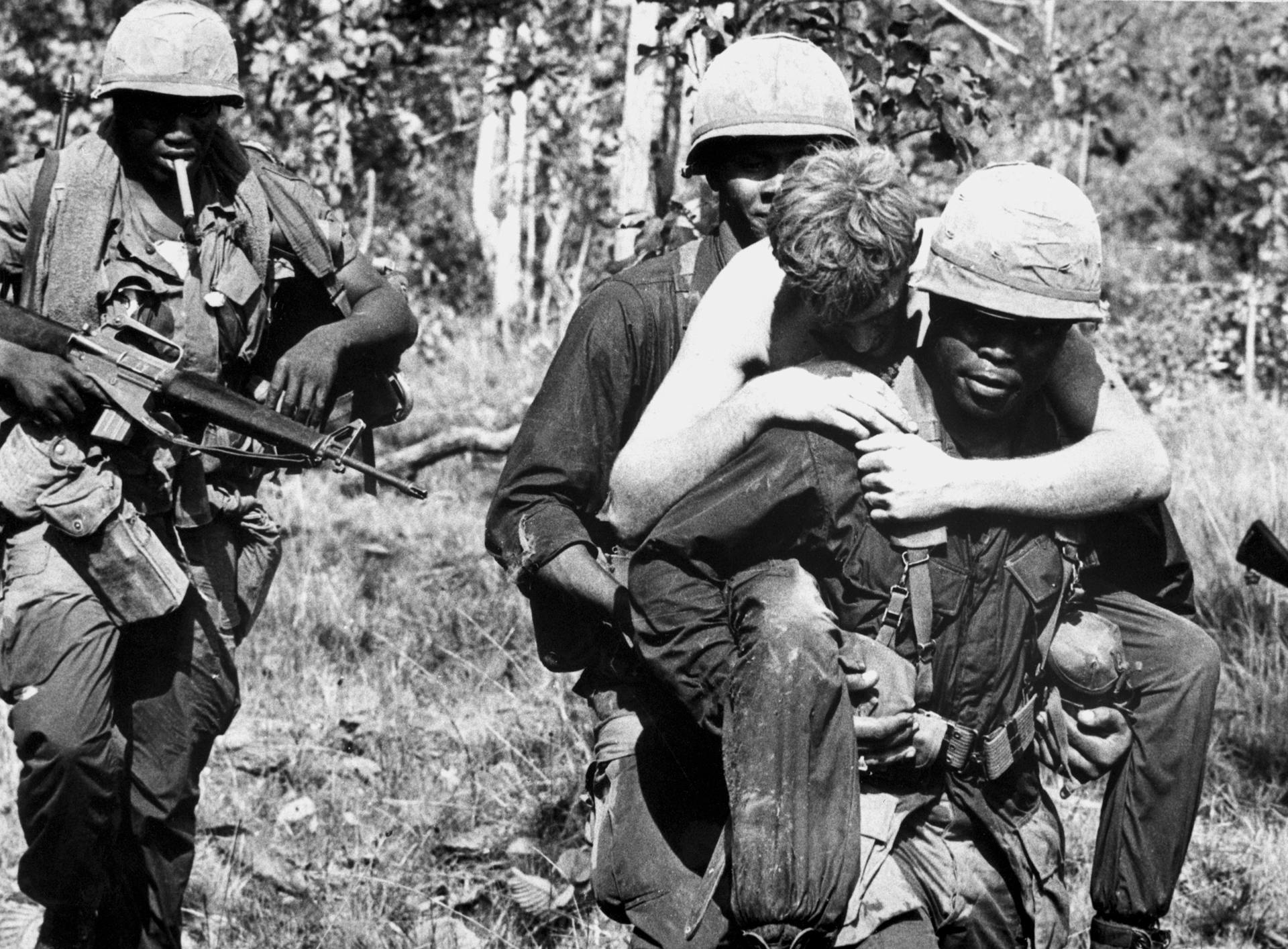 A wounded soldier is carried by members of the 1st Cavalry Division near the Cambodian border during the Vietnam War. Bettmann/GettyImages
In an article explaining the point of view of 35 military officers who have asked the Supreme Court to continue to allow affirmative action, Travis Knoll, a historian at the University of North Carolina - Charlotte, looked to the nation’s – and the military’s – racial experience during the Vietnam War.
“[I]n 1962, when U.S. involvement was starting to grow in Vietnam, Black commissioned officers represented only 1.6% of the officers corps,” he wrote. “Military academies remained virtually segregated, with Black people making up less than 1% of enrollees. As a result, the number of Black officers didn’t grow much.”
That led to unrest in the ranks: “Over the next five years, the number of Black soldiers fighting and dying on the front lines grew to about 25%. Racial tensions between white and Black soldiers led to at least 300 fights in a two-year-period that resulted in 71 deaths,” Knoll wrote. “Fueling those fights was the belief among Black soldiers that the largely white officers didn’t care about their lives.”
That experience, Knoll explained, drove home to the military the idea that diversity in leadership was extremely important. “It also began the military’s use of affirmative action, including race-conscious admissions policies at service academies and in ROTC programs.”
This story is a roundup of articles from The Conversation’s archives.
___

Justices’ past affirmative action views, in their own words
Chief Justice John Roberts
Updated
CHIEF JUSTICE JOHN ROBERTS
In his 17 years leading the court Roberts has repeatedly opposed affirmative action policies and criticized race-based categorizations.
In a 2007 case in which the court rejected efforts to combat segregation in Seattle schools he wrote: "The way to stop discrimination on the basis of race is to stop discriminating on the basis of race." And in a different case involving race in redistricting he memorably wrote: "It is a sordid business, this divvying us up by race."
The last time the court considered an affirmative action case, in 2015, Roberts asked about the benefits of diversity this way during arguments: "What unique perspective does a minority student bring to a physics class?"
Clarence Thomas
Updated
CLARENCE THOMAS
Thomas has a long record of opposition to affirmative action programs, and his views relate to is own experience. The court's second Black justice is also its most outspoken opponent of affirmative action and has said that his law degree from Yale was "tainted" because people assumed was admitted to the school because of affirmative action.
In 2003, Thomas dissented when the court, by a 5-4 vote, backed the use of race in admissions. He wrote in that case, Grutter v. Bollinger: "I believe Blacks can achieve in every avenue of American life without the meddling of university administrators." Every time "the government places citizens on racial registers and makes relevant to the provision of burdens or benefits, it demeans us all."
Samuel Alito
Updated
SAMUEL ALITO
Alito has made no secret of his disagreement with the court's affirmative action rulings. In 2016 when the court upheld a University of Texas admissions program that takes account of race — a ruling surprising some observers — Alito wrote a dissent that was more than twice as long as the majority opinion. He also summarized his dissent out loud in court, a rare step justices take as a way of emphasizing their displeasure.
Neil Gorsuch, Brett Kavanaugh, Amy Coney Barrett
Updated
NEIL GORSUCH, BRETT KAVANAUGH, AMY CONEY BARRETT
The court's remaining three conservatives, all appointed by President Donald Trump, have no track record on affirmative action. Of the three, however, Kavanaugh has underscored his commitment to diversity in his own hiring practices. During his Senate confirmation hearing he noted that a majority of the young lawyers he's hired as law clerks have been women and more than a quarter have been minorities.
Still, at the time, groups pointed to a 1999 Wall Street Journal article Kavanaugh wrote as evidence he would oppose affirmative action. The article quoted conservative Justice Antonin Scalia to say that it's a fundamental constitutional principle that "in the eyes of government, we are just one race here. It is American."
Sonia Sotomayor
Updated
SONIA SOTOMAYOR
The liberal Sotomayor has repeatedly and proudly said that she's a "product of affirmative action." The court's first Hispanic justice grew up in the Bronx, New York, and attended Princeton on a full scholarship. She excelled and went on to Yale Law School. Affirmative action was a "door opener that changed the course of my life," she has said.
On the court, Sotomayor has defended affirmative action, most strongly perhaps in a 2014 case in which her colleagues upheld a Michigan affirmative action ban passed in the wake of the court's Grutter decision. "The way to stop discrimination on the basis of race is to speak openly and candidly on the subject of race, and to apply the Constitution with eyes open to the unfortunate effects of centuries of racial discrimination," she wrote, pointedly paraphrasing Roberts.
Elena Kagan
Updated
ELENA KAGAN
Before becoming a Supreme Court justice, Kagan was dean of Harvard Law School and President Barack Obama's top Supreme Court lawyer as solicitor general. She sat out earlier affirmative action cases at the court, likely because of her involvement in the cases while in government. The Obama administration took positions supporting affirmative action.
Ketanji Brown Jackson
Updated
KETANJI BROWN JACKSON
Jackson, who earlier this year became the first Black woman to sit on the Supreme Court, could have a lot to say on the topic of affirmative action. While the group challenging Harvard's and UNC's policies argues that the Constitution is "colorblind," Jackson said earlier this month in a different case that she believes constitutional amendments made following the Civil War were adopted in a race-conscious way.
Jackson will only participate in the UNC case. During her confirmation hearings earlier this year the liberal justice pledged to sit out the Harvard case because she was a member of the school's board.
Sandra Day O'Connor
Updated
SANDRA DAY O'CONNOR
Yes, the court's first female justice retired from the court nearly two decades ago. But her words are likely to echo at Monday's arguments since she's the author of the Grutter v. Bollinger opinion the justices are being asked to overturn. O'Connor closed that 2003 opinion in part by saying that affirmative action's days might be numbered. She wrote: "We expect that 25 years from now, the use of racial preferences will no longer be necessary to further the interest approved today."
If the court does bar race-conscious admissions when it decides the case by the middle of 2023, it would shave five years off her timeline.


