


Astronauts on board the International Space Station are getting a new $23 million space toilet.
CAPE CANAVERAL, Fla. (AP) — NASA’s first new space potty in decades — a $23 million titanium toilet better suited for women — is getting a not-so-dry run at the International Space Station before eventually flying to the moon.
It’s packed inside a cargo ship set to blast off late Thursday from Wallops Island, Virginia. NASA has a live stream for the 9:38 p.m. EDT launch.
Barely 100 pounds (45 kilograms) and just 28 inches (71 centimeters) tall, it’s roughly half as big as the two Russian-built toilets at the space station. It's more camper-size to fit into the NASA Orion capsules that will carry astronauts to the moon in a few years.
Station residents will test it out for a few months. If the shakedown goes well, the toilet will be open for regular business.

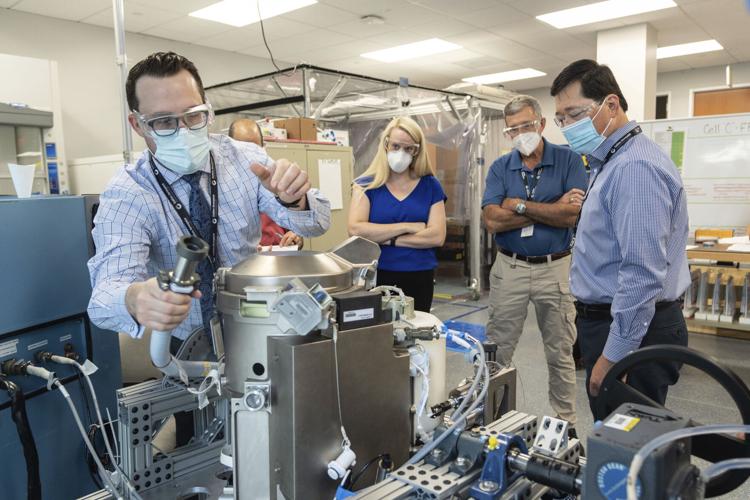
In this June 18, 2020 photo provided by NASA, astronaut Kate Rubins, center, and support personnel review the Universal Waste Management System, a low-gravity space toilet, in Houston. The new device is scheduled to be delivered to the International Space Station on Oct. 1, 2020.
With SpaceX now launching astronauts to the space station and Boeing less than a year from sending up its first crew, more toilets are needed. The new one will be in its own stall alongside the old one on the U.S. side of the outpost.
The old toilets cater more toward men. To better accommodate women, NASA tilted the seat on the new toilet and made it taller. The new shape should help astronauts position themselves better for No. 2, said Johnson Space Center's Melissa McKinley, the project manager.
“Cleaning up a mess is a big deal. We don’t want any misses or escapes,” she said.
Let’s just say everything floats in weightlessness.

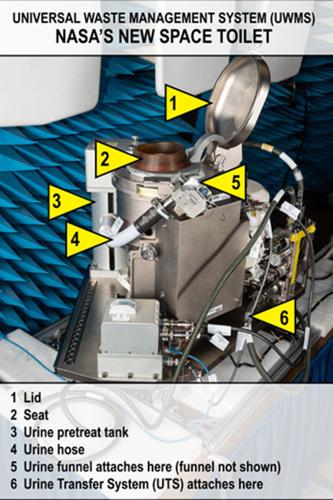
This photo made available by NASA shows the Universal Waste Management System (UWMS), a new space toilet. The device is scheduled to be delivered to the International Space Station on Oct. 1, 2020.
As for No. 1, the funnels also have been redesigned. Women can use the elongated and scooped-out funnels to urinate while sitting on the commode to poop at the same time, McKinley said. Until now, it’s been one or the other for female astronauts, she noted.
Like earlier space commodes, air suction, rather than water and gravity, removes the waste. Urine collected by the new toilet will be routed into NASA’s long-standing recycling system to produce water for drinking and cooking. Titanium and other tough alloys were chosen for the new toilet to withstand all the acid in the urine pretreatment.
Going to the bathroom in space may sound simple, but “sometimes the simple things become very difficult” without gravity, said NASA astronaut Mike Hopkins, commander of the second SpaceX crew, due to launch Oct. 31 from Kennedy Space Center.
While the old design isn't that hard to use, subtle design changes can make all the difference for women, noted NASA astronaut Shannon Walker, a former space station resident who’s also on the next SpaceX crew.
“Trust me, I’ve got going to the bathroom in space down, because that is a vital, vital thing to know how to do,” she told The Associated Press earlier this week.
The typical space station population will go from six to seven with the next SpaceX flight, and even more when non-professionals like tourists start showing up as early as next year. Astronauts normally stay six months.

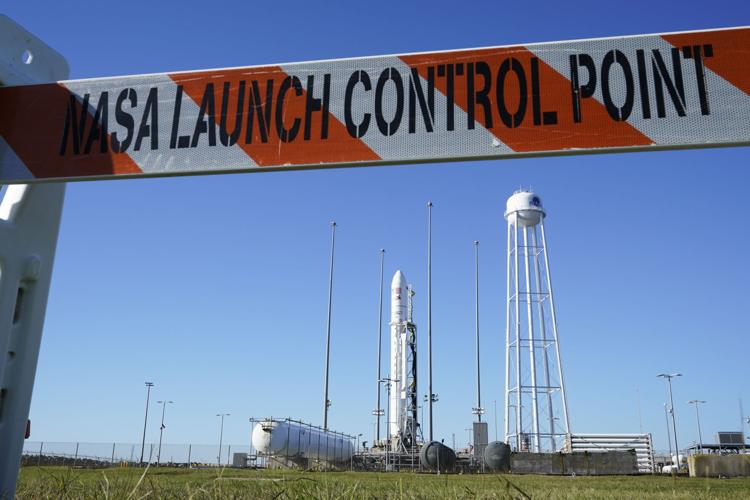
Northrup Grumman's Antares rocket is poised for launch at the NASA Wallops test flight facility Thursday, Oct. 1, 2020, in Wallops Island, Va. The rocket is set to launch Thursday evening to deliver supplies to the International Space Station.
The last time NASA ordered up a new toilet was in the early 1990s to accommodate two-week space shuttle missions. The agency contracted with Collins Aerospace to provide the latest model; the company also worked on the shuttle potties.
Also in the 8,000-pound (3,600-kilogram) shipment aboard Northrop Grumman’s Cygnus capsule: air tanks to make up for a slight space station leak, radish seeds for greenhouse growing and a cinematic 360-degree VR camera for you-are-there-spacewalk shots.
Perhaps the most unique payload: Estee Lauder’s newest wrinkle serum. The cosmetics company is paying $128,000 for an out-of-this-world photo shoot, part of NASA’s push to open the final frontier to marketing, industry and tourism.
Don’t count on perfumed aromas, though, to counter bathroom odors.
The serum is fragrance-free and the 10 bottles will remain sealed until returned to Earth early next year.
___
The Associated Press Health and Science Department receives support from the Howard Hughes Medical Institute’s Department of Science Education. The AP is solely responsible for all content.
Shoot for the stars: 11 things you didn’t know about applying to be a NASA astronaut
Shoot for the stars: 11 things you didn’t know about applying to be a NASA astronaut
Help wanted
Updated
Currently, NASA has 48 astronauts in its corps and is seeking more applicants.
Sign of the times
Updated
According to WHTR, the application closed on March 31 and included, for the first time, an online assessment portion.
Stem's the word
Updated
One of the basic application requirements to be an astronaut in the next class of Artemis Generation is a master’s degree in a STEM-related field. According to the NASA website, “The requirement for the master’s degree can also be met by: Two years (36 semester hours or 54 quarter hours) of work toward a Ph.D. program in a related science, technology, engineering or math field; A completed doctor of medicine or doctor of osteopathic medicine degree; Completion (or current enrollment that will result in completion by June 2021) of a nationally recognized test pilot school program.
Learning to fly
Updated
Being an astronaut for NASA requires a bit of flight experience, specifically, “at least 1,000 hours of pilot-in-command time in jet aircraft,” according to NASA’s website. They can also have at least two years of professional experience related to their degree which can include jobs like teaching kindergarten.
Extras
Updated
Space.com notes that astronaut candidates (known by the acronym ASCAN) can help themselves in the application process by having other skills like scuba diving, wilderness experience and fluency in a foreign language (Space.com notes that all astronauts are required to speak Russian).
Height requirement
Updated
ASCANs should be between 62 and 75 in. (5’2” to 6’3” in.) to meet NASA’s “anthropomorphic requirements,” Science Direct notes. According to the NASA website, these contemporary requirements are much more flexible. During the first flight in 1959, astronauts had to be shorter than 5 feet 11 inches to fit in the Mercury spacecraft.
Get your sea legs before space
Updated
According to Science Direct, ASCANs have to also pass a swim test, become SCUBA certified and pass a military water survival test. CBS notes that the swim test includes swimming three lengths of a pool and treading water for 10 minutes in a flight suit and tennis shoes.
If at first you don't succeed
Updated
Many astronauts don’t get accepted on the first try, Space.com says. In fact, Clay Anderson applied 15 times and waited two more years before becoming an astronaut and serving as a member of the Expedition 15 crew aboard the International Space Station in 1998.
I can see clearly now
Updated
Perfect vision is crucial for ASCANS—even if they need a little help to achieve it. Part of the physical requirements to be an astronaut are 20/20 vision either with or without glasses or contacts.
A shrinking application pool
Updated
The NASA application, according to Wired, drew in more than 18,000 applicants. Of those applicants, Wired reports that around 14,000 will meet the basic requirements. A review panel of experienced astronauts then whittles down the applicant pool to 500. After reference checks and a first round of interviews, the pool goes from 500 to 100 to around 50 or 60 who go on to the second round of interviews. After the intense space-flight physical, between eight and 14 applicants will become astronauts and begin training
Age ain't nothing but a number
Updated
Astronauts have been a wide range of ages according to CBS. Most fall between the ages of 26 and 46, with the average being about 34 years.

