

Two years after former President Donald Trump's false claims about widespread election fraud sparked an attack on the U.S. Capitol, more evidence is piling up that those who spread the misinformation knew it was false.
On Thursday, the voting machine company Dominion filed court papers documenting that numerous Fox News personalities knew there was no evidence to support the claims peddled by Trump's allies, but aired them anyway on the nation's most-watched cable network. The same day, a special grand jury in Atlanta concluded there was no evidence of the fraud that Trump alleged cost him Georgia during the 2020 election.

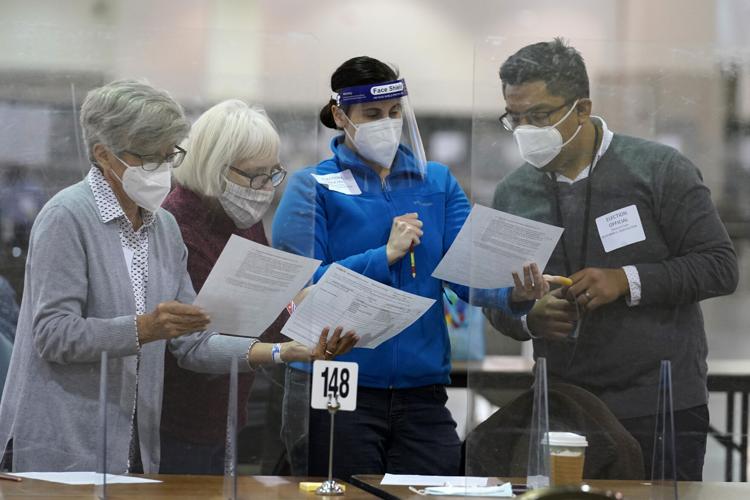
Election officials read documents before a hand recount of ballots Nov. 20, 2020 at the Wisconsin Center in Milwaukee, Wis. Former President Donald Trump claimed that fraud cost him wins in key swing states that determined the White House — Arizona, Georgia, Michigan, Nevada, Pennsylvania and Wisconsin. But investigations in those states turned up no evidence that had happened.
In December, the congressional Jan. 6 committee disclosed that Trump's top advisers and even family members repeatedly warned him that the allegations he was making about fraud costing him reelection were false — only to have the president continue making those claims, anyway.
The latest revelations are not just historical curiosities. They add to the wealth of evidence that there was no widespread fraud during the 2020 presidential election and that even some of Trump's most prominent supporters were aware of that fact at the time.
Trump has announced he's running for president again in 2024 and continues to repeat the lie that he lost in 2020 only because of fraud and irregularities.
"It demonstrates a profound cynicism about the political process and the gullibility of Trump's supporters," said Rick Hasen, a law professor at the University of California, Los Angeles, who has followed the election falsehoods closely since 2020.

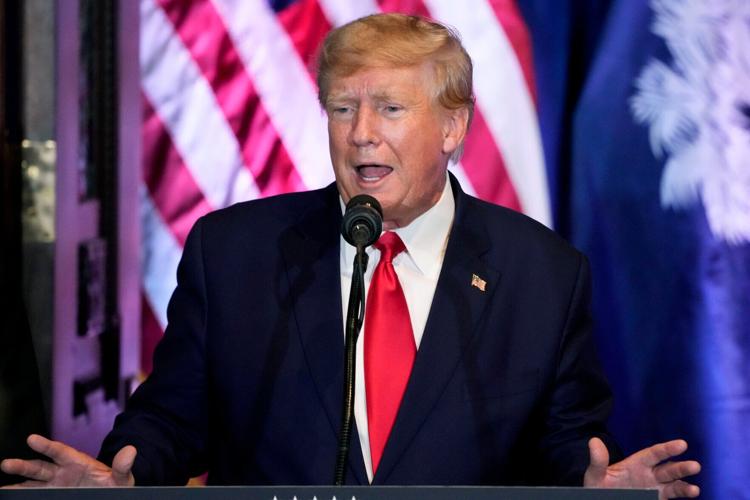
Former President Donald Trump speaks at a campaign event Jan. 28 at the South Carolina Statehouse in Columbia, S.C.
"It's really playing with fire," Hasen said. "It's one thing to make extravagant and unsupported statements about someone's position on taxes or immigration." But doing the same about the actual process of voting and counting ballots is different, he said: "Lies about elections are much more dangerous than lies about actual policy."
From the beginning, it was clear that Trump's assertions of widespread fraud were false.
Trump's own attorney general told him there was no evidence of significant wrongdoing related to the election. He and his supporters filed dozens of lawsuits and lost all but one of them — a bid to reduce the time voters had to correct errors on Pennsylvania mail ballots.
Trump claimed that fraud cost him wins in key swing states that determined the White House — Arizona, Georgia, Michigan, Nevada, Pennsylvania and Wisconsin. But, repeatedly, reviews of the vote tallies or Republican-controlled investigations in those states turned up no evidence that had happened.
In Michigan, an investigation by the GOP-controlled state Senate found no widespread fraud and debunked several false claims of irregularities from Trump allies. In Nevada, the Republican secretary of state said there was no evidence of significant errors in the election. In Wisconsin, an audit from the nonpartisan Legislative Audit Bureau — which reports to the Republican-controlled Legislature — found the election there was "safe and secure."
In Georgia, where Trump's efforts to overturn the results is being investigated, the 2020 ballots were counted three times — each tally confirming Biden's win. That included a hand recount of the 5 million ballots cast in the presidential race.
In Arizona, a months-long, error-riddled review of ballots in the state's largest county, Maricopa, that was run by election conspiracy theorists ended by finding that Biden had won by a slightly larger margin than official results showed. The review was not more reliable than the official tally by Republican-run Maricopa County, which has repeatedly said there were no irregularities in the 2020 election there.
The latest revelation that people spreading Trump's false claims knew there was no evidence to support them comes from a court filing in a defamation suit filed by Dominion Voting Systems against Fox News. Dominion's machines were the targets of Trump and other conspiracy theorists' allegations in late 2020 and last year, including the contention that they had been rigged by an international cabal seeking to defeat Trump.
In its latest filing, Dominion cites texts and emails between prominent Fox personalities who did not believe the allegations or the people closest to Trump who spread them most aggressively, former New York Mayor Rudolph Giuliani and attorney Sidney Powell.

The Dominion filing alleges that the network was initially cautious about fraud claims, with its top anchor, Bret Baier, privately stating two days after the 2020 election "there is NO evidence of election fraud."
But after Powell and Giuliani began making allegations about fraud that were picked up by conservative competitors, executives and top hosts started worrying about losing viewers to the conservative network Newsmax, which repeatedly aired unrebutted allegations from Trump's side. Fox started inviting the two Trump allies on their shows and top executives pushed back on news reporters who tried to fact-check the allegations.
"Sidney Powell is lying" about having evidence of election fraud, Tucker Carlson told a producer about the attorney on Nov. 16, 2020, according to an excerpt from an exhibit that remains under seal. Two days later, according to the filing, Carlson told fellow Fox News host Laura Ingraham, "Our viewers are good people and they believe it."
The next day, the lawsuit notes, Carlson addressed the issue on his show less bluntly: "Maybe Sidney Powell will come forward soon with details on exactly how this happened, and precisely who did it. … We are certainly hopeful that she will."
Fox, in response, filed a counterclaim against Dominion alleging it was trying to chill coverage of a political controversy and that it aired denials of the allegations from Dominion and its representatives.
11 searing moments of Jan. 6: From 'an attempted coup' to chaos
'An attempted coup'
Updated
The first hearing, aired in prime time and watched by more than 20 million viewers, set the stage for the next seven.
It laid out the conclusion that the panel would come back to in every hearing: that Trump conspired to overturn his own defeat, taking actions that sparked the violent insurrection at the Capitol on Jan. 6, 2021, when hundreds of his supporters beat police and broke through windows and doors to interrupt the certification of Biden’s victory.
“January 6th was the culmination of an attempted coup, a brazen attempt, as one rioter put it shortly after January 6th, to overthrow the government,” said the committee chairman, Rep. Bennie Thompson, D-Miss. “The violence was no accident. It represents seeing Trump’s last stand, most desperate chance to halt the transfer of power.”
'Carnage' at the Capitol
Updated
Capitol Police Officer Caroline Edwards (pictured), one of two witnesses at the first hearing, described what she saw outside the Capitol on Jan. 6 as a “war scene.” As some Republicans, including Trump, have tried to play down the violence of the insurrection, calling it “peaceful,” Edwards recalled the brutality she experienced on the front lines. She suffered a traumatic head injury that day as some of the first protesters barreled through the flimsy bike rack barriers that she and other officers were trying to hold.
“I couldn’t believe my eyes,” Edwards testified. “There were officers on the ground. You know, they were bleeding. They were throwing up. … It was carnage. It was chaos.”
'Detached from reality'
Updated
The committee has used clips of its interview with former Attorney General Bill Barr (pictured) in almost every hearing, showing the public over and over his definitive statements that the election was not stolen by Biden — and Barr's description of Trump’s resistance as he told the president the truth.
At the second hearing, the committee showed a clip of Barr recalling how he told Trump to his face that the Justice Department had found no evidence of the widespread voter fraud that Trump was claiming. Barr said he thought Trump had become “detached from reality” if he really believed his own theories and said there was “never an indication of interest in what the actual facts were.”
“And my opinion then and my opinion now is that the election was not stolen by fraud and I haven’t seen anything since the election that changes my mind on that,” Barr said.
A tense conversation
Updated
One question going into the hearings was what Trump and Vice President Mike Pence talked about in a phone call the morning of Jan. 6. The conversation came after Trump had pressured his vice president for weeks to try and somehow object or delay as he presided over Biden’s certification. Pence firmly resisted and would gavel down Trump's defeat — and his own — in the early hours of Jan. 7, after rioters had been cleared from the Capitol.
While only Trump and Pence were on the Jan. 6 call, White House aides filled in some details at the committee’s third hearing by recounting what they heard Trump say on his end of the line.
“Wimp is the word I remember,” said former Trump aide Nicholas Luna. “You’re not tough enough,” recalled Keith Kellogg, Pence’s national security adviser. “It became heated” after starting out in a calmer tone, said White House lawyer Eric Herschmann.
“It was a different tone than I’d heard him take with the vice president before,” said Ivanka Trump.
40 feet away
Updated
Encouraged by Trump’s tweet, after the attack had started, that Pence “didn’t have the courage to do what should have been done,” rioters at the Capitol singled out the vice president. Many chanted “Hang Mike Pence!” as they moved through the building. Pence evacuated the Senate just minutes before the chamber was breached, and later was rushed to safety as rioters were just 40 feet away.
Greg Jacob, the president’s lawyer, testified at the third hearing and said he had not known they were that close.
Jacob said Secret Service agents wanted them to leave the building but Pence refused to get in the car. “The vice president didn’t want to take any chance” that the world would see him leaving the Capitol, Jacob said.
'I will not break my oath'
Updated
At the committee’s fourth hearing, state officials detailed the extraordinary pressure the president put on them to overturn their states’ legitimate and certified results. Rusty Bowers (pictured), Arizona’s House speaker, told the committee how Trump asked him directly to appoint alternate electors, falsely stating that he had won the state of Arizona and not Biden.
Bowers detailed additional calls with Trump lawyer Rudy Giuliani. “I will not do it,” Bowers told him, adding: “You are asking me to do something against my oath, and I will not break my oath.”
Lives upended
Updated
Georgia election workers Wandrea “Shaye” Moss (left) and her mother, Ruby Freeman, also testified in the fourth hearing, describing constant threats after Trump and his allies spread false rumors that they introduced suitcases of illegal ballots and committed other acts of election fraud. The Justice Department debunked those claims.
The two women said they had their lives upended by Trump’s false claims and his efforts to go after them personally. Through tears, Moss told lawmakers that she no longer leaves her house.
In videotaped testimony, Freeman said there is “nowhere I feel safe” after the harassment she experienced.
Justice Department resists the scheme
Updated
When his efforts to overturn his defeat failed in the courts and in the states, Trump turned his focus to the leadership of the Justice Department.
Richard Donoghue (right), the acting No. 2 at the time, testified about his resistance to entreaties by another department official, Jeffrey Clark, who was circulating a draft letter recommending that battleground states reconsider the election results. Trump at one point floated replacing then-acting Attorney General Jeffrey Rosen (center) with Clark, but backed down after Donoghue and others threatened to resign.
“For the department to insert itself into the political process this way, I think would have had grave consequences for the country,” Donoghue testified. “It may very well have spiraled us into a constitutional crisis.”
'They're not here to hurt me'
Updated
In a surprise sixth hearing, former White House aide Cassidy Hutchinson (pictured) recounted some of Trump’s actions on Jan. 6, including his dismissive response when told that some in the crowd waiting for him to speak outside the White House were armed.
“I was in the vicinity of a conversation where I overheard the president say something to the effect of, ‘I don’t effing care that they have weapons,’” Hutchinson said. “'They’re not here to hurt me. Take the effin’ mags away. Let my people in. They can march to the Capitol from here.'”
Upset that the crowd didn’t appear larger, Trump told his aides to take the metal-detecting magnetometers away. In the coming hours, he would step on the stage and tell them to “fight like hell.”
Hutchinson also described Trump’s anger after security officials told him he couldn’t go to the Capitol with his supporters after he had told them he would. She said she was told that the president even grabbed the steering wheel in the presidential SUV when he was told he couldn’t go.
For the president to have visited the Capitol during Biden’s certification, and as his supporters descended on the building, would have been unprecedented.
'Unhinged' White House meeting
Updated
At its seventh hearing, the committee painstakingly reconstructed a Dec. 18 meeting at the White House where outside advisers to Trump pushing election fraud claims clashed with White House lawyers and others who were telling him to give up the fight.
The six-hour meeting featured profanity, screaming and threats of fisticuffs, according to the participants, as Trump lawyer Sidney Powell and others threw out conspiracy theories, including that the Democrats were working with Venezuelans and that voting machines were hacked. Pat Cipollone (pictured), the top White House lawyer, testified that he kept asking for evidence, to no avail.
Hours later, at 1:42 a.m., Trump sent a tweet urging supporters to come for a “big protest” on Jan. 6: “Will be wild,” Trump promised.
187 minutes
Updated
The final hearing focused on what Trump was doing for 187 minutes that afternoon, between his speech at the rally and when he finally released a video telling the rioters to go home at 4:17 p.m.
They showed that Trump was sitting at a dining room table near the Oval Office, watching Fox News coverage of the violence. But he made no calls for help — not to the Defense Department, the Homeland Security Department or the attorney general — even as his aides repeatedly told him to call it off.
In the video released at 4:17 p.m., as some of the worst of the fighting was still happening down the street, Trump told rioters to go home but said they were “very special.”
The committee showed never-before-seen outtakes of a speech Trump released on Jan. 7 in which he condemned the violence and promised an orderly transition of power. But he bristled at one line in the prepared script, telling his daughter Ivanka Trump and others in the room, “I don’t want to say the election is over.”

