


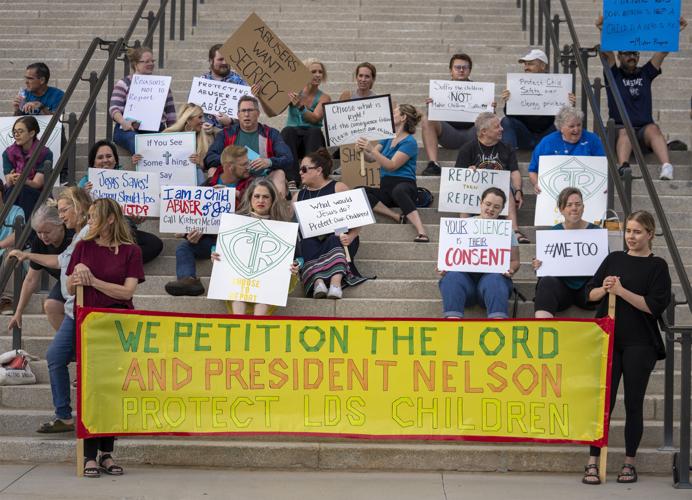
SALT LAKE CITY — Lindsey Lundholm looked out over hundreds of people at the Utah State Capitol last year and felt a deep sense of healing. Abuse survivors, religious leaders and major party politicians were all gathered to rally for an end to a legal loophole that exempts religious clergy from being required to report child sexual abuse once it comes to their attention.
Lundholm, one of the rally’s organizers, recalled telling the crowd how, growing up as a member of The Church of Jesus Christ of Latter-day Saints in Idaho, she told her bishop about her painful abuse only to see it go unreported.

Protesters gather on the steps of the Utah State Capitol, at a rally to gain support for removing the clergy exemption from mandatory reporting in cases of abuse and neglect, on Aug. 19, 2022, in Salt Lake City.
Unearthing the trauma wasn’t easy, but back in August she hoped reforms could be forthcoming so others would not face what she did.
“There was really a lot of momentum,” said Lundholm, now a teacher in northern Utah. “Everyone we were talking to was like, ‘This is a no brainer. This is something that needs to be changed.’”
It hasn’t.
Proposals to reform laws that exempt clergy from child sex abuse reporting requirements went nowhere in Utah’s statehouse this year, failing to receive even a hearing as lawmakers prepare to adjourn for the year. Efforts were stymied by a coalition of powerful religious groups, continuing a yearslong pattern in which Catholics, Latter-day Saints and Jehovah’s Witnesses have defended the exemptions as survivors like Lundholm fight for reform.
In Utah, where the majority of lawmakers are members of The Church of Jesus Christ of Latter-day Saints, state law requires most professionals — therapists, doctors and teachers among them — to report abuse, yet clergy are exempt from alerting authorities about abuse they learn of through confessions.
Republicans and Democrats announced plans last year to reform laws that exempt religious clergy from reporting child sexual abuse cases revealed in conversations with parishioners.

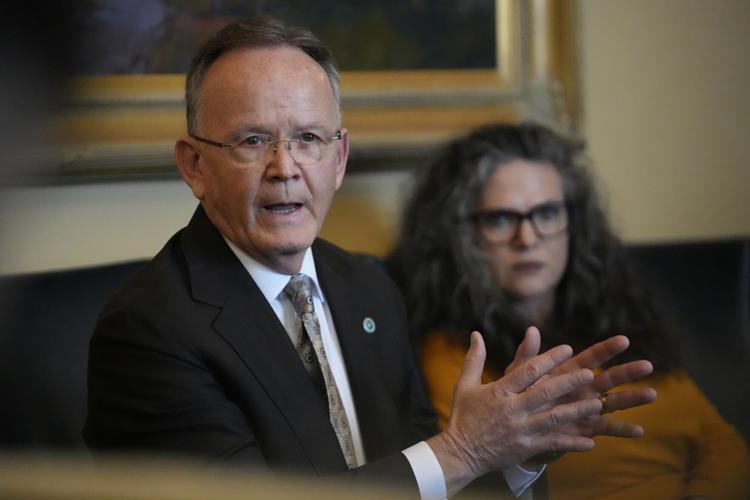
Utah Senate President Stuart Adams speaks during a media event Feb. 27 at the Utah State Capitol in Salt Lake City.
Behind-the-scenes conversations between legislative leaders in Utah and what Senate President Stuart Adams said was “a broad base of religious groups” helped thwart four separate proposals to add clergy to the list of professionals required to report child sexual abuse.
“I think they have First Amendment rights and religious protections,” Adams, a Latter-day Saint himself, said, noting fears among religious leaders that clergy could be punished for breaking vows of confidentiality.
Each proposal was introduced or announced after an Associated Press investigation found that the Utah-based Church of Jesus Christ of Latter-day Saints’ sexual abuse reporting hotline can be misused by its leaders to divert abuse accusations away from law enforcement and instead to church attorneys who may bury the problem, leaving victims in harm’s way.
In lawsuits detailed in the investigation, attorneys from the faith widely known as the Mormon church have argued clergy-penitent privilege allows them to refuse to answer questions and turn over documents about alleged sexual abuse.
Church officials declined to comment about the stalled legislative efforts. The Catholic Diocese of Salt Lake City did not respond to requests for comment but campaigned against them, saying in January that priests and clergy were different from other professionals mandated to report sexual abuse.
“Legislation that would require a priest to (report sexual abuse) violates our right to practice our religion,” Bishop Oscar Solis, of the Salt Lake City Diocese, wrote in a Jan. 25 letter to parishioners.
Utah Gov. Spencer Cox last month said he “had no problem with the bills moving forward” and receiving consideration in the statehouse.
“I think it’s an important conversation to have. We’ve encouraged the Legislature to look at this and make sure that our model is the right model,” he told reporters.
Marci Hamilton, chief executive of the abuse prevention nonprofit Child USA, said churches have maintained the same playbook for decades in opposing more disclosure.
Routinely it involves a two-pronged approach, defending clergy-penitent privilege in statehouses and using it to avoid damaging disclosures in court cases, said Hamilton, also a University of Pennsylvania law professor.
“They have not veered from it. Both institutions are hoping that time will simply let everybody start trusting them again,” Hamilton said, referring to Catholics and Latter-day Saints.
But, she added, “by preventing the public — and especially the sincere believers — from getting the full story you don’t create the accountability that these organizations should be held to and the secrets continue.”
Laws in 33 states exempt clergy — regardless of religion — from laws requiring people report child sexual abuse allegations to authorities. Religious leaders have systematically fought efforts to expand the list of states. They currently oppose efforts from Vermont to Washington.
Kansas lawmakers introduced multiple proposals on penalties for not reporting suspected child sexual abuse, including one in the state Senate that would have added clergy to a list of mandatory reporters. It faced especially fierce public rebukes from Catholic leaders because it didn’t exempt confessions. No proposal received even a hearing before an initial deadline this year.
In the wake of the AP’s investigation last year, Republican state Rep. Phil Lyman and Democratic Rep. Angela Romero announced plans to reform Utah’s clergy-penitent privilege loophole. Lyman, who served six years as a Latter-day Saints’ bishop, said at the time lawmakers should want to reexamine the loophole “regardless of religious or political affiliation.”
“People should be able to go and confess their sins to their bishop without fear of being prosecuted up until when they are confessing something that has affected someone’s else life significantly,” he told the AP in August.
Lyman ultimately released a proposal that broadly affirmed clergy’s exemption from mandatory reporting. It didn’t advance or receive a hearing.
Portraits of resilience: Survivors of clergy abuse tell their stories
Patrick Shepard
Updated
For many years Patrick Shepard wouldn’t touch a basketball. His molester, a priest, had taught him the game, and as much as he loved it, he had “so many bad memories." The abuse sent him spiraling down, through anger and alcohol abuse and sadness. But now he has a loving partner, a son he adores, and the responsibilities and joys of fatherhood help eclipse his pain. He still finds himself crying sometimes, but the tears do not come as often as they once did. And he has taught his son to play basketball.
Dorothy Small
Updated
Dorothy Small was 60 years old when she met the priest. She thought it was love — that was the only way to make sense of what happened. But another priest had a different word for it. “You were raped,” he told her. She reported the encounter, the priest was sent back to the Philippines, and Small was ostracized by the church community that once was her lifeline. It left her shattered. Now, she does not go to any church. She finds spiritual fulfillment in private rituals and meaning in her advocacy for adult survivors of priest abuse. “The healing came from standing up for myself, finally,” she says. “It came from not going away.”
Salvador Bolivar
Updated
Salvador Bolivar doesn’t like to talk about what happened to him without first summoning the spirit of his ancestors to give him courage. It was the awareness of these ancestors 11 years ago, in a sweat lodge in Colombia, that first compelled him to break his silence about the sexual abuse he suffered at the hands of his Catholic high school dean. Bolivar's belief that his suffering must be part of a plan, meant to arm him with the experience necessary to help other survivors, helps him get through the most difficult days. Still, such trauma takes a toll. “I knew this spiritual task would come at a price,” he said.
The Charbonneau sisters
Updated
The nine Charbonneau sisters never forgot the beatings and harsh discipline they endured at the St. Paul’s Indian Mission School in South Dakota. But in their 50s and 60s they remembered, one by one, something even worse: the sexual abuse they suffered at the hands of priests and nuns. Most have given up their fight to sue the church, and want to forget. But four of them (pictured wrapped in a quilt made by their mother, left to right: Francine Soli, Barbara Dahlen, Joann Braget and Louise Aamot) persist. Says Dahlen: “Sometimes I wish the hell we never remembered anything.”
Jacob Olivas
Updated
More than four decades have passed since the year Jacob Olivas was molested, one of more than 100 children victimized by the Rev. Edward Anthony Rodrigue. Olivas, now 50, is prone to fear, nightmares, crippling panic attacks. He finds strength in his unshakable Catholic faith — “When you think you’re most alone is when God is closest to you” — and solace in the mountains. But the pain is still with him. Years ago the priest wrote Olivas a letter of apology from prison. He cannot bring himself to read it.
Mark Belenchia
Updated
Mark Belenchia didn’t stay quiet. He told his mother and his uncle, in the mid-1970s. He told a parish priest, then the vicar general, in 1985. Still, the clergyman Belenchia said sexually abused him when he was a child in Shelby, Mississippi, remained in collar and cassock. “It showed me that the system says you’re insignificant. It doesn’t matter what you said, or what happened to you,” Belenchia says. Over the years, his quest to make sense of his own tragedy transformed into a crusade against clergy abuse that’s become his life’s focus. Activism, he said, gives him purpose and direction. Through this work he’s able to make use of his pain, to help other survivors struggling to cope with theirs.
John Vai
Updated
John Vai doesn’t think or talk about the abuse. It took him four decades to tell anyone: The Catholic church was the heartbeat of his working-class, Italian-American Delaware neighborhood. But so many years later he took a risk, went to trial and won. He unboxed those memories, and the experience almost ripped him apart, he said. He will not do it again. And so, he wakes up at the same time each morning. He plays golf, swims in the country club pool, sips a cocktail when the sun goes down. Happiness isn’t what he’s after. Stability, he said, is what he needs to survive. “Get into a routine,” he said, “and the pain goes away.”

