

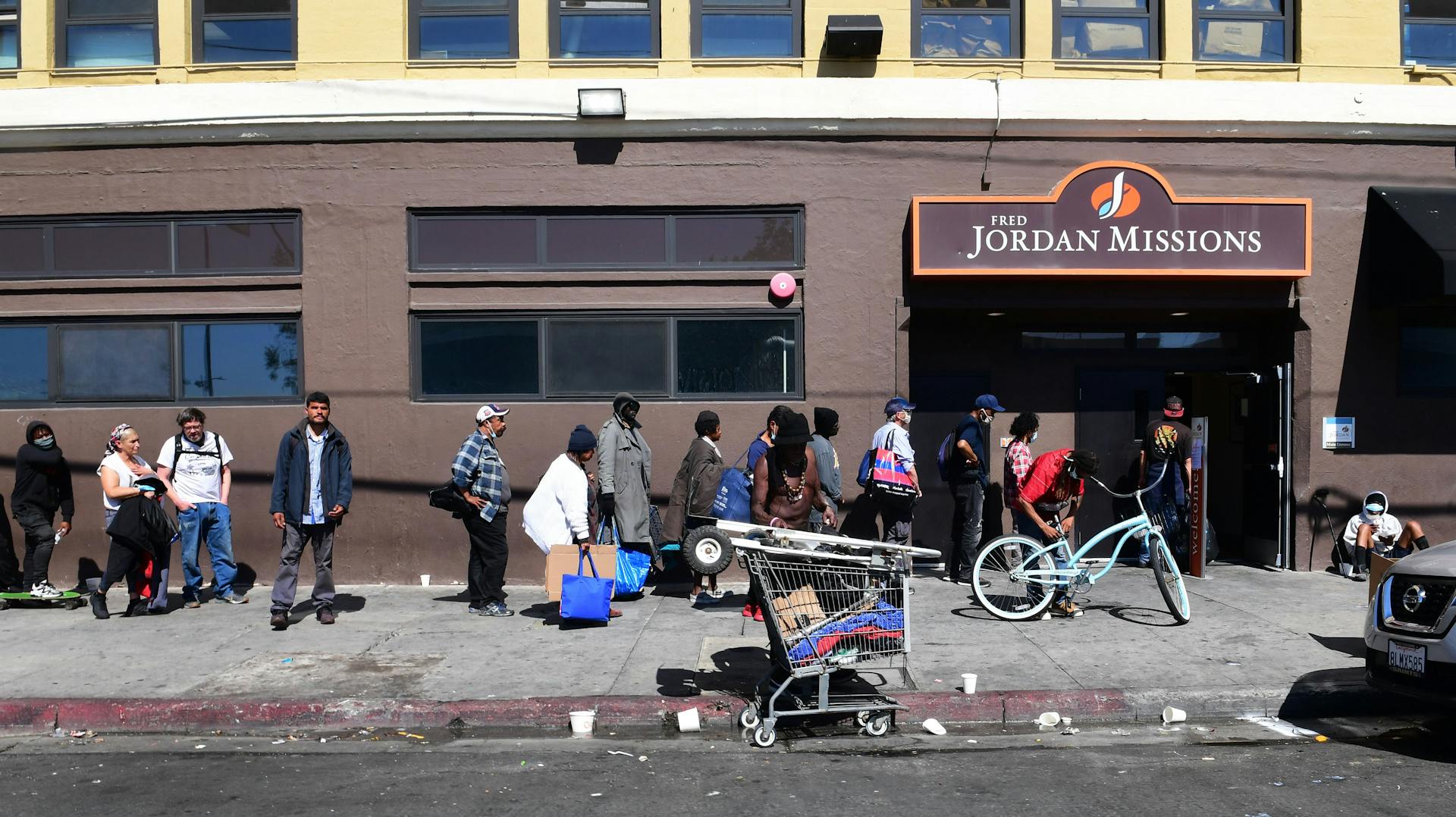
 People wait in line for a free morning meal in Los Angeles in April 2020. High and rising inequality is one reason the U.S. ranks badly on some international measures of development. Frederic J. Brown/ AFP via Getty Images
The United States may regard itself as a “leader of the free world,” but an index of development released in July 2022 places the country much farther down the list.
In its global rankings, the United Nations Office of Sustainable Development dropped the U.S. to 41st worldwide, down from its previous ranking of 32nd. Under this methodology – an expansive model of 17 categories, or “goals,” many of them focused on the environment and equity – the U.S. ranks between Cuba and Bulgaria. Both are widely regarded as developing countries.
The U.S. is also now considered a “flawed democracy,” according to The Economist’s democracy index.
As a political historian who studies U.S. institutional development, I recognize these dismal ratings as the inevitable result of two problems. Racism has cheated many Americans out of the health care, education, economic security and environment they deserve. At the same time, as threats to democracy become more serious, a devotion to “American exceptionalism” keeps the country from candid appraisals and course corrections.
‘The other America’
The Office of Sustainable Development’s rankings differ from more traditional development measures in that they are more focused on the experiences of ordinary people, including their ability to enjoy clean air and water, than the creation of wealth.
So while the gigantic size of the American economy counts in its scoring, so too does unequal access to the wealth it produces. When judged by accepted measures like the Gini coefficient, income inequality in the U.S. has risen markedly over the past 30 years. By the Organization for Economic Cooperation and Development’s measurement, the U.S. has the biggest wealth gap among G-7 nations.
These results reflect structural disparities in the United States, which are most pronounced for African Americans. Such differences have persisted well beyond the demise of chattel slavery and the repeal of Jim Crow laws.
Scholar W.E.B. Du Bois first exposed this kind of structural inequality in his 1899 analysis of Black life in the urban north, “The Philadelphia Negro.” Though he noted distinctions of affluence and status within Black society, Du Bois found the lives of African Americans to be a world apart from white residents: a “city within a city.” Du Bois traced the high rates of poverty, crime and illiteracy prevalent in Philadelphia’s Black community to discrimination, divestment and residential segregation – not to Black people’s degree of ambition or talent.
More than a half-century later, with characteristic eloquence, Martin Luther King Jr. similarly decried the persistence of the “other America,” one where “the buoyancy of hope” was transformed into “the fatigue of despair.”
To illustrate his point, King referred to many of the same factors studied by Du Bois: the condition of housing and household wealth, education, social mobility and literacy rates, health outcomes and employment. On all of these metrics, Black Americans fared worse than whites. But as King noted, “Many people of various backgrounds live in this other America.”
The benchmarks of development invoked by these men also featured prominently in the 1962 book “The Other America,” by political scientist Michael Harrington, founder of a group that eventually became the Democratic Socialists of America. Harrington’s work so unsettled President John F. Kennedy that it reportedly galvanized him into formulating a “war on poverty.”
Kennedy’s successor, Lyndon Johnson, waged this metaphorical war. But poverty bound to discrete places. Rural areas and segregated neighborhoods stayed poor well beyond mid-20th-century federal efforts.
 Camp Laykay Nou, a homeless encampment in Philadelphia. High and rising inequality is one reason the US rates badly on some international development rankings. Cory Clark/NurPhoto via Getty Images
In large part that is because federal efforts during that critical time accommodated rather than confronted the forces of racism, according to my research.
Across a number of policy domains, the sustained efforts of segregationist Democrats in Congress resulted in an incomplete and patchwork system of social policy. Democrats from the South cooperated with Republicans to doom to failure efforts to achieve universal health care or unionized workforces. Rejecting proposals for strong federal intervention, they left a checkered legacy of local funding for education and public health.
Today, many years later, the effects of a welfare state tailored to racism is evident — though perhaps less visibly so — in the inadequate health policies driving a shocking decline in average American life expectancy.
Declining democracy
There are other ways to measure a country’s level of development, and on some of them the U.S. fares better.
The U.S. currently ranks 21st on the United Nations Development Program’s index, which measures fewer factors than the sustainable development index. Good results in average income per person – $64,765 – and an average 13.7 years of schooling situate the United States squarely in the developed world.
Its ranking suffers, however, on appraisals that place greater weight on political systems.
The Economist’s democracy index now groups the U.S. among “flawed democracies,” with an overall score that ranks between Estonia and Chile. It falls short of being a top-rated “full democracy” in large part because of a fractured political culture. This growing divide is most apparent in the divergent paths between “red” and “blue” states.
Although the analysts from The Economist applaud the peaceful transfer of power in the face of an insurrection intended to disrupt it, their report laments that, according to a January 2022 poll, “only 55% of Americans believe that Mr. Biden legitimately won the 2020 election, despite no evidence of widespread voter fraud.”
Election denialism carries with it the threat that election officials in Republican-controlled jurisdictions will reject or alter vote tallies that do not favor the Republican Party in upcoming elections, further jeopardizing the score of the U.S. on the democracy index.
Red and blue America also differ on access to modern reproductive care for women. This hurts the U.S. gender equality rating, one aspect of the United Nations’ sustainable development index.
Since the Supreme Court overturned Roe v. Wade, Republican-controlled states have enacted or proposed grossly restrictive abortion laws, to the point of endangering a woman’s health.
I believe that, when paired with structural inequalities and fractured social policy, the dwindling Republican commitment to democracy lends weight to the classification of the U.S. as a developing country.
American exceptionalism
To address the poor showing of the United States on a variety of global surveys, one must also contend with the idea of American exceptionalism, a belief in American superiority over the rest of the world.
Both political parties have long promoted this belief, at home and abroad, but “exceptionalism” receives a more formal treatment from Republicans. It was the first line of the Republican Party’s national platform of 2016 and 2020 (“we believe in American exceptionalism”). And it served as the organizing principle behind Donald Trump’s vow to restore “patriotic education” to America’s schools.
In Florida, after lobbying by Republican Gov. Ron DeSantis, the state board of education in July 2022 approved standards rooted in American exceptionalism while barring instruction in critical race theory, an academic framework teaching the kind of structural racism Du Bois exposed long ago.
With a tendency to proclaim excellence rather than pursue it, the peddling of American exceptionalism encourages Americans to maintain a robust sense of national achievement – despite mounting evidence to the contrary.
___
Kathleen Frydl ne travaille pas, ne conseille pas, ne possède pas de parts, ne reçoit pas de fonds d'une organisation qui pourrait tirer profit de cet article, et n'a déclaré aucune autre affiliation que son organisme de recherche.
___
Resources for homelessness in every state
Resources for homelessness in every state
Updated
The causes and conditions that lead to homelessness are varied and complex. Issues like domestic abuse, addiction, financial hardship, eviction, disabilities, and mental illness can contribute to or cause an often sudden change in living situations that can leave adults, children, families, or veterans without shelter, food, or medical care.
According to the National Alliance to End Homelessness, 567,715 people were homeless in 2019. Being that these are the most recent available numbers on a national level and that the COVID-19 pandemic has had a dramatic impact on the world’s population in 2020, those numbers could potentially be much higher in 2020 and 2021. Homeless individuals already suffer from chronic medical conditions at a rate much higher than housed individuals, and the pandemic has put the most vulnerable members of an already vulnerable population at greater risk.
The issue of homelessness also has disproportionate effects on minority populations. LGBTQ youth experience one of the highest rates of homelessness, with 40% of individuals accessing services identifying as being LGBTQ.
Much of the funding for state programs comes from federal grants provided by the United States Office of Housing and Urban Development. Though federal funds are accessed for services other than those that provide shelter as their primary resource, many homeless shelters, food banks, and free or low-cost medical clinics remain functional through multiple funding and staffing streams, including the utilization of volunteer workers, private donations, and corporate partnerships. Medical services in particular receive little funding from federal sources.
Though there are ample phone numbers to call, from local 211 hotlines to national crisis centers, many homeless people experience challenges accessing resources, transitioning into programs—some of which have stringent protocols to maintain alcohol and drug abstinence—or participate in other treatment programs. Stacker compiled a list of resources in each state that help house and serve local homeless populations using a variety of government, private, charitable, nonprofit, and academic sources.
Click through to find out how your state is helping alleviate homelessness.
[Pictured: An aerial view of San Francisco's first temporary sanctioned tent encampment for the homeless on May 18, 2020.]
You may also like: U.S. cities with the dirtiest air
Alabama: Homeless to Independence
Updated
Calling 211 is the first step for many seeking assistance for basic housing, food, and health care needs in Alabama. Various local shelters and food assistance programs are available throughout the state, one being Homeless to Independence, which provides necessary supplies for homeless individuals and families.
Alaska: Alaska Housing Finance Corporation
Updated
Alaskans experiencing housing emergencies can call 211 during business hours or access services 24/7 online. State and federal programs provide rental and housing assistance throughout the state.
Arizona: Arizona Department of Economic Security
Updated
Arizona provides residents in need with rapid housing and emergency shelter options. There are programs for those behind on utility bills, and there are also a number of food banks throughout the state.
Arkansas: Arkansas Department of Human Services
Updated
Arkansas provides a list of shelters in each county that can be accessed by those in need of services. In addition, millions of pounds of food are distributed through a network of food banks.
California: California Department of Social Services
Updated
California offers numerous programs to help individuals and families who are experiencing homelessness. As of March 2020, there is a newly created program specifically to help those who have contracted or are at risk of contracting COVID-19.
Colorado: Colorado Coalition for the Homeless
Updated
Resources for housing, employment, and child care are available throughout Colorado. Whether they’re for families or single individuals, for the Native American population, or those with substance use issues, there are specific programs available to provide assistance.
Connecticut: Connecticut State Housing and Homeless Services Unit
Updated
Dialing 211 can provide access to various services in Connecticut. The state provides programs for people in need of rental assistance, permanent housing, mental health treatment, and more.
Delaware: Delaware Division of State Services Center
Updated
Accessing local programs in Delaware involves utilizing a state-run network of service providers. Emergency housing, financial assistance, and support services can be accessed through the Delaware Division of State Services website.
Florida: Florida Coalition to End Homelessness
Updated
Florida provides resources for the homeless through the Department of Housing and Urban Development, Feeding America, and the National Coalition for Homeless Veterans. Access to those programs, along with specific locations and contact numbers, can be found by contacting the Florida Coalition to End Homelessness.
Georgia: Georgia Department of Community Affairs
Updated
Georgia offers a network of local food banks and pantries that provide supplies and readymade meals. Accessing services starts with a call to 211. The United Way provides connections to services for individuals who are having difficulties meeting their basic needs.
You may also like: 10 most common items polluting the ocean
Hawaii: University of Hawai’i at Manoa
Updated
The University of Hawai’i at Manoa has compiled a comprehensive list of resources for homeless people throughout the state. Among the available options are programs to help house those with mental health issues and free medical services for the uninsured.
Idaho: Idaho Housing and Finance Association
Updated
Homeless individuals in Idaho are able to access aid through federal programs. The average wait time for a response to a rental assistance application is 12-24 months. For financial education, legal support, immediate eviction mediation, and housing support, organizations like Jesse Tree may be able to help in a matter of days.
Illinois: Illinois Department of Human Services
Updated
Help is available in Illinois through its Department of Human Services. The state connects individuals with services to prevent homelessness, provide emergency COVID-19 housing, and protect homeless youth.
Indiana: Indiana Coalition for Homeless Intervention & Prevention
Updated
A comprehensive list of local services is provided in the Indiana Coalition for Homeless Intervention & Prevention’s Handbook of Help. Services for veterans, the Latinx community, LGBTQ individuals, and more are listed within.
Iowa: Iowa Finance Authority
Updated
Resources for housing assistance arrive from federal funds and are dispersed throughout Iowa by the Iowa Finance Authority. The Iowa Department of Human Services’ Projects for Assistance in Transition from Homelessness (PATH) provides limited coverage to a handful of counties. Local housing programs with additional services are available, as well.
You may also like: How Americans feel about 30 major issues
Kansas: University of Kansas Medical Center
Updated
The University of Kansas Medical Center provides an online list of housing facilities throughout the state. These include programs for homeless veterans and mothers with children who are in need of immediate assistance.
Kentucky: Homeless and Housing Coalition of Kentucky
Updated
Nearly all the residents of Kentucky, besides those in Jefferson and Fayette Counties, are able to apply for emergency shelter vouchers through the Homeless and Housing Coalition of Kentucky. The organization provides information to connect with legal and eviction prevention services.
Louisiana: Louisiana Balance of State Continuum of Care
Updated
Federally funded agencies in Louisiana list ways to contact and connect with local resources in the state. Various municipalities provide localized services, some of which include emergency housing, street outreach teams, and services for victims of domestic violence.
Maine: Maine State Housing Authority
Updated
The Maine State Housing Authority lists emergency shelters by county. Its Stability through Engagement (STEP) program provides short-term rental assistance to individuals in order to assist them in finding more stable, permanent housing.
Maryland: Maryland Department of Housing and Community Development
Updated
Calling 211 in Maryland will help connect homeless individuals with needed resources throughout the state. The Maryland Department of Housing and Community Development website also lists contacts for veterans services, as well as a concise, printable street card to make services easier to access for homeless individuals in Baltimore.
You may also like: How Lil Nas X broke all-time music streaming records with 'Old Town Road'
Massachusetts: Massachusetts Department of Housing and Community Development
Updated
Massachusetts provides an easily located and accessible directory of resources for individuals who are homeless and need support services. Numerous emergency and longer-term housing supports are available. Resources for the food-insecure are easily accessible and widely available throughout the state.
Michigan: Michigan State Housing Development Authority
Updated
The Michigan State Housing Development Authority provides assistance to “extremely low-income households” who meet all application requirements. Their 811 Project Rental Assistance program lists two locations that provide housing, making a total of 12 units available. More resources are available through localized community programs.
Minnesota: Disability Hub MN
Updated
Services for homeless or disabled individuals are easily accessible in Minnesota through the Hub, a comprehensive database organized by the state. Resources are separated by county, and individuals seeking assistance can connect with support workers through online chats, by email, or by calling during business hours.
Mississippi: Mississippi United to End Homelessness
Updated
Mississippi offers an easy-to-access guide to resources for those with unstable housing. Applications for emergency shelter and long-term housing are available, as well.
Missouri: Missouri Department of Social Services
Updated
Missouri offers housing programs that are grant-funded through federal programs. Emergency shelter service inquiries can be utilized by calling 211. Food services, as well as those for victims of domestic violence and for veterans, are also available.
You may also like: How America has changed since the first Census in 1790
Montana: Poverello Center, Inc.
Updated
Montana’s resources can be utilized by calling 211 or directly reaching out to state organizations. Programs offer resources from housing to food, clothing, and employment services. There are also local religious mission programs that offer support.
Nebraska: Nebraska Department of Health and Human Services
Updated
The Nebraska Department of Health and Human Services provides homeless services and can be contacted directly. The state program disperses funds and resources to counties, and services available include help for medical treatment and financial assistance.
Nevada: Nevada Homeless Alliance
Updated
According to The United States Interagency Council on Homelessness, 7,169 individuals, including 1,285 youths without adult supervision, were homeless in Nevada in January 2019. The Nevada Homeless Alliance connects individuals needing support with providers. Services include emergency shelter and employment assistance.
New Hampshire: New Hampshire Department of Health and Human Services
Updated
The state of New Hampshire provides information about local housing and assistance programs through a 211 hotline. There are six shelters providing specialized programs for youth, substance use treatment, pregnant women, and female ex-offenders.
New Jersey: New Jersey COVID-19 Information Hub
Updated
New Jersey residents experiencing financial and housing issues during the pandemic can now utilize resources through a newly created COVID-19 Information Hub. Included are links to resources for cash assistance, housing, and medical care.
You may also like: Most and least popular governors in America
New Mexico: New Mexico Mortgage Finance Authority
Updated
Resources for emergency housing can be found through the New Mexico Mortgage Finance Authority. Local contact numbers for assistance with rent and utilities are available, as well. The Supportive Housing Coalition of New Mexico has a list of long-term rental properties for those needing permanent, affordable housing.
New York: Coalition for the Homeless
Updated
Organizations across New York provide legal, shelter, and food assistance for vulnerable state populations. The Coalition for the Homeless lists local and national hotlines for those needing immediate help and clearly states what services are necessary for homeless populations across the state in order to continue to meet the growing level of need. It also provides reports arguing for more support and funding for assistance programs.
North Carolina: North Carolina Coalition to End Homelessness
Updated
Federal resources provided to North Carolina are split up into county programs. The North Carolina Coalition to End Homelessness provides a list of contacts for most counties. Additional resources for homeless children are available, as well.
North Dakota: North Dakota Homeless Coalition
Updated
North Dakota homeless resources are broken up by region, and immediate housing requests can be accessed by calling 211. Shelter listings, tenants’ rights information, and COVID-related emergency services are also available.
Ohio: Coalition on Homelessness and Housing in Ohio
Updated
Ohio provides information on direct housing support through a state hotline. Resources for individuals facing legal challenges are available, as well. The Ohio Association of Foodbanks has a map of locations to obtain free food in each county.
You may also like: Most lopsided state legislatures in America
Oklahoma: HeartLine Oklahoma
Updated
Access to resources for those who are homeless, hungry, or under financial duress can be accessed in Oklahoma by calling 211 or another of the state’s hotlines. A limited amount of winter shelter beds are available in Oklahoma City.
Oregon: Housing Oregon
Updated
Resources for housing are available to those who currently do not have stable living arrangements in the state. Housing Oregon provides an interactive map of restrooms and hygiene stations in the Portland area. Portland Homeless Family Solutions has a family shelter that can be reached by calling 211 and offers rapid rehousing programs for families in need.
Pennsylvania: Philadelphia Office of Homeless Services
Updated
Assistance programs in Pennsylvania are broken up by county and can be accessed by calling 211. There are emergency resources for homeless youth across the state, as well as city-specific services for local homeless populations.
Rhode Island: Rhode Island Coalition for the Homeless
Updated
A variety of services can be accessed through a list of contacts at the Rhode Island Coalition for the Homeless. The coalition hotline provides assistance in multiple languages to meet the needs of a wider number of residents. The Rhode Island Food Bank has a map of resources, including local support organizations and food banks that supply meals and groceries.
South Carolina: SCIWAY
Updated
Individuals in South Carolina who need to be connected with resources for food and housing can go to SCIWAY (short for South Carolina Information Highway and pronounced “skyway”) for a list of organizations and programs in each county. Lists of local churches and charity organizations are also provided.
You may also like: Major newspaper headlines from the year you were born
South Dakota: U.S. Department of Housing and Urban Development
Updated
South Dakota offers federal assistance to homeless individuals through programs funded by U.S. Housing and Urban Development office, as well as through local organizations. Hotlines are available for immediate needs, while local missions also provide services.
Tennessee: Tennessee Department of Mental Health and Substance Abuse Services
Updated
Information to help homeless and at-risk individuals in each county is provided by the Tennessee Department of Mental Health and Substance Abuse Services. The state also provides a comprehensive list of locations to receive medical treatment.
Texas: Texas Health and Human Services
Updated
For housing assistance and additional services, individuals in Texas can call 211 or reach out to Texas Health and Human Services. Resources are provided for each local area and provide services for adults with mental illness and families in need. Both permanent housing programs and temporary shelters are available.
Utah: Salt Lake County Homeless Services
Updated
Local and state organizations provide services for the homeless in Utah. The Road Home is an organization with shelters, permanent housing programs, and other support services. Hotlines for local, national, and statewide programs are provided by Homeless Services of Salt Lake County.
Vermont: Department of Children and Families
Updated
Vermont’s Department of Children and Families provides resources for vulnerable populations in the state. Individuals needing help during business hours can contact the agency directly or call 211 anytime, 24/7. The Vermont Coalition to End Homelessness has a list of contacts for team leaders focusing on local homeless response.
You may also like: 100 years of military history
Virginia: U.S. Department of Housing and Urban Development
Updated
A breakdown of local resources and shelters is available for Virginia residents through the U.S. Department of Housing and Urban Development website. Seven separate Feeding America food banks are located throughout the state.
Washington: Washington State Department of Commerce
Updated
Contact information for programs to help with evictions and housing is available through the Washington State Department of Commerce. Calling 211 will help individuals find local services that can provide direct assistance.
Washington D.C.: U.S. Department of Human Services
Updated
Emergency shelters are available in Washington D.C. for both men and women. Some emergency shelters are considered “low barrier” and provide 12-24 hour stays. Transitional family housing resources are available, as well.
West Virginia: West Virginia Department of Health and Human Resources
Updated
A list of local shelters in West Virginia is provided by the Homeless Shelter Directory and broken up by town. Hotlines connecting with various support services are available through the West Virginia Department of Health and Human Resources. The state’s Bureau for Children and Families can connect individuals with medical, food, and clothing resources.
Wisconsin: Wisconsin Department of Children and Families
Updated
Through the Wisconsin Department of Children and Families, people who need assistance can connect with state, local, and federal resources. The agency provides mailing addresses for homeless individuals, as well as a map of facilities around the state that serve homeless youth.
Wyoming: Wyoming 211
Updated
Wyoming provides connections to all available support services through 211, both by phone and online. Also available online are maps of shelters, resources for financial help, and programs for veterans, families, and those with substance use challenges.
You may also like: Most dangerous countries for journalists

