


The ability to create embryos from stem cells without eggs or sperm is revolutionary, but for many, it also raises ethical question marks.
Scientists have created "synthetic" mouse embryos from stem cells without a dad's sperm or a mom's egg or womb.
The lab-created embryos mirror a natural mouse embryo up to 8 ½ days after fertilization, containing the same structures, including one like a beating heart.
In the near term, researchers hope to use these so-called embryoids to better understand early stages of development and study mechanisms behind disease without the need for as many lab animals. The feat could also lay the foundation for creating synthetic human embryos for research in the future.
"We are undoubtedly facing a new technological revolution, still very inefficient … but with enormous potential," said Lluís Montoliu, a research professor at the National Biotechnology Centre in Spain who is not part of the research. "It is reminiscent of such spectacular scientific advances as the birth of Dolly the sheep" and others.
A study published Thursday in the journal Nature, by Magdalena Zernicka-Goetz at the California Institute of Technology and her colleagues, was the latest to describe the synthetic mouse embryos. A similar study, by Jacob Hanna at the Weizmann Institute of Science in Israel and his colleagues, was published earlier this month in the journal Cell. Hanna was also a coauthor on the Nature paper.
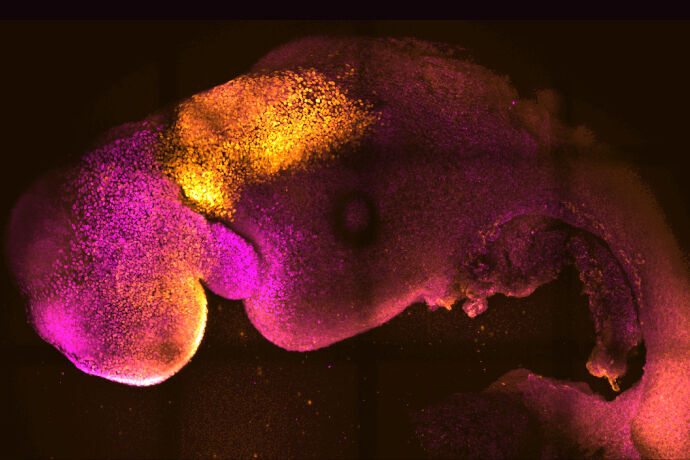
This microscope image provided by researchers Gianluca Amadei and Charlotte Handford shows a synthetic mouse embryo with colors added to show brain and heart formation.
Zernicka-Goetz, an expert in stem cell biology, said one reason to study the early stages of development is to get more insight into why the majority of human pregnancies are lost at an early stage and embryos created for in vitro fertilization fail to implant and develop in up to 70% of cases. Studying natural development is difficult for many reasons, she said, including the fact that very few human embryos are donated for research and scientists face ethical constraints.
Building embryo models is an alternative way to study these issues.
To create the synthetic embryos, or "embryoids," described in the Nature paper, scientists combined embryonic stem cells and two other types of stem cells — all from mice. They did this in the lab, using a particular type of dish that allowed the three types of cells to come together. While the embryoids they created weren't all perfect, Zernicka-Goetz said, the best ones were "indistinguishable" from natural mouse embryos. Besides the heart-like structure, they also develop head-like structures.
"This is really the first model that allows you to study brain development in the context of the whole developing mouse embryo," she said.
The roots of this work go back decades, and both Zernicka-Goetz and Hanna said their groups were working on this line of research for many years. Zernicka-Goetz said her group submitted its study to Nature in November.
Scientists said next steps include trying to coax the synthetic mouse embryos to develop past 8 ½ days — with the eventual goal of getting them to term, which is 20 days for a mouse.
At this point, they "struggle to go past" the 8 1/2-day mark, said Gianluca Amadei, a coauthor on the Nature paper based at the University of Cambridge. "We think that we will be able to get them over the hump, so to speak, so they can continue developing."
The scientists expect that after about 11 days of development the embryo will fail without a placenta, but they hope researchers can someday also find a way to create a synthetic placenta. At this point, they don't know if they will be able to get the synthetic embryos all the way to term without a mouse womb.
Researchers said they don't see creating human versions of these synthetic embryos soon but do see it happening in time. Hanna called it "the next obvious thing."
Other scientists have already used human stem cells to create a "blastoid," a structure mimicking a pre-embryo, that can serve as a research alternative to a real one.
Such work is subject to ethical concerns. For decades, a "14-day rule" on growing human embryos in the lab has guided researchers. Last year, the International Society for Stem Cell Research recommended relaxing the rule under limited circumstances.
Scientists stress that growing a baby from a synthetic human embryo is neither possible nor under consideration.
"Perspective on this report is important since, without it, the headline that a mammalian embryo has been built in vitro can lead to the thought that the same can be done with humans soon," said developmental biologist Alfonso Martinez Arias of the Universitat Pompeu Fabra in Spain, whose group has developed alternative stem cell based models of animal development.
"In the future, similar experiments will be done with human cells and that, at some point, will yield similar results," he said. "This should encourage considerations of the ethics and societal impact of these experiments before they happen."
___
The Associated Press Health and Science Department receives support from the Howard Hughes Medical Institute's Department of Science Education. The AP is solely responsible for all content.
Watch Now: Boosting your heart health after COVID, and more videos to improve your life
Here are some tips for improving your heart health after COVID, how to break free if your parents had bad money habits, and more videos to improve your life.

Even those who are super fit can find themselves with heart-related symptoms after COVID.

This is how you break away from your parents’ bad money habits. Pennygem’s Natasha Abellard has the story.

Taking your next work meeting to the park may have more benefits than you’d think! Yair Ben-Dor has more.

On nights before a big event, we try to get to bed early and beg for sleep, often to no avail. The harder we try to sleep, the more we worry w…

Dr. Jerry Klein, Chief Veterinary Officer at the American Kennel Club in Chicago, Illinois, has these tips on what and what not to feed your puppy.

It seems that recently everyone has become interested in healing their gut so here are 4 delicious foods that will help with this.

If you spend most of your day out in the sun, then it is only natural that your chance of burning increases.

Pets can get in stinky situations, but when that’s not the case it's important not to mask their smell. Buzz60’s Maria Mercedes Galuppo has th…

You’d think it’s obvious, but we’ve all sinned in the group chat department. Here are some ideas about group chatting to keep in mind.

A new study finds adults that went beyond the minimum guidelines for physical activity had a lower risk of premature mortality. Yair Ben-Dor h…

When your car breaks down, you want to get it fixed and back on the road right away. Unfortunately, car repair shops are notorious for adding …

While a couple of drinks may help you fall asleep, experts say those same drinks may disrupt the later stages of sleep.

