


WASHINGTON - Elated scientists, cheered by the successful landing of the most sophisticated collection of scientific instruments ever landed on the surface of Mars, got to work Monday to ready the rover named Curiosity for what they hope will be years of discovery about the origins of the red planet.
After 36 weeks in space - and a final "seven minutes of terror" - Curiosity was gently lowered to the Martian surface by a "sky crane" operation never before attempted by NASA. An orbiting Mars satellite sent back a picture of the rover and its hovercraft dangling from a parachute.
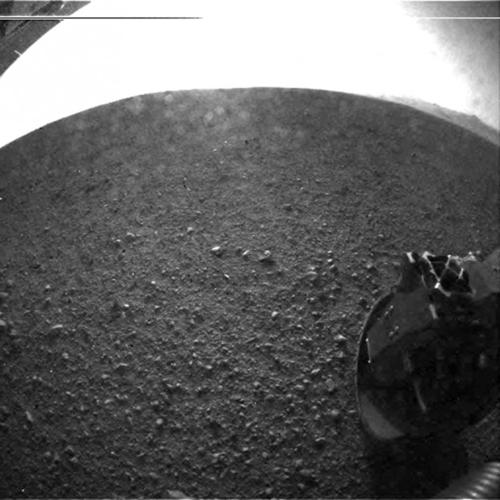
Within hours of its touchdown at 10:32 p.m. Tucson time Sunday, the one-ton rover was transmitting black-and-white images of the Martian landscape beneath an afternoon sun, the first of what scientists predict will be literally millions of bits of information, including a possible answer to the question of whether there was ever organic life on Mars.
"I can only imagine what incredible data and new understandings are going to be uncovered in the coming days, months and years because of this success," said John Holdren, the top science adviser to the White House.
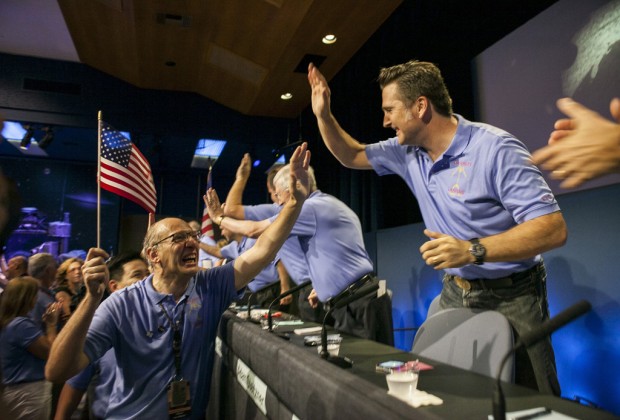
Mission control center at NASA's Jet Propulsion Laboratory in Pasadena, Calif., erupted into cheers, and NASA workers in light blue T-shirts hugged and high-fived one another as Curiosity confirmed its touchdown. Then they got back to work testing the rover's systems, a process that could take several weeks before it is declared operational.
"It's absolutely incredible. It doesn't get any better than this," said NASA Administrator Charlie Bolden. "It's a huge day for the nation."
Declared President Obama, in a statement issued by the White House: "It proves that even the longest of odds are no match for our unique blend of ingenuity and determination."
Added U.S. Sen. Bill Nelson, D-Fla., looking ahead to a flight that won't happen for a decade, if then: "I'm confident it will not be too long in the future before human footprints follow in the path of Curiosity."
It was the seventh time the U.S. has landed a craft on Mars, with Curiosity being the largest and most sophisticated by far. Many other attempts - including at least one by Russia - have failed.
The success of Monday's landing means the SUV-sized rover, which cost $2.5 billion to build and launch, soon can begin its exploration of the red planet, using 10 science instruments as well as a robot and even a laser to zap rocks and dirt to see what they're made of.
Though its mission life is two years, NASA officials hope they can extend that timeframe to four or more years, not an impossible goal given the longevity of two smaller rovers NASA landed in 2004; one of them is still working.
Curiosity's hunting range will be a 96-mile crater near Mars' equator, one of the lowest points on Mars. The basin, dubbed Gale Crater after an Australian astronomer, has been compared to the Grand Canyon - as both have their geological history neatly layered in the rock. It also sports a 3-mile-high mountain called Mount Sharp, and scientists believe the basin may have even held water once.
In the coming weeks, the rover - powered by a plutonium battery - will grind its way around the crater at a top speed of about one-tenth a mile an hour.

