

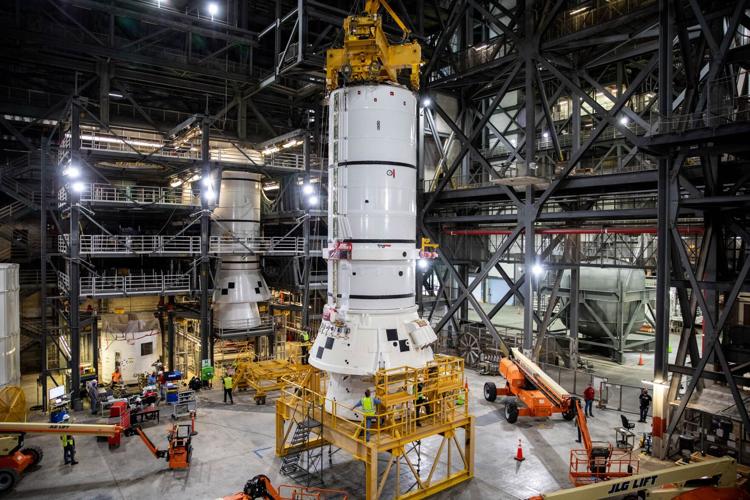
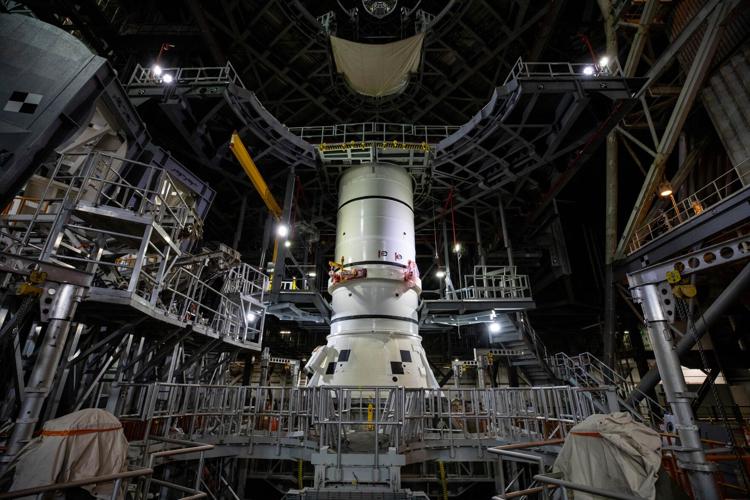

The aft segments of the Space Launch System solid rocket boosters for the Artemis I mission prepares to move from high bay 4 inside the VAB for stacking on the mobile launcher inside high bay 3.
NASA engineers have begun assembling the massive rocket designed to take the first woman to the moon later this decade as part of the Artemis program.
The first booster segment of the Space Launch System (SLS) was stacked on top of the mobile launcher at NASA's Kennedy Space Center in Florida earlier this week in preparation for its maiden flight, NASA said Tuesday.
A total of 10 segments will form the twin solid rocket boosters before its first liftoff, which is expected to take place next year.
The rocket is a key part of NASA's Artemis lunar exploration program, which aims to send the first woman and next man to the Moon by 2024. NASA officials also hope the SLS will be used to reach Mars and other "deep space destinations."
Once fully assembled, NASA said the SLS rocket will stand taller than the Statue of Liberty and have about 15% more thrust at liftoff than the Saturn V rockets that powered the Apollo missions about50 years ago, making it the most powerful rocket ever built.

The aft segments of the Space Launch System solid rocket boosters for the Artemis I mission moves from high bay 4 inside the VAB for stacking on the mobile launcher inside high bay 3.
However, the project has been dogged by delays and cost overruns.
"Stacking the first piece of the SLS rocket on the mobile launcher marks a major milestone for the Artemis Program," said Andrew Shroble, an integrated operations flow manager with Jacobs, a company working with NASA on the Artemis program, in a NASA news release.
"It shows the mission is truly taking shape and will soon head to the launch pad."
NASA's Artemis I mission is expected to launch in 2021 with two test flights around the moon without astronauts. Artemis II is set to launch in 2023 with astronauts on board in preparation to have Artemis III bring astronauts to the surface of the moon.
Artemis is named after the Greek goddess of the moon and is twin sister of Apollo.
How do astronauts sleep? 12 things you never knew about life in space
How do astronauts sleep? 12 things you never knew about life in space
The space shuttle had kind of has a new car smell
Updated
Astronaut Mike Fincke flew on space shuttle Endeavour’s final mission in 2011. He wistfully remembered the shuttle’s smell in an interview. “The space station has a very neutral smell to me, but the shuttle has a slight metallic twang,” he told the Los Angeles Times. “Words can’t describe that particular blend.”
No poker game
Updated
Astronaut Greg Johnson took a deck of cards aboard the space shuttle, but then found it nearly impossible to play in zero gravity.
Watch the snacks
Updated
Astronaut Mike Fincke, who flew on Endeavour’s final mission in 2011, told the Los Angeles Times what NOT to bring on the space shuttle: No peanuts or other small snacks. The pieces would fly around and get stuck in hard-to-reach spots that would have to be cleaned up before landing.
They have to strap in to sleep
Updated
Zero-gravity makes sleeping in space tricky. Astronauts strap sleeping bags to walls or ceilings so they don’t float around while they sleep.
What time is it?
Updated
Another thing that makes sleep tricky: The International Space Station orbits the Earth every 90 minutes. So the sun is rising – and setting – every hour and a half.
Chores in space
Updated
Each astronaut had specific duties aboard the space shuttle: building or fixing machinery on marathon spacewalks, wielding the shuttle’s 56-foot robotic arm, cleaning the toilet — an onerous task typically dealt to the pilot.
Zero-gravity Games
Updated
Occasionally, astronauts make time to goof around. While Endeavour was hooked up to the International Space Station during the 2010 Winter Olympics, one astronaut performed a figure-skating twirl while another jumped with small makeshift skis.
Astronauts get taller in space
Updated
Freed from gravity’s pull, the spine straightens and the body lengthens.
They are aware of their place in history
Updated
Space shuttle Endeavour was named after the HMS Endeavour, which was 18th century British explorer Capt. James Cook’s ship. When Astronaut Andrew Thomas flew aboard Endeavour in 1996, he brought along a slim stick of wood from the HMS Endeavour. “That would have blown Capt. Cook’s mind,” Thomas said. “That piece of wood traveled about, oh, 6 million miles.”
Other things they carried
Updated
On Garrett Reisman’s first flight on Endeavour in 2008, he packed his high school physics teacher’s rosary beads, a Christmas card from a friend who had died in the Sept. 11 attacks and a gold chain his late father wore. He also carried two pairs of wedding rings for his former California Institute of Technology professor Christopher Brennen. “I was trying to thank people that had helped me along the way,” Reisman said.
Floating is as cool as you might imagine
Updated
Does floating look like the coolest thing about being in orbit? Astronauts say you’re right; it is. “Floating is one of the most wondrous parts of being in space,” said Jeffrey Hoffman, an MIT aeronautics professor who flew on the first mission to repair the Hubble Space Telescope in 1993.
The toilet is … tricky
Updated
Floating did have its downsides — particularly concerning the toilet. “Um, it’s quite complex,” Fincke said. “You have to strap yourself in, and there’s these leg stirrups, and you need to make a ‘perfect seal.’”

