

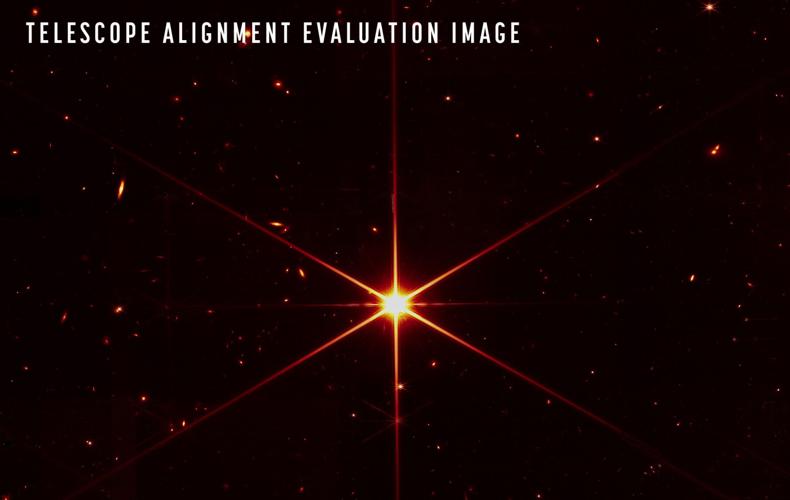
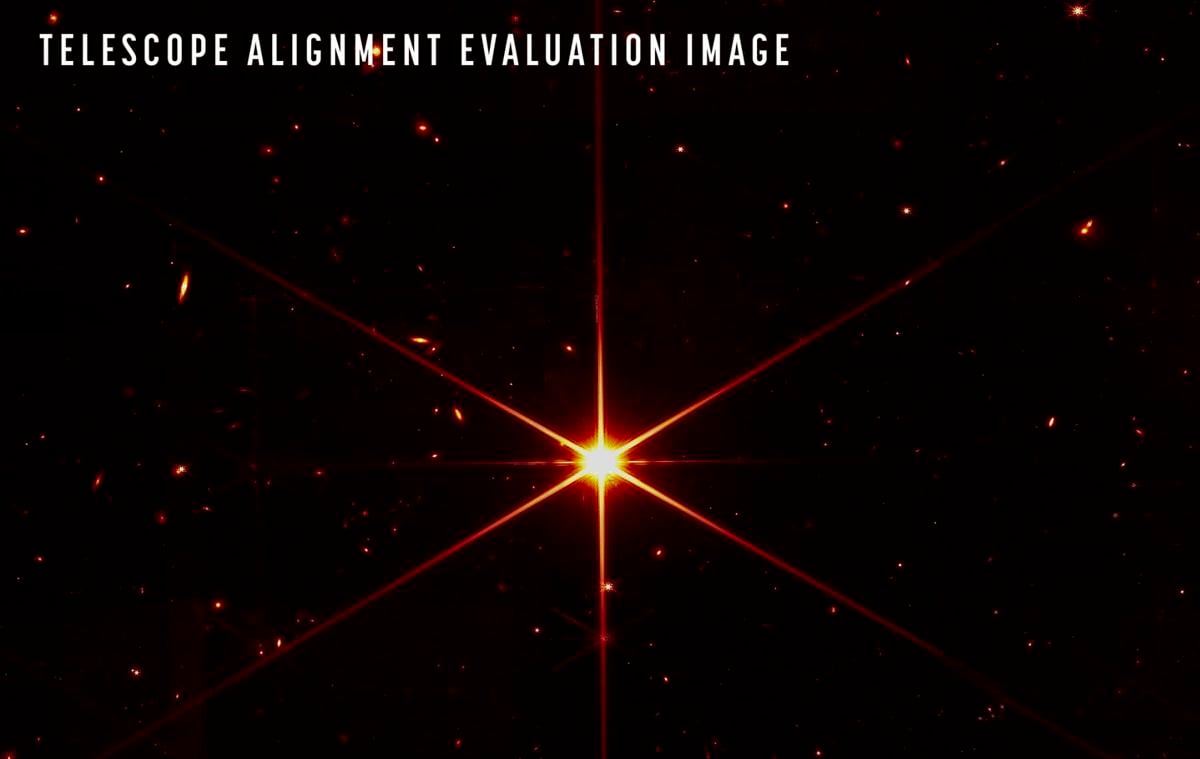
A highly sensitive optical device called the Near Infrared Camera, which University of Arizona scientists developed and now manage, has allowed the James Webb Space Telescope to capture its first focused image of a single star.
“More than 20 years ago, the Webb team set out to build the most powerful telescope that anyone has ever put in space and came up with an audacious optical design to meet demanding science goals,” Thomas Zurbuchen, associate administrator for NASA’s Science Mission Directorate in Washington, D.C., said at a news conference Wednesday. “Today, we can say that design is going to deliver.”
The Webb telescope, which NASA first launched Dec. 25, 2021, has a 21-foot-4-inch primary mirror, which is composed of 18 hexagonal, gold-plated, beryllium mirror segments. All of those mirror segments had to be folded up to launch into space. When the telescope first arrived in outer space, those mirrors had to unfold and were not yet aligned, so they produced 18 images of the same star.
The NIRCam (that’s the shorthand name for the UA-developed camera) helped to align the mirrors to first produce one image of an out-of-focus star. The image released Wednesday shows a single image of a fully focused star, as well as the galaxies and stars behind it. The image provides confirmation that the telescope is capable of meeting — and exceeding — the expectations its designers had for it.
“In addition to enabling the incredible science that Webb will achieve, the teams that designed, built, tested, launched and now operate this observatory have pioneered a new way to build space telescopes,” Lee Feinberg, Webb’s optical telescope element manager at NASA’s Goddard Space Flight Center in Greenbelt, Maryland, said at a news conference.

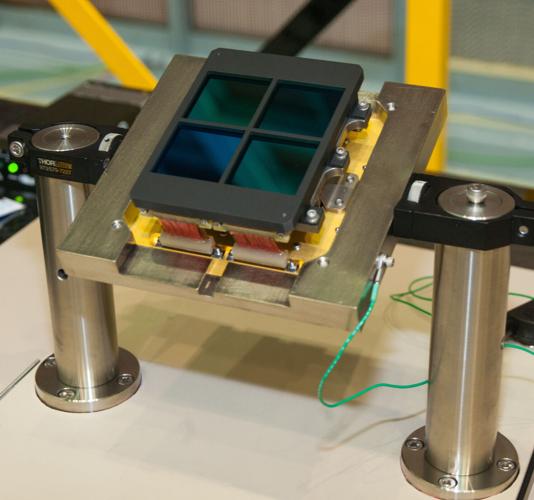
This figure shows four 0.6-2.5 µm James Webb Space Telescope NIRCam H2RGs mounted into a focal plan module. This figure shows the black optical baffle that admits light onto the four detectors while blocking it from hitting any surfaces that might reflect, such as the edges of a detector.
The picture released Wednesday, “represents the culmination of a huge amount of work just to get here,” Kevin Hainline, an assistant professor of astronomy at the UA and NIRCam team member, told the Arizona Daily Star. “If the telescope were sitting here in Tucson, you could take a picture of a basketball in Albuquerque, New Mexico. That’s how good the focus is.”
Last week, the Webb team completed the “fine phasing” stage of alignment, which means every optical parameter on the telescope it has checked or tested is working at or above expectations. Scientists overseeing the telescope’s commission also found no major issues and no blockages or contaminations that would obstruct the telescope’s optical path.
Now that the fine phasing is complete, NIRCam, which is the telescope’s primary imager, is fully aligned to the observatory’s mirrors.
Over the next six weeks, the Webb team will work on aligning the telescope to other cameras in addition to NIRCam, which include the Near-Infrared Spectrograph, the Near InfraRed Imager and Slitless Spectrograph and the Mid-Infrared Instrument, or MIRI, which is led by UA astronomy professor George Rieke.
The final details of that process are expected to conclude by May, and Webb’s first full-resolution imagery and science data will be released in the summer, according to a NASA news release.

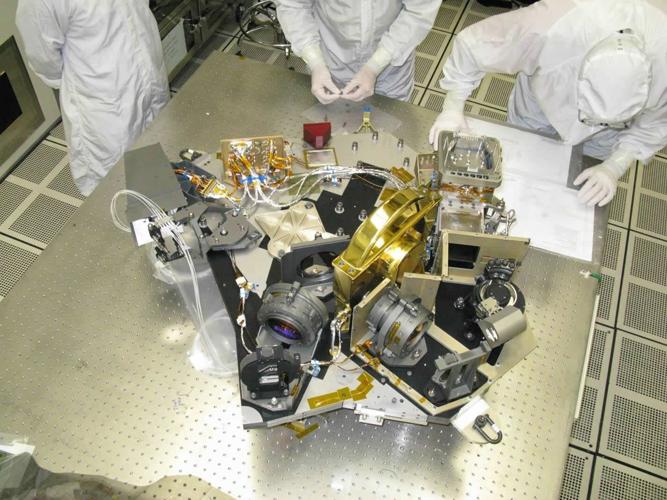
The James Webb Space Telescope's NIRCam instrument has passed its testing at Lockheed and is being readied for shipment to Goddard.
At that time, astronomers will be able to utilize the powerful telescope for varying projects.
“While we’re going to be doing amazing things for stars and planets in our own galaxy, (the Webb telescope) has an enormous mirror … that is perfect for studying the very distant universe and helping us understand the evolution of the universe from earliest time to today,” Hainline, the UA astronomer who works on NIRCam, said.
Likening the universe to the development of a human person, Hainline said the Hubble Space Telescope, which was the most powerful telescope before Webb, “let us see what the universe was like as a 1-year-old.” Now, the Webb telescope “will let us see what the universe was like as a 1-day-old baby.”
“The amount of things you can learn about a baby from one day to one year is incredible, and (Webb) will let us do that for the universe.”
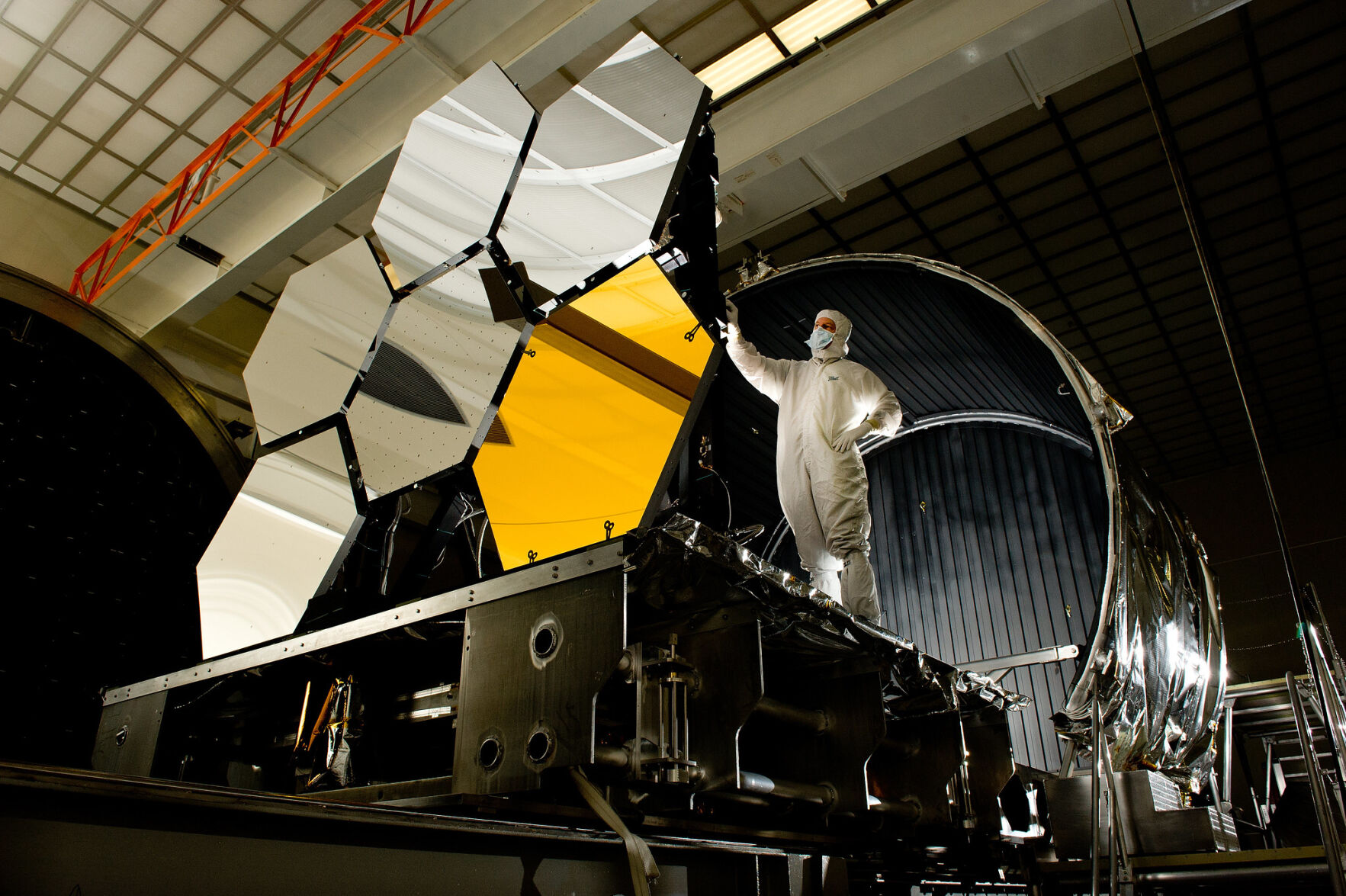
Ball Aerospace lead optical test engineer Dave Chaney inspects six primary mirror segments, critical elements of NASA's James Webb Space Telescope, before cryogenic testing in the X-ray & Cryogenic Facility at NASA's Marshall Space Flight Center in Huntsville, Ala.

