

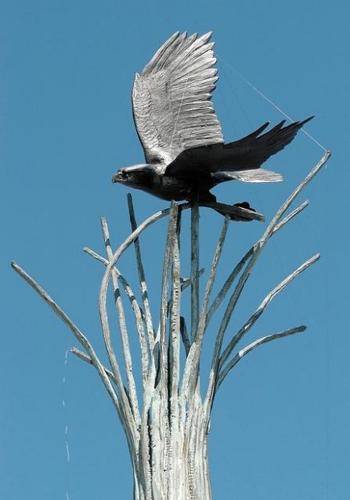
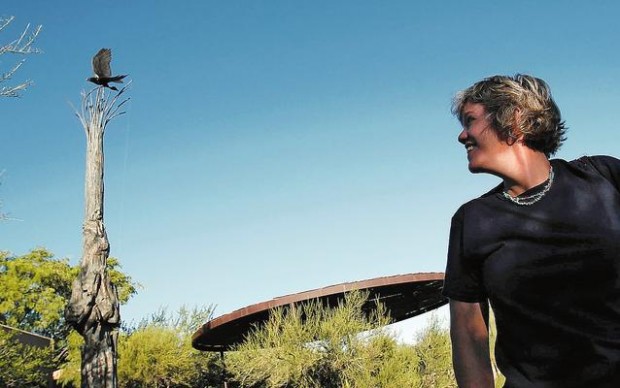
Laurel Clark's family chose a Harris' hawk image to help memorialize her because the birds often work in teams of seven — like the space shuttle team of astronauts.
Officials dedicated a 20-foot bronze sculpture Saturday of a Harris' hawk spreading its wings atop a saguaro, in memory of Dr. Clark, one of seven astronauts who died in 2003 when space shuttle Columbia burned and disintegrated on return to Earth.
The sculpture by Tucson artist Mark Rossi will be a permanent exhibit at the Arizona-Sonora Desert Museum. It took two years to create, cast and install, with part of the cost donated by the artist.
Clark was a physician and aviator who had been stationed in Yuma, had relatives in Tucson and often visited the museum. There she enjoyed watching hawks soar in the free-flight exhibit.
In South America, the highly social birds usually hunt in pairs. Farther north in the Chihuahuan Desert, they often work in trios.
"But in the Sonoran Desert we see these really larger groups — four to eight birds," said Sue Tygielski, an animal behaviorist at the museum.
"It's thought that (because of) the pressures of the Sonoran Desert — because it's so spiny and prickly — that it's safer to hunt in a pack."
Clark had a lifelong passion for nature, according to remarks prepared for Gov. Janet Napolitano, who was at the museum Saturday.
Clark's mother, Margory Brown, has established the museum's Earth Camp, a program to teach children about the natural world and its connection to the universe.
●To donate either to the sculpture project or to the Laurel Clark Environmental Education Endowment Fund, call 883-3055 or visit www.desert museum.org.

