


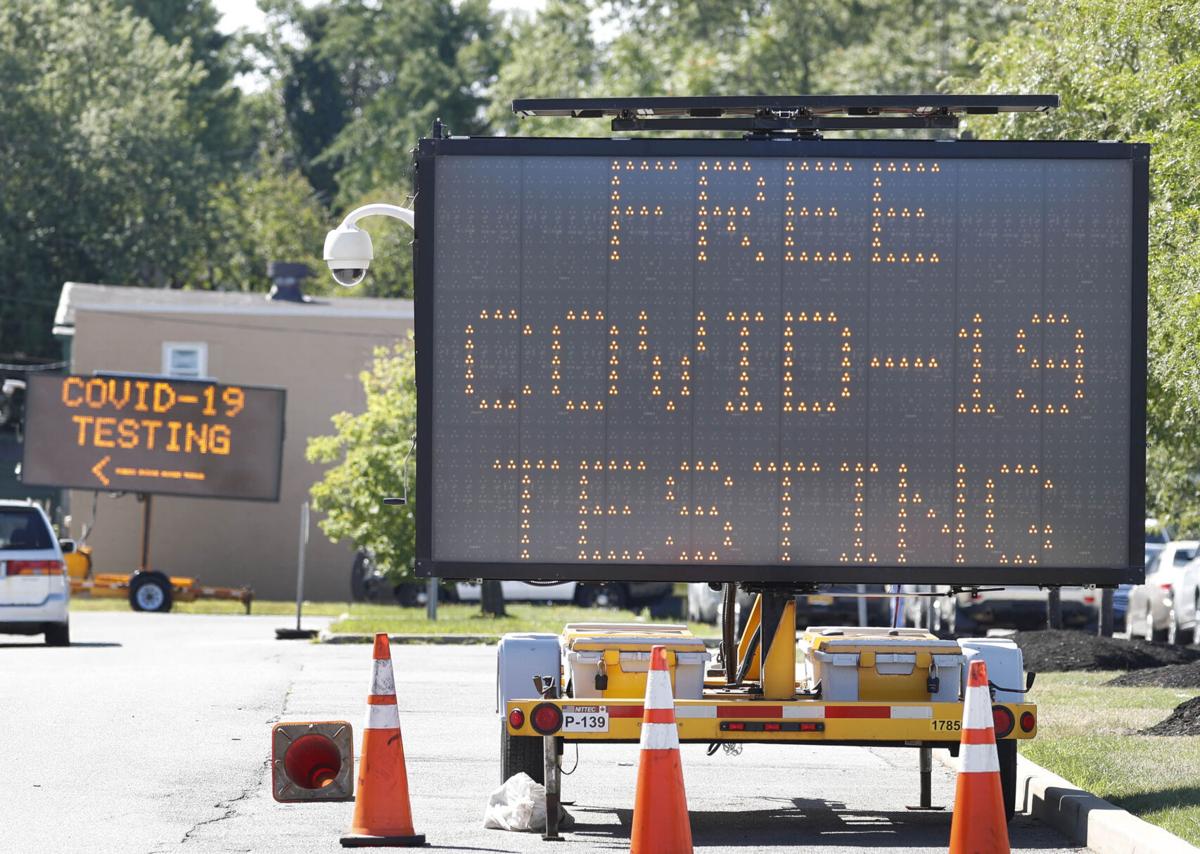
Doctors who have firsthand experience with the Covid-19 pandemic are trying to figure out why Western New York's positive test rate remains among the highest in the state and why hospitalizations have reached levels last seen several months ago.
In interviews Saturday, the head of one of Erie County's largest neighborhood health clinics said the virus continues to disproportionately affect the many Black, refugee and immigrant patients the office serves, and a University at Buffalo infectious disease expert said students likely are sickening their older relatives.
The physicians said those are some of the reasons why Covid-19 numbers in Erie County and the rest of the region have taken a troubling turn in recent weeks, based on data reported by the county and state.
"The communities we serve have stubbornly high Covid rates compared to the general population," said Dr. Myron Glick, chief medical officer of Jericho Road Community Health Center.
Dr. Thomas A. Russo said he doesn't believe the situation requires the crackdown Gov. Andrew M. Cuomo has ordered to address Covid-19 hot spots in parts of New York City and its suburbs, but he cautions that looming colder weather and major holidays make keeping the virus in check that much more difficult.
"I think it's good that we get a wake-up call here," said Russo, a professor and chief of infectious diseases at UB.
Western New York's positive test rate Friday was at 1.4%, the second-highest rate in the state behind the 1.5% rate for the mid-Hudson region, Cuomo reported Saturday. There were 96 positives out of 6,722 tests performed in the five-county region.
The rolling, seven-day average for the region's positive test rate was 1.3%. That figure has remained between 1.2% and 1.4% since Sept. 15.
The statewide positive test rate was 1.07% on Friday. For Erie County alone, the 50 positives among 4,063 tests reported Friday produced a positive rate of 1.2%, County Executive Mark Poloncarz said on Twitter.
Covid-19 hospitalizations in the region reached 59 on Friday, up four from Thursday and their highest total since June 16. The rolling, seven-day average of 53 hospitalized patients also was at its highest since June.
Patients in hospital intensive care units in the region rose by one to 15 on Friday, when the seven-day average of 14 was at its highest level since late June.
No new Covid-19 deaths in the region were reported as of late afternoon Saturday.
Representatives for Poloncarz and the Erie County Health Department did not immediately respond to a request seeking comment.
Glick said he's not surprised by the local numbers.
Jericho Road Community Health Center has conducted coronavirus testing at two clinics, one on the West Side and one in Broadway-Fillmore, on about 11,000 patients since the end of March with nearly 1,100 testing positive. Since March, 56 Jericho Road patients have been hospitalized and seven have died.
The cumulative positive test rate of 9.5% is lower than it was at the peak of the crisis but has remained between 4% and 6% on a rolling, 14-day average basis even in recent weeks, Glick said.
That overall number hides disparities within the clinics' patient population.
Whites have a 3% chance of testing positive, Blacks have a 13% chance of testing positive and immigrants and refugees from Burma – just one of a number of countries where Jericho Road patients come from – have a 24% chance of testing positive, Glick said.
The patients of color and patients from other countries served by Jericho Road are more likely to need to go to a job – at a manufacturing company, retail store or nursing home – where they risk exposure to the virus, he said.
"A lot of people that we serve didn't have the ability to sit this one out," he said. "They still have to go to work."
And they often live with large numbers of relatives, often from several generations in the same home, making it easier for the virus to spread within a family, he said.
Glick said he's aware of one case of a woman infected through her job who ended up spreading the virus to 11 of the 14 relatives who lived in her household.
And, he said, many of the patients are more likely to have underlying health conditions that make them more vulnerable to the virus. Many of those are rooted in poverty and other factors that disproportionately affect people of color.
The positive test rate for Covid-19 is driven by how many tests are conducted in a region and who gets tested, Russo said.
Hospitalizations, and deaths, are metrics that are less dependent on testing and are more a reflection of how well we protect the people most vulnerable to the virus, he said.
The number of patients receiving care in hospitals or their ICU units bottomed out in the region in early to mid-August, Russo noted, and those figures have been rising steadily since.
"The reality is we're doing worse than we were," he said.
Since that time in the summer, classes have restarted at the region's colleges and K-12 schools. Although some students are remotely learning, many have returned to school for at least some of their classes and Russo points to this as a key development.
Russo said it's unlikely the rising number of hospitalized Covid-19 patients includes very many children, teenagers or people in their early 20s.
But, he said, as infection rates rose among the youngest people being tested, there's a good possibility they are spreading the virus to parents, grandparents and other older relatives. And that's who is at risk of becoming seriously ill, or dying, from the virus.
"I think we're starting to see some of the ripple effects," Russo said.
Russo said some college students have been caught socializing without following public-health rules. But he noted that many high school and college students also work jobs that can't be done remotely, such as working the register at a supermarket or working behind the counter at a coffee shop.
Both Glick and Russo made a distinction between the Covid-19 trends here and the recent outbreaks downstate that have prompted the governor to impose tougher restrictions in select "red zones" – where just over 6% of tests came back positive this past week.
In those cases, large gatherings at houses of worship, weddings and funerals without proper social distancing appear to be driving spikes in Covid-19 cases.
"I don't think it's the same situation," Glick said.
But Russo said he is concerned about the months ahead, when colder weather will shift more activities inside and holidays including Halloween, Thanksgiving and Christmas will spur more people to want to spend time with family and friends.
"I think we need to gather ourselves at this point and really double down on our best behavior," he said, adding, "We do control what happens to us."

