


New York State's efforts to control the Covid-19 outbreak are entering a new phase as officials change which activities are permissible within virus hot spots and which metrics will trigger further restrictions in those communities.
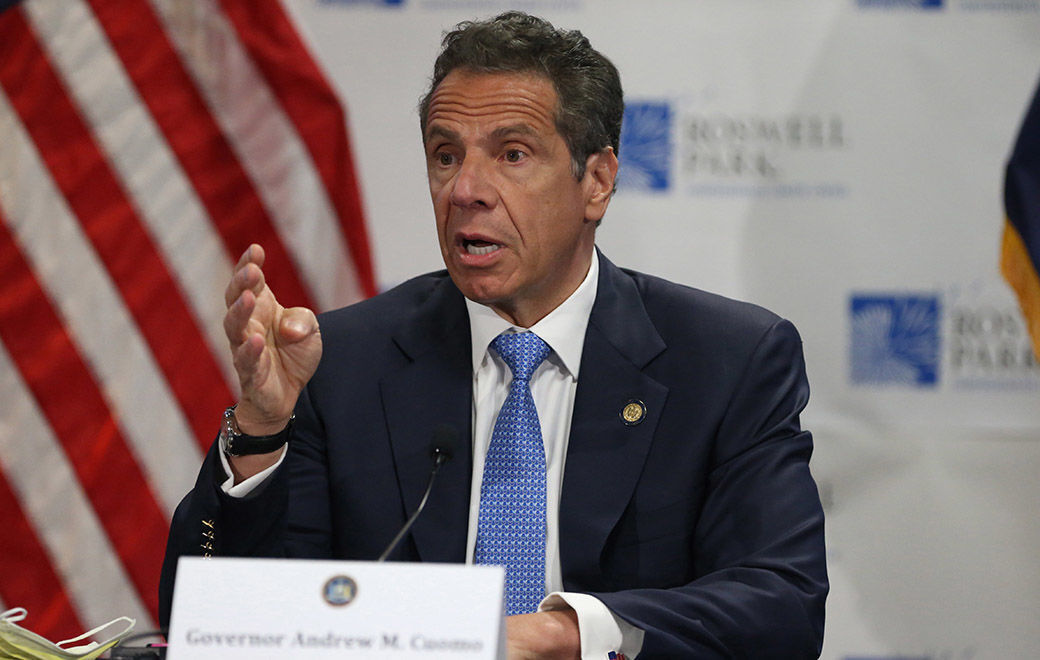
In the most notable shift, salons and gyms located in an "orange zone," such as the one that covers Buffalo and its immediate suburbs, are allowed to reopen with restrictions on capacity, Gov. Andrew M. Cuomo announced Friday, when he also pointed out a "flattening" in cases in the Western New York region.

Gyms and hair salons and spas can reopen in the state's orange zones, Gov. Andrew Cuomo announced Friday.
The change highlights a series of new measures and modifications to existing rules meant to respond more precisely to the recent surge in coronavirus cases. These adjustments included suspending all indoor dining in New York City and adding hospitalizations as a key factor in the decision whether to move a community to a restrictive "orange zone" or "red zone."
Also Friday, the governor's office for the first time provided details on where the virus is most likely to spread. Household and social gatherings were responsible for 74% of the state's Covid-19 exposures from September to November, according to an analysis of the state's contact tracing data.
This information raises questions about the restrictions imposed on businesses that aren't identified as a significant source of virus spread. And it comes as the state awaits its initial batches of the Covid-19 vaccine.
Cuomo on Friday defended the public health measures he has put in place, saying many of his office's decisions are driven by recommendations from the federal Centers for Disease Control and Prevention.
"We're on the theory of do everything you can within reason," he told reporters. "It's not forever – we have to get through this period."
Read the full story from News Staff Reporter Caitlin Dewey
New data pinpoints spread
Friday's contact tracing data release shows social gatherings such as parties, large family meals and other private household get-togethers are the most common reason the virus has spread in the state over the previous three months.
Nearly three-fourths of Covid-19 exposures where contact tracers could identify a source traced to those gatherings, the governor's office revealed. Public health officials have warned about this danger for months, especially for the high-risk period between Halloween and New Year's Day.
"This upcoming holiday season comes at the end of a very challenging year, and the thought of not being able to celebrate with loved ones is frustrating to every single one of us," Dr. Gale Burstein, Erie County's health commissioner, said in an email. "But we have to stay vigilant, and avoid gatherings with people that we don’t live with for now, so that we can have many healthy and happy holidays in the future."
The second-most common source of spread among 30 categories was within the health care sector, at 7.8%, followed by college and university students at 2%, teachers and school staff at 1.5% and restaurants and bars at 1.4%.
The data is based on contact tracing interviews with 46,000 people who contracted Covid-19 between September and November, or about 20% of the total cases in the state from this period.
State Budget Director Robert Mujica on Friday said the analysis only includes cases where a source of the infection could be pinpointed and does not include those where the patient couldn't be reached, couldn't or declined to provide a definitive source or where interviews still are being conducted.
Business owners cry foul
Critics for months have asked what data supports the state's decisions to close or curtail certain activities while allowing others to proceed.
Owners of gyms and salons are among the business operators who argued that they could operate safely and that there was no evidence showing their establishments were fueling the outbreak.
Gyms, salons feel vindicated with approval to reopen
Friday's contact tracing data ranks the hair and personal care category tied for 20th, at 0.14% of identified cases, and gyms tied for 25th, at 0.06% of cases from the three-month period.
Cuomo on Friday announced gyms, hair salons and barbershops located in "orange zones" can reopen at 25% of their normal capacity.
But Lt. Gov. Kathy Hochul had updated information late Friday afternoon, and said that hair salons could open with 50% capacity and weekly testing of those who work in them.
"Even with the limited capacity numbers, we're thrilled and cannot wait to have our members back in the gym and keeping everyone healthy through the holidays," said Lauren Shagla-McKotch, director of operations at Jada Blitz Fitness in Clarence.

The five-county region Western New York region reported a daily high of 1,135 cases on Thursday.
Most of Erie County is still in an "orange zone," with other parts of the county in a less-restrictive "yellow zone."
Restaurants in "orange zones" only can provide takeout or delivery service and can't offer indoor dining.
Cuomo on Friday announced he was again banning indoor dining in New York City's restaurants, citing the surge in Covid-19 cases, the city's natural density and recommendations from federal experts.
This prompted questions about restaurant owners' warnings that many won't survive without substantial government assistance. Cuomo said he understood the pain felt by owners of restaurants and other small businesses but said such decisions are driven by public health concerns.
"I suffer every lost dollar with these businesses," Cuomo said, citing lost sales tax revenue for transactions that don't take place.
He added the state is analyzing Covid-19 data from indoor dining and a change in the guidelines could come Monday.
Cuomo also reiterated his belief that it's clear children are better off, for educational and health reasons, in school. Still, Buffalo Public Schools plan to continue fully remote learning until Feb. 1 at the earliest, a development Cuomo addressed Friday.
"The City of Buffalo recently announced they’re going to keep their schools closed. I respect local governments, I respect the prerogative of local governments with education, I understand the balance," Cuomo said. "But my advice … most informed experts will say test in the schools but if the schools are safer, then leave the schools open."
Erie County Executive Mark Poloncarz said he addressed this issue in a phone call with the governor early Friday.
"As previously noted, we are not seeing transmission in local schools among students, but do see among staff," Poloncarz said in a tweet. "We are all concerned about lack of in-school learning in some districts."
Hospital capacity key
Cuomo also broke down new metrics that would determine whether the state imposes a "red zone," "orange zone" or "yellow zone" in a community.
The state has in recent weeks focused on hospitalizations as a data point and the changes announced Friday center on a community's ability to handle its Covid-19 patient load.
Now, the state will impose a "red zone," essentially a return to the springtime shutdown, if data show an area is 21 days away from reaching 90% of its hospital capacity.
"The only reason you would close the economy is because we're going to overwhelm the hospitals," Cuomo said.
The state would impose an "orange zone" if a community reaches a 4% positive test rate over 10 days and 85% of its hospital capacity.
A "yellow zone" would come if an area hits 3% positivity over a 10-day period and it's seeing a high per-capita rate of hospital admissions and growth in daily admissions.
The governor said new zones will be calculated with weekend data taken into account and will be announced Monday.
As of Wednesday, 73% of hospital beds in the Western New York region were in use, according to the state. Erie County Executive Mark Poloncarz said Erie County's snapshot hospital bed capacity as of Tuesday was 84%.
"We are getting to a point now where we’re very concerned," Poloncarz said Thursday.
Under New York state's new "microcluster strategy," red zone hot spots would have to adhere to the following restrictions.
WNY surge flattens
This warning comes as the first 170,000 doses of Pfizer's Covid-19 vaccine – a dose includes the two shots each person needs to take – should reach New York this weekend. Cuomo said Friday a second batch from Moderna, double the size of the Pfizer shipment, should arrive the week of Dec. 21.
The initial doses will be provided to nursing home residents and staff and front-line health care workers and distributed based on each region's share of those populations.
Cuomo on Friday had some promising news for this region. Cuomo said the overall statewide positive rate is 4.98%, with Western New York at a 7.22% rate that, for once, did not lead the state.
The hospitalization rate by population in the five-county Western New York region is 0.04%, tied with Central New York. The Finger Lakes region, which includes Rochester, has the highest hospitalization rate at 0.05%.
"Western New York, where we've been focused on for quite some time, we've seen a flattening ... and that's good news," Cuomo said Friday.
The governor also focused on the state's "Rt," or rate of transmission, which is up to 1.3. That means one person will infect 1.3 people, and the governor previously has warned any rate above 1 is concerning.
In addition, the five-county region, which includes Erie, Niagara, Chautauqua, Cattaraugus and Allegany counties, reported a daily high of 1,160 cases on Thursday.
The five-county case total broke the record of 1,102 set a week earlier on Dec. 3. It is the eighth time a daily high has been recorded since Nov. 5.
News Business Reporter Matt Glynn contributed to this report.

