

TUBA CITY — The virus arrived on the reservation in early March, when late winter winds were still blowing off the mesas and temperatures at dawn were often barely above freezing.
It was carried in from Tucson, doctors say, by a man who had been to a basketball tournament and then made the long drive back to a small town in the Navajo highlands. There, believers were preparing to gather in a small, metal-walled church with a battered white bell and crucifixes on the window.
On a dirt road at the edge of the town, a hand-painted sign with red letters points the way: “Chilchinbeto Church of the Nazarene.”
From that church, COVID-19 took hold on the Navajo Nation, hopscotching across families and clans and churches and towns, and leaving the reservation with some of the highest infection rates in the U.S.
Crowding, tradition, and medical disparities have tangled together on the tribe’s land — an area nearly three times the size of Massachusetts —creating a virological catastrophe.
And the most basic measures to fight the virus’ spread — handwashing and isolation — can be difficult.
One-third of the homes across the vast, dry reservation don’t have running water, forcing families to haul it in. Many in close-knit Navajo communities live in crowded houses where self-quarantine is impossible, and many must drive hours to the nearest grocery store. To most Navajo, isolating an infected person from their family is deeply alien.
The Chilchinbeto meeting, which brought people together from across the region, included everything from discussions of church finances to a joyful meal of roast beef. They prayed for strength in the face of the new virus, which seemed like a distant worry.
Instead, it was already in their midst.
“We’re such a small town. We’re so remote, “said Evelyna Cleveland-Gray, a Chilchinbeto official who struggled to keep residents from panicking as the virus ripped through the town of about 500, eventually killing more than a dozen people. “We never thought it would hit us.”
By now, the loss is felt across the Navajo Nation.
With roughly 175,000 people on the reservation, which straddles Arizona, New Mexico and a small corner of Utah, the Navajo Nation has seen 3,122 cases — a rate of nearly 18 cases per 1,000 people. At least 100 people have died.
If Navajo Nation were its own state, it would have the highest per-capita rate of confirmed positive coronavirus cases in the country, behind only New York. In the states it spans, the number of cases and deaths among people who are Native American, on and off the reservations, is disproportionately high.
There was the beloved 42-year-old high school basketball coach who left behind five children. There was the carpenter who lived with his brother and died on Easter morning at age 34. There was the 28-year-old mother who competed in Native American pageants.
And on the far western side of the reservation, there’s the extended Dinehdeal family who live in a cluster of prefabricated houses and mobile homes in Tuba City. A dog on a long chain lies in the driveway, sleeping in the soft red dirt that sweeps across the landscape. Another runs in circles waiting for someone, anyone, to throw a ball. Pickups, some in various states of dismemberment, are scattered across the property.
This is where generations of Dinehdeal children have ridden their bikes and played basketball against a weathered plywood backboard. It’s where the men have tinkered with those pickups and where the entire family — the tight-knit web of parents, aunties, uncles and cousins raised like siblings — have gathered for potluck meals, birthday parties and holiday celebrations. It’s where relatives from out of town have always been welcomed.
Now, it’s where the family mourns.
It began in late March with Maryann Welch, who at age 82 was still riding horses and running a small sheep ranch on Navajo Mountain, the dome-shaped expanse that looms over this part of the reservation. When she started to feel sick, her nephew and her 71-year-old sister, Eva Dinehdeal, drove the 90 miles from Tuba City to take her to the hospital. Soon Eva was sick, too, with low oxygen levels and a fever. Then it was Maryann’s son, Larry, a veteran of the Army’s 82nd Airborne Division, who divided his time between the ranch and the Tuba City houses.
Larry and Maryann died a day apart. Larry was buried on what would have been his 60th birthday.
Dinehdeal’s daughter, Gloria Uriarte, had moved back to Tuba City from outside Phoenix with her 6-year-old son, Curly, thinking they’d be safer there as the virus spread. But almost immediately she was caring for nearly everyone around her, often using the traditional practices that are deeply ingrained among Navajos. She kept sage boiling on the stove, for example, and encouraged everyone to drink it.
"We're tough as saguaros," editorial cartoonist David Fitzsimmons says. He says he saw a video made for the people of Detroit and became inspired to do his own take for Tucson.
Gloria, 45, didn’t escape sickness. She and her mother died April 11 within hours of each other, in different hospitals.
In a small bedroom in one of the prefabricated houses, just down the hall from a wooden table displaying the three women’s urns, Curly was tucked under a blanket. He is immobile and nonverbal after a brain injury and doesn’t know what happened to his mother. His family keeps Gloria alive for him by playing recordings of her voice on a cellphone. Set on a pillow next to Curly’s head of thick, black hair, Gloria gently calls out “Good morning, good morning.”
Curly coos softly.
Gloria’s sister and her partner are now caring for him.
The losses stripped the family of their matriarchs. They regret not learning how to make Eva’s famous yeast bread, which she sold at the local flea market every Friday.
They wonder what to do with her clothes, which fill every closet in the house and its storage sheds.
Angelina Dinehdeal, one of Eva’s daughters-in-law, is trying to hold the family together. Grief and exhaustion weigh heavily on her.
“It just seems like every time I take someone in (to the hospital) they never come out,” she said.
In Navajo tradition, communities gather for four days of mourning before a burial. Sacred stories are told. Elders talk to the young about coping with death. Donations are collected to cover funeral costs. In a culture where dying is rarely spoken about, it is a chance to openly grieve.
But with families hunkered down to avoid the spread of the virus, burials have become rushed graveside services. With funeral homes overwhelmed by the dead, some families have sidestepped tradition and had their relatives cremated.
Mourning is done over text messages, video conferences and three-way phone calls.
“You can’t even go see your mom and dad. You can’t see your relatives to find that comfort,” said Cheryl Blie, a Navajo who lost a cousin to the virus. “And the grief — the grief is so unbearable.”
The virus hit like a tsunami in mid-March, and smaller medical centers quickly were overwhelmed. Health problems that make COVID-19 more deadly, such as obesity, diabetes and heart disease, are all much more common among Native Americans than the general U.S. population.
A cobbled-together coalition of caregivers — doctors from the federal Indian Health Service and local hospitals, Navajo Nation officials, the National Guard, community health nurses, volunteer doctors, nurses and EMTs from across the country — has rallied as the number of cases grow.
The doctors are exhausted, the hospitals don’t have enough staff and the protective gear is carefully rationed. Three isolation centers were set up in basketball gyms — normally packed with fans for a sport that’s hugely popular among Navajos — to keep those recovering from COVID-19 away from their families. The sickest patients are flown to larger hospitals off the reservation.
Medical workers on the reservation work relentlessly.
When an oxygen valve failed on a ventilator at the Kayenta Health Center, a volunteer hand-pumped oxygen into a patient’s lungs for three hours.
“You literally cannot move. You have to breathe for them,” said Cindy Robison, an Air Force veteran who was among the volunteers. “You are paralyzed by the overwhelming ‘I know I can’t abandon this position even for a second.’”
The Navajo Nation or Diné Bikéyah includes some of the most rugged, beautiful and isolated land in the United States. The reservation stretches across 27,000 square miles with just over 6 people per square mile.
But that statistic hides how most Navajos actually live: in small towns or isolated outposts. A trip to the grocery store or the post office is a chance to socialize, shake hands, hug and catch up — all the things people are asked to avoid doing now.
Navajo Nation officials are trying to get people to isolate, putting out statements about coronavirus in English and Navajo, and imposing nightly curfews and weekend lockdowns. They’ve closed non-essential businesses and popular tourist sites like Canyon de Chelly and Monument Valley. They also must balance the restrictions with the realities of reservation life.
“I hear a lot of people saying, ‘Close the borders, shut down, shut down,’” said Jonathan Nez, the Navajo Nation president. “Our folks are supposed to be helping get water for the livestock, water for the household. You shut all that down, how can our elders wash their hands with soap and water if there’s no water available for them?”
If the Navajo are susceptible to the virus’ spread in part because they are so closely knit, that’s also how many believe they will beat it.
They’re leaving boxes of food and supplies on the steps of elders’ homes or in grocery bags hanging from fence posts. They’re driving for hours to take relatives to hospitals. They’re delivering water to friends and family.
Outside a tribal office in Tuba City, a steady stream of pickup trucks waited to fill large plastic containers.
Photos for April 23: Tucson gets by during Coronavirus Pandemic
Tucson, coronavirus
Updated
Erika Munoz, owner of Seis Kitchen, hands over a bag of meals to Michael Gallagher Carondelet, a registered nurse at St. Joseph's Hospital, to distribute to other nurses and hospital workers, on April 23, 2020. The donation was made in conjunction with A+C (Athletes/Artists+Causes) Foundation's “Project Frontline.” In two deliveries, 400 meals (200 poc chuck chicken and 200 puerco verde burritos) will be given to medical personnel at Carondelet St. Joseph’s Hospital. The particular donation was made possible by the Houston Astros' Pitching Coach Brent Strom, who lives in Tucson.
Tucson, coronavirus
Updated
Hospital workers wheel in carts full of catered meals donated by Seis Kitchen to Carondelet St. Joseph's Hospital, on April 23, 2020. The donation was made in conjunction with A+C (Athletes/Artists+Causes) Foundation's “Project Frontline.” In two deliveries, 400 meals (200 poc chuck chicken and 200 puerco verde burritos) will be given to medical personnel at Carondelet St. Joseph’s Hospital. The particular donation was made possible by the Houston Astros' Pitching Coach Brent Strom, who lives in Tucson.
Tucson, coronavirus
Updated
Kristi Hall, a sixth grade teacher at Desert Sky Middle School, participates in planning a lesson with a fellow teacher on Zoom, at her home on April 17, 2020. Schools in the Vail School District are supposed to open in July due to their year-round school calendar. Plans are being made for the possibility of students returning to the physical classroom.
Tucson, coronavirus
Updated
Bry Kelley, a warehouse assistant, places a pallet filled with food down next to other items donated to the Community Food Bank of Southern Arizona on on April 21, 2020. Forty-one thousand pounds of flour, pasta and canned goods were donated by The Church of Jesus Christ of Latter-day Saints. The donation is part of an ongoing global effort by the church to address immediate needs of people and orgainzations due to the coronavirus disease (COVID-19) pandemic.
Tucson, coronavirus
Updated
A pallet of food is placed down next to other items donated to the Community Food Bank of Southern Arizona on on April 21, 2020. Forty-one thousand pounds of flour, pasta and canned goods were donated by The Church of Jesus Christ of Latter-day Saints. The donation is part of an ongoing global effort by the church to address immediate needs of people and orgainzations due to the coronavirus disease (COVID-19) pandemic.
Tucson, coronavirus
Updated
Christian Bergman, 4th year University of Arizona medical student, takes the temperature of a patient outside the Z Mansion, 288 N. Church Ave., in Tucson, Ariz., on April 19, 2020. Medical students from the University of Arizona and other universities volunteer to help the homeless population with the growing concerns of Coronavirus Disease (COVID-19) within the homeless population. “This is a vulnerable population in our community; they can’t defend themselves in a society already running short on supplies and resources,” said Bergman. Medical students and medical personal help by giving out food, drinks with electrolytes and masks to the homeless. Those who are sick, medically impaired or have been exposed to those with COVID-19 are isolated outdoors in tents on the property. As of Sunday April 19, there were 13 individuals whom are isolated in tents.
Tucson, coronavirus
Updated
Lekha Chesnick, 1st year medical student at Burrell College of Osteopathic Medicine, talks with a homeless man (whom choose to not give his name) outside of the Z Mansion, 288 N. Church Ave., in Tucson, Ariz., on April 19, 2020. Medical students from the University of Arizona and other universities volunteer to help the homeless population with the growing concerns of Coronavirus Disease (COVID-19) within the homeless population. Medical students and medical personal help by giving out food, drinks with electrolytes and masks to the homeless. Those who are sick, medically impaired or have been exposed to those with COVID-19 are isolated outdoors in tents on the property. As of Sunday April 19, there were 13 individuals whom are isolated in tents.
Tucson, coronavirus
Updated
Christian Bergman, 4th year University of Arizona medical student, checks on a patient outside the Z Mansion, 288 N. Church Ave., in Tucson, Ariz., on April 19, 2020. Medical students from the University of Arizona and other universities volunteer to help the homeless population with the growing concerns of Coronavirus Disease (COVID-19) within the homeless population. “This is a vulnerable population in our community; they can’t defend themselves in a society already running short on supplies and resources,” said Bergman. Medical students and medical personal help by giving out food, drinks with electrolytes and masks to the homeless. Those who are sick, medically impaired or have been exposed to those with COVID-19 are isolated outdoors in tents on the property. As of Sunday April 19, there were 13 individuals whom are isolated in tents.
Tucson, coronavirus
Updated
Elliott Dumont, owner of Roadrunner Bicycles, 6177 E. Broadway Blvd., works on a customer's bike on April 22, 2020. The coronavirus disease (COVID-19) has not slowed down bike shops. With many people at home, they are bringing bicycles for repairs and buying new ones for exercise. Dumont says he's booked out till the first week of May for tuneups on bikes.
Tucson, coronavirus
Updated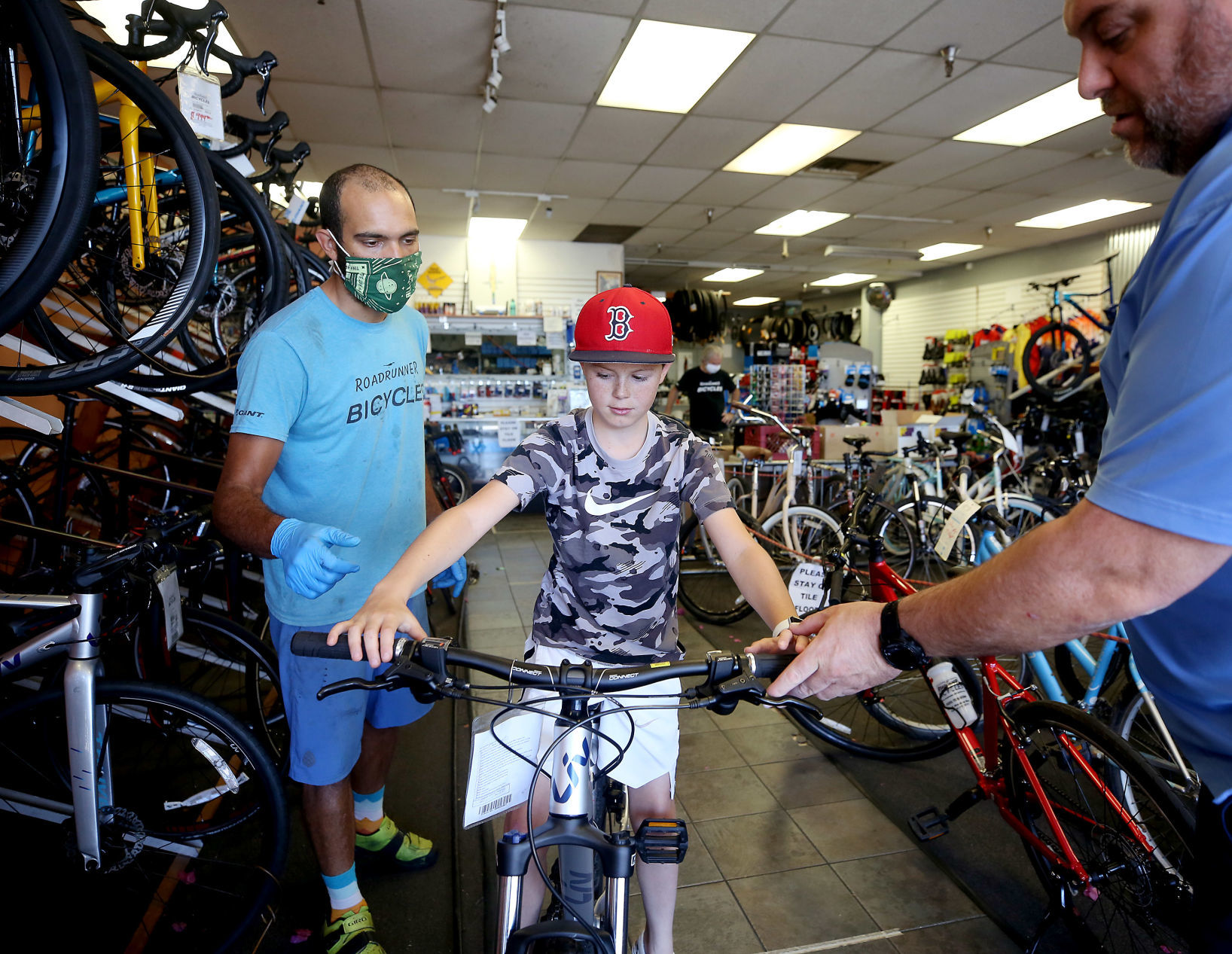
Elliot DuMont, owner of Roadrunner Bicycles, 6177 E. Broadway Blvd., far left, helps Ethan Sasz, far right, and his son, Evan, 10, with a mountain bike purchase on April 22, 2020. The coronavirus disease (COVID-19) has not slowed down bike shops. With many people at home, they are bringing bicycles for repairs and buying new ones for exercise. Dumont says he's booked out till the first week of May for tuneups on bikes.
Tucson, coronavirus
Updated
Marcella Montoya waits in her vehicle as general manger David Kessler brings out her order, as Bear Canyon Pizza serving their customers despite COVID-19 restrictions, April 22, 2020, Tucson, Ariz.
Tucson, coronavirus
Updated
Kitchen manger Koa Hoffmann tosses dough while working up a crust for a call-in order as he and few others keep cooking at Bear Canyon Pizza despite COVID-19 restrictions, April 22, 2020, Tucson, Ariz.
Tucson, coronavirus
Updated
Alvaro Enciso, a local artist, works in one of his studios at his home on April 9, 2020. Every Tuesday Enciso travels into the Sonoran desert to post crosses where migrants have died after crossing illegally over the U.S./Mexico border as part of a project he's titled Donde Mueren Los Suenos / Where Dreams Die. With the outbreak of the coronavirus disease his six year project is on hold and instead he works on other artwork at home.
Tucson, coronavirus
Updated
Dolly Spalding works on a pen and ink drawing in her apartment at the Redondo Tower Apartments on April 7, 2020. During her quarantine, Spalding has been creating drawings of all the Greek goddesses. She is collaborating with Emlyn Boyle, an artist from Ireland, and plans to publish a book with Boyle's writings.

