


At 8 a.m., the sun hadn’t yet started to scorch the dry landscape in the shadow of northern Arizona’s Gray Mountain, about 40 miles north of Flagstaff. Under a non-working windmill, Paul Lincoln crouched to examine hoof prints on the dusty earth.
“Notice no two hoof prints are the same,” he said. “They’re like human palms. See that ridge that looks like an arrowhead? We call it that, the arrowhead. It’s sacred to us. The horses are like thunder and lightning. They are sacred to us.”
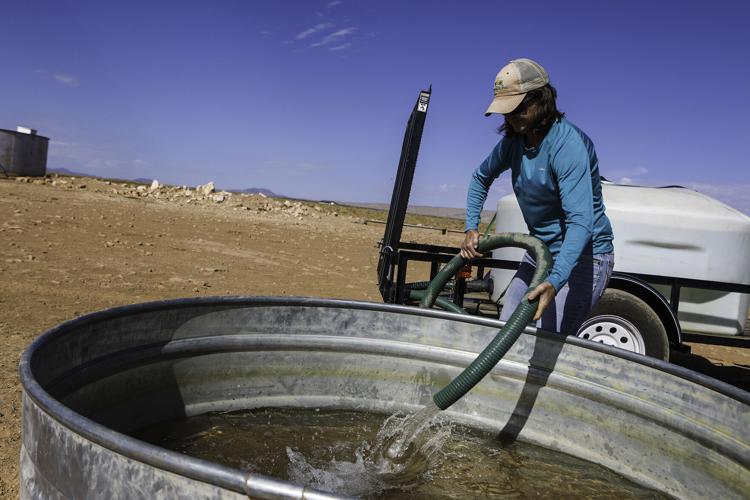
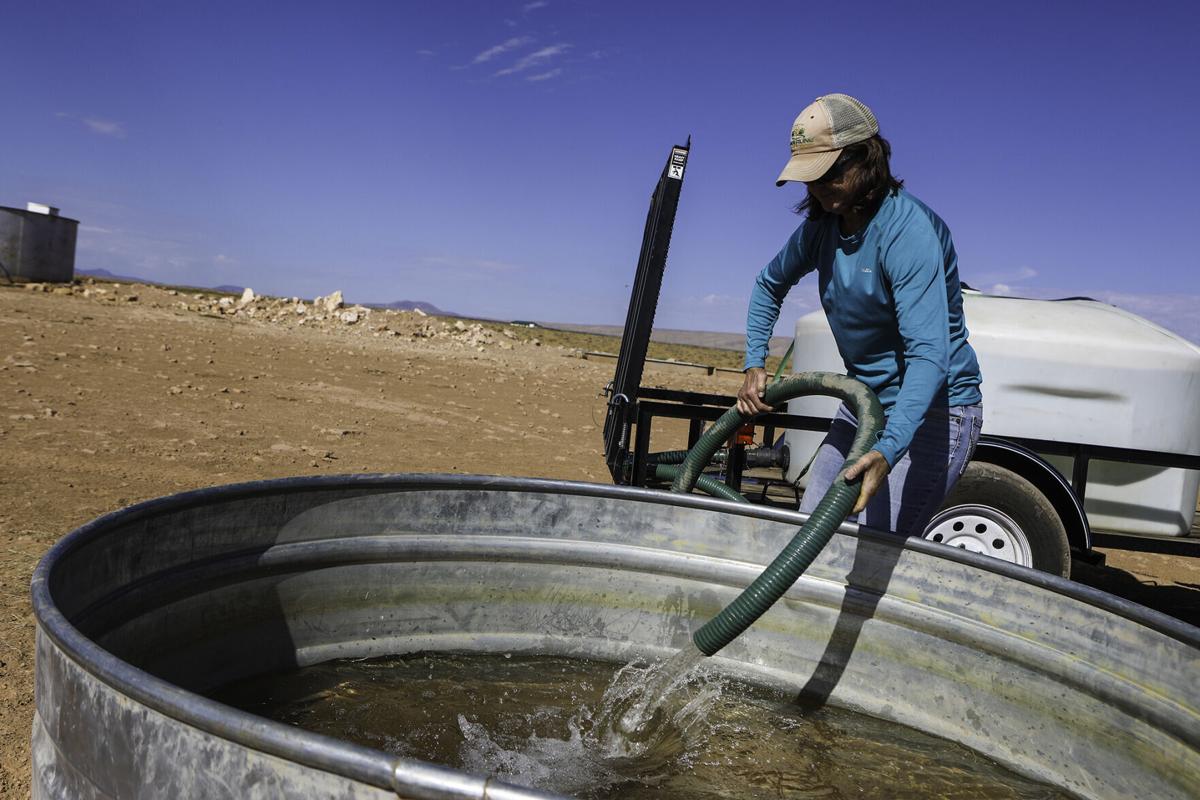
Lincoln is a former Navajo police officer who lives in Tuba City. Every morning in the summer he and his partner Glinda get in their truck, drive to Cameron to pick up a water trailer, and haul water to a series of tanks and troughs in Gray Mountain.
Those tanks are a critical water source for the nearby population of wild horses.
Gray Mountain is situated at a lower elevation than Flagstaff — about 5,000 feet — and in the past few weeks temperatures have climbed to a sweltering 109 degrees Fahrenheit, according to Lincoln. Horses come down from the mountain dragging their heads, he said, starving and dehydrated.
“It’s a desolate area. The vegetation is dry. There’s no water, no place to get out of the sun,” he said, gesturing widely over the rocky soil to the open sky.

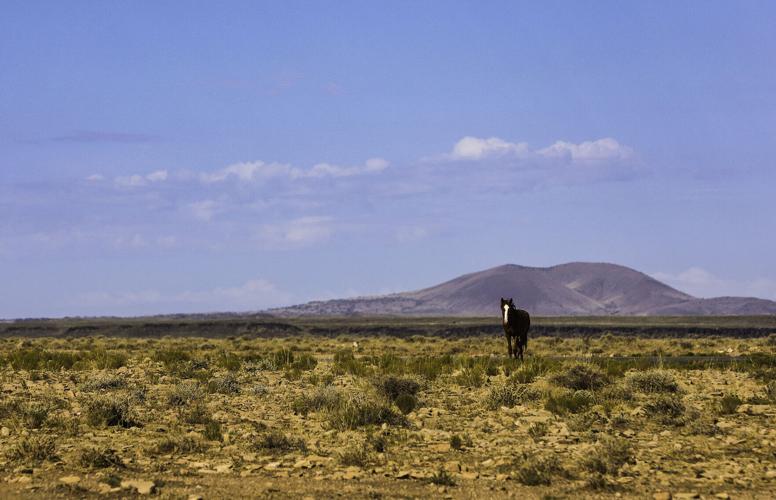
A wild horse makes its way across the plains near Gray Mountain as volunteers fill water tanks and leave hay for the horse and its companions.
In the fall, the horses are largely self-sufficient, but Lincoln knows that under the summer sun, they need a little help.
That’s why in 2018 he decided to start hauling water and bringing hay to the foot of the windmill. Initially, Lincoln lived in Gray Mountain and noticed the horses were desperate for water. He started filling kiddie pools and water bottles, trying his best to bring some hydration to the herd.
That same year, close to 200 horses died of dehydration in the Gray Mountain area.
“Horse Heroes”
Posts on Facebook started to spread about the dire condition of the animals, mobilizing people such as Eileen Taggart and Beth Buchanen to help Lincoln in his simple cause of bringing life-saving water to wild horses.
“I saw a post from another realtor named Billy McGraw that said these horses at Gray Mountain were starving and dehydrating. It was this amazing, emotional, really heartfelt post. There were people on the ground trying to help,” Taggart said. “I drove out and it was amazing. I met Paul and Glinda. Paul started making me laugh; I felt like I’d known him my whole life. It was a magical thing for me. It was something that filled a need to be with nature and help my feeling of helplessness. I saw the horses and I knew we could help them.”
Soon, a grassroots effort sprung up, and a new Facebook page called Gray Mountain Horse Heroes was published.
Meanwhile, the growing group of interested people connected with a Gilbert-based nonprofit that had helped equines in Arizona since 1995. Wildhorse Ranch Rescue, a 501(c )(3) organization, proved to be a valuable partner.
The nonprofit helped raise funds for Lincoln and his volunteers, first to purchase infrastructure — water tanks and troughs — then the water to fill it.
The tanks themselves hold about 1,100 gallons of water. It costs more than $750 a week to keep them full.
“The way we framed this is the wild horses bring the gift of water to Gray Mountain for everyone,” said Kimberly Meagher, the founder of Wildhorse Ranch Rescue.
The water can be used by wildlife, horses, cattle and local people who need it, Meagher said, so long as the horses themselves have a place to safely drink.
The spot beneath the windmill, where the tanks are located, is accessible via a mostly paved road, and it’s frequented by the area’s equine population.
“This is where it all began,” Lincoln said. “At the time the windmill wasn’t running. Then, just last year we got it going through the Navajo tribe. It lasted for so long and then, after that, it just stopped pumping water. I’m working on that, too. We’re trying to get Navajo Nation to help us.”
Via Facebook, Gray Mountain Horse Heroes has gained international attention.
According to Buchanan, donors from France, Canada, the UK, Australia and Italy have rallied to buy water and feed for the Gray Mountain horses. One generous horse lover in Texas helped raise $1,000 for the cause.
“It’s where our hearts are”
Guided by his heart for the area’s wild horses, Lincoln came out regularly, keeping an eye on the herd’s well-being to get them through the grueling summers.
“It just started out like that. Trying to help them out kind of gives me that inspiration, helping animals like people. Advocates. Mine is horses,” Lincoln said.
Five years on, Lincoln said the horses recognize his truck and usually come down for a fresh drink and and Bermuda hay breakfast while he’s on site.
“I actually have been able to touch them. After a while they trust you, they know the vehicles and stuff like that,” he said. “They have character … I keep an eye on them, I look through the herd when they get here. There’s one foal I’m looking at, he or she is really small, too.”
The animals are not tame, but they are thirsty, now more than ever. Water in the area is scarce even during years with heavy monsoons. The sure-footed wild horses that cautiously come down from the mountain to drink have been leaving the tanks drained dry in recent weeks.
On July 25, Elise Wilson hauled water to Gray Mountain and loaded a few bales of hay in the bed of her pick-up truck for the animals. She donated the water she hauled herself, filling up at a water stand in Flagstaff.
“I know it’s tough out here on the reservation for the horses and for the people. Most of us have horses, and our hearts are in this. We want to help as much as we can at least through the summer. It’s where our hearts are,” she said.
Sometimes horses don’t make it through the harsh summers; foals in particular struggle to survive.
“I’m sure there are foals who didn’t make it out there,” Lincoln said. “The foals, the strong ones, will make it out here (for water).”
Lincoln said he’s found orphaned foals who stayed by the water tanks and didn’t survive. But he’s been instrumental in saving some.

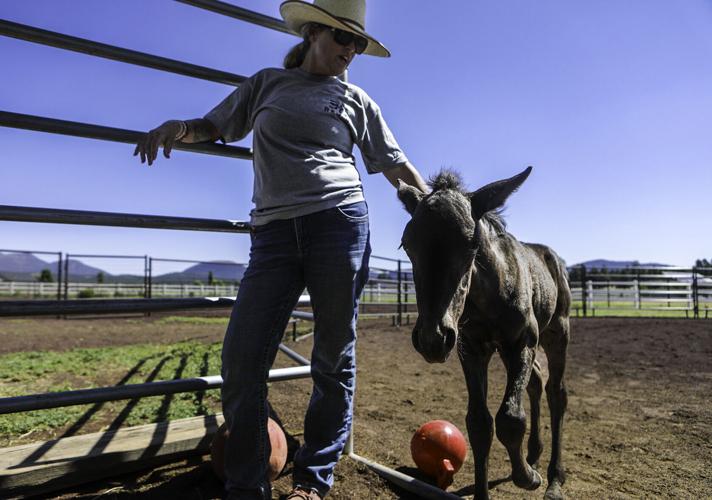
Barbara Hill pets 3-week-old colt Spirit as she discusses how he came to live with her. Spirit lost his mother and was in need of care when Hill took him in, but now she states she won’t be letting the sweet young horse go as he has found a home on her ranch.
“Baby Ash” found in dire straits
Wildhorse Ranch takes in orphaned foals from Gray Mountain and uses donations to cover the cost of medical care. Volunteers are still needed to get the colts and fillies from Gray Mountain to the Valley to see the vet and find more permanent sanctuary.
One foal, lovingly named Ash, Lincoln found in dire straits. Wilson ended up loading the baby horse in the back seat of her car to take him to Wildhorse Ranch.
“I’ve been around horses forever and I never thought about putting one in my truck. When we came I had my horse trailer ready, but there’s no way he would have made it in the trailer,” Wilson said.
The drive takes about four hours under the best conditions, but Wilson said Ash’s trip was especially eventful. On his journey, Wilson was passed by law enforcement officers engaged in hot pursuit with another vehicle. The high speed chase further delayed their journey.
Ultimately, Ash arrived in Gilbert and needed thousands of dollars’ worth of veterinary care.
“Baby Ash was in the hospital for 11 days. He’s a $7,000 baby horse,” Meagher said.
Because Gray Mountain Horse Heroes work as an informal, grassroots group, they don’t take donations directly. Instead, they receive dollars through Wildhorse Ranch. Donations are what supported baby Ash in his recovery.
“When we go get babies up at Gray Mountain, it’s Paul and Glinda who find them, keep them safe, give them milk. We couldn’t do it without them,” Meagher said.
Not long after Ash was found, another orphan was spotted in Gray Mountain. The high temperatures in Gilbert, along with the critical nature of the dark bay baby’s condition, meant he needed a foster in Flagstaff.
Barbara Hill took in the days-old colt. The first time he saw the veterinarian, he needed a name for record-keeping purposes. At the time Hill said she was chatting with the vet’s daughter about the animated movie “Spirit.” In the film, which follows a wild horse on adventures from his birth, the horse is a buckskin.
Despite his darker coloring, the name stuck. Hill said she’s realized the little guy has a lot of spirit.
She’s since decided to adopt him permanently.
The young horses that do end up in Gilbert are kept in a barn with commercial-grade misters, otherwise the heat would be too brutal to bear there, too.
Meagher said one day she hopes to have a fully air conditioned barn, but in the meantime every effort to save wild horses matters.
“What’s really important for people to remember is that wild horses have a place in our society. They’re important, they’re spiritual. It’s important for them to be safe along with everyone else,” Meagher said.
She believes the horses should be allowed to live in their family bands, with the exception of orphaned foals that wouldn’t make it otherwise.
“We believe they’re wild, we understand the population issues. We are in talks about doing birth control for the mares. It’s not like we just think there should be 10 million horses at Gray Mountain, but there shouldn’t be zero,” Meagher said.
That’s why after five years, Lincoln and his partner still work hard to get the Gray Mountain herd through the summer.
A few paces from one of the 300-gallon water tanks the horses rely on, Lincoln has stacked stones in the shape of a turtle.
Every time he stops to water the horses, he takes an orange lid off of a tote on his water trailer and dips it carefully into the tank. Then, he carries the water to his turtle, and with a steady hand, gently pours water onto the backs of the rocks.
It’s a prayer for rain, he explained.
Rain is always needed in Gray Mountain. When it rains, the horses don’t have to rely on humans to bring in water. When it rains, there is relief.
When it doesn’t, Lincoln is there, diligently caring for the animals he considers sacred.
These horses roam the lower Salt River in the Tonto National Forest. The herd is now managed by the Salt River Wild Horse Management Group under contract with the Arizona Department of Agriculture. It is believed the herd is descended from horses brought to Arizona by Father Eusebio Kino in the 1600s. Video by L.K. Bailey

