



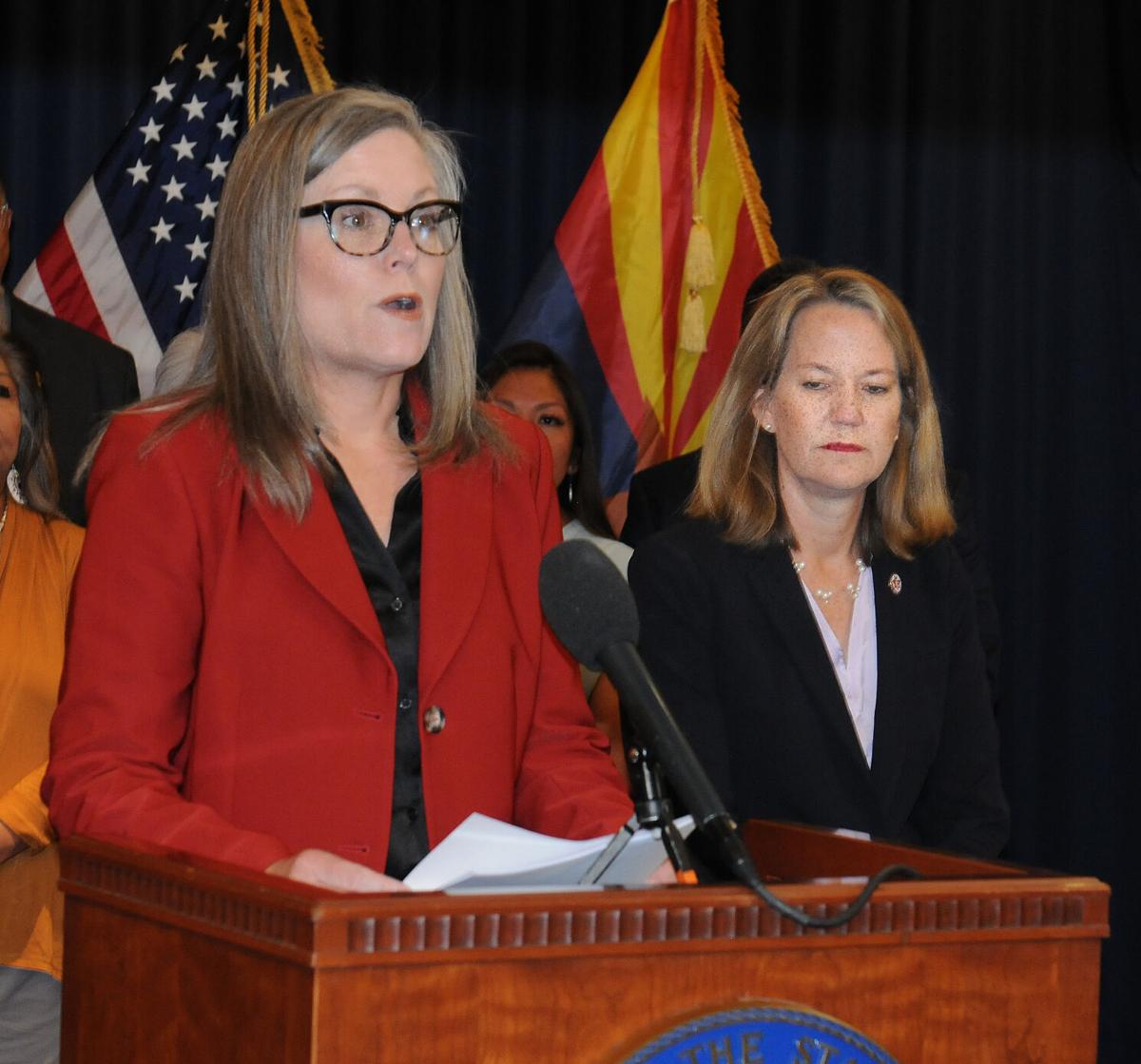
PHOENIX — The state now has the go-ahead to immediately take $115 million from an opioid settlement to balance the budget.
And Attorney General Kris Mayes says she won’t fight it — at least not now.
Late Monday, Maricopa County Superior Court Judge John Hannah dissolved a temporary restraining order that Mayes had obtained just days ago barring Gov. Katie Hobbs and the state Legislature from diverting the funds. The judge said it is not clear the attorney general has such a power.
Hannah acknowledged Mayes’ concerns the state got the $1.14 million multi-year settlement as part of agreements with opioid manufacturers, distributors and pharmacies to deal with the damages caused by drug addiction. He said there is language that limits how the money can be spent.
But the judge said, at least at this point, there is no evidence the budget plan would violate that by giving the money to the Arizona Department of Corrections, Rehabilitation and Reentry.
This isn’t the end of the issue.
Hannah said if it turns out the money is not spent in accordance with the agreement, then Mayes might have legal recourse to seek judicial action. If the money is misspent, she could ask the state agency to restore those dollars to the opioid fund, he said.
Even that, however, is not a sure thing.
“As a judge, I cannot agree with the proposition that the attorney general can enter a litigation settlement ... that the attorney general can give himself in that settlement the authority to determine how state money is spent,’’ Hannah said.
Mayes said after the hearing she still believes it was wrong for Hobbs and lawmakers to sweep the funds, and she continues to insist it “puts at risk future settlement payments.’’ But, for now, the attorney general said she will not appeal, saying she will be in a wait-and-see mode.
“I will be closely monitoring each penny of spending by ADCRR,’’ Mayes said, leaving the door open for possible future litigation.
All sides appear to agree Arizona got the funds for itself and its cities and towns to deal with the effects of the opioid epidemic. Mayes said the agreements — there are several — require the funds “must be used for specified abatement purposes, not for the ordinary operation of government agencies.’’
Strictly speaking, the budget adopted by lawmakers and signed by Hobbs transferring the money to the prison system does say the money must be used for past and current costs for care, treatment, programs and other expenditures for those with opioid-related issues. It says any spending would be “as prescribed’’ in the settlement agreements or any court orders.
Mayes, however, said that disguises the move by lawmakers to deal with a budget shortfall by replacing opioid funds the agency already was spending, a maneuver that freed up that cash to be used elsewhere to balance the budget.
She won the first round late last week by getting a Maricopa County Superior Court commissioner to sign a temporary restraining order barring the Department of Administration, the agency charged with moving the funds, from going forward. Hobbs and lawmakers responded by asking Hannah to intercede, and quickly.
Brett Johnson, representing the Legislature, told the judge this isn’t a legal question for him to resolve.
“What we have here is a difference of opinion,’’ he said. “Attorney General Mayes wants the money spent in her way.’’
But Johnson said there are “other approved mechanisms’’ for the Legislature to decide how to spend the money “as part of the policy-making process and the governor then approves as part of the budgetary process.’’
“And the attorney general, underneath our constitution, has to abide by the different statutes,’’ he said.
“When there’s a policy difference between the attorney general ... she can advocate and lobby to the Legislature as how she wants that appropriation to go,’’ Johnson continued. “But once the Legislature and governor have come to terms, we all have to live with it, of course, within the confines of the law.’’
And he said the budget, adopted as law, does contain the legally sufficient language, in compliance with the settlement agreements, to allow legislators to decide to use the money as they want.
Ron Kilgard, one of the attorneys representing Mayes, said that ignores the terms of the settlements — and the possibility that spending the money in a way that doesn’t comply endangers future payments. There is still more than $1 billion owed to the state for the next 16 years.
That, in turn, goes to the other problem: What happens if a future court determines that Mayes was, in fact, right, and the Legislature spent the money in violation of the terms of the deals.
“Once it’s spent on paying salaries, then how do we get it back exactly?’’ Kilgard asked. He said this isn’t like someone collecting a debt who can get a court judgment and “take it down to the sheriff on a Friday afternoon.’’
Hannah, in issuing his order, agreed that much of what Mayes was arguing makes sense — from the perspective of ensuring the money is spent to remediate the opioid crisis that was caused by the manufacturers, distributors and pharmacies. But that still doesn’t give her the right to decide, unilaterally, how the funds should be spent, he said.
The judge also took a separate swat at Mayes for how she got the restraining order in the first place: having her lawyers go to court last week and get Court Commissioner Mary Cronin to sign a prepared order, without the ability for Cronin to hear from Hobbs or the Legislature.
Mayes’ attorneys said she did nothing wrong, and that her office sent three emails to the properly named defendants and their general counsel “and called to notify them of the emergency motion and when and where it would be heard.’’
Hannah was not impressed. “Notifying somebody that the judge is about to decide is, in effect, without notice,’’ he said,
Hobbs press aide Christian Slater said the judge’s ruling proves what the governor had been arguing all along.
“The attorney general is flatly wrong on the law and mischaracterized the opioid funding in the bipartisan budget,’’ Slater said in a prepared statement, saying Hannah’s decision “gets it right.’’
Get your morning recap of today's local news and read the full stories here: tucne.ws/morning

