


PHOENIX — Calling President Donald Trump’s actions “unconstitutional’’ and “bizarre,’’ Arizona Attorney General Kris Mayes is asking a federal judge to void his bid to end birthright citizenship.
In legal papers filed Tuesday, Mayes said it has been settled law since the 14th Amendment was adopted in 1868 that anyone born in the United States is automatically entitled to citizenship. The law was upheld 30 years later when the U.S. Supreme Court affirmed the citizenship of a man born in California to two Chinese nationals living there, she said.
Now Mayes and Democratic colleagues from Washington, Oregon and Illinois are asking a federal judge to immediately bar the Trump administration from enforcing his executive order while its legality is being decided.
“I will not allow Donald Trump to shred the United States Constitution,” Mayes said.
Time is crucial: The order the president signed Monday is supposed to take effect in 30 days. After that point, babies born to parents who do not meet what Trump said are legal requirements for citizenship will be, according to Mayes, “rendered undocumented, subject to removal or detention, and many will be stateless — that is, citizens of no country at all.’’

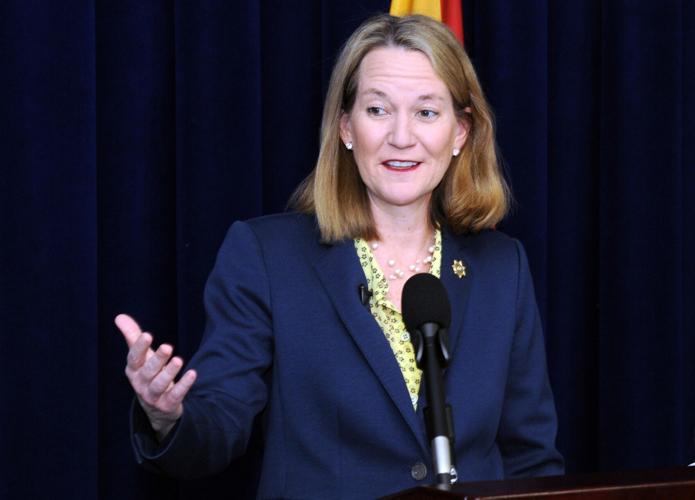
Arizona Attorney General Kris Mayes details Tuesday why she contends President Donald Trump exceeded his legal authority in declaring that not everyone born in the United States is automatically entitled to citizenship.
At least two similar lawsuits have been filed in other federal courts, all seeking to block the presidential action.
Not everyone thinks that what Trump did is beyond his powers.
Arizona state Rep. Alexander Kolodin, a Scottsdale Republican, said the 1898 U.S. Supreme Court case cited by Mayes was based on a situation where the parents, while not U.S. citizens, were in this country legally. By contrast, Kolodin said, Trump’s order is aimed at parents who are not.
And state Sen. John Kavanagh, a Fountain Hills Republican, said that, if nothing else, the Trump executive order will force the nation’s high court to revisit the old ruling. He said the justices are free to change their minds — just as they did in 2022 when they reversed Roe vs. Wade and its right to abortion.
The three lawsuits virtually guarantee the case will again reach the nation’s highest court.
The dispute is over the 14th Amendment to the U.S. Constitution.
The wording is simple: “All persons born or naturalized in the United States, and subject to the jurisdiction thereof, are citizens of the United States and of the state wherein they reside.” Approved after the Civil War, it was designed to ensure that Black Americans — including people formerly enslaved — had citizenship.
In 1898, the U.S. Supreme Court heard the case of Wong Kim Ark, who was born in San Francisco to Chinese immigrants. The 1882 Chinese Exclusion Act prevented them from becoming citizens.
At age 21, he traveled to China to visit his parents, who had returned to their home country. When he returned he was denied entry on the ground that he was not a citizen based on the 1882 law.
In a 6-2 ruling, the high court declared the “explicit’’ language of the 14th Amendment voided that interpretation.
Trump’s executive order directs federal departments and agencies to reinterpret that ruling. It bars them from issuing citizenship documents in cases where the mother was not lawfully present in this country and the father was neither a U.S. citizen nor a lawful permanent resident. He is forbidding federal agencies from recognizing documents issued by state or local governments.
It goes even further. It would deny citizenship to someone whose mother’s presence in the country was “lawful but temporary’’ and the father was not a citizen or permanent resident. That could take in even those who are here on visas.
“The privilege of United States citizenship is a priceless and profound gift,’’ the president wrote in his order. He said the 14th Amendment was the right move, overturning the 1857 Dred Scot case that excluded Blacks, whether free or enslaved, from being considered citizens and, by extension, denying them certain legal protections, including the right to sue in federal court.
But Trump argued the amendment “has never been interpreted to extend citizenship universally to everyone born within the United States.” He made no reference to the 1898 ruling.
Kolodin, who is an attorney, said the key to that argument is the phrase “subject to the jurisdiction thereof.’’ He said that excludes illegal immigrants by definition. By entering the United States illegally, parents have not subjected themselves to the jurisdiction of the country, he said.
Solicitor General Josh Bendor said that interpretation is wrong. “The text of the 14th Amendment doesn’t suggest any difference between whether a person has been lawfully admitted or not,’’ he said.
Mayes, the state’s top prosecuting attorney, said this is not just about the law. She said there are real consequences for the children who would fall under the order.
Mayes said it could force hospitals to try to ascertain the legal status of the parents before issuing a birth certificate, the basic form of identification for people.
Even if hospitals continue to issue birth certificates — they are, after all, just a registration of a live birth — those birth certificates could no longer be relied on for other benefits, ranging from getting a driver’s license to registering to vote, she said.
There are also financial implications for the state, Mayes said.
Right now, children born to those in the U.S. are entitled to various federal benefits such as Medicaid. Mayes said Trump’s order would allow the federal government to cut off its funding for care provided to those who are not considered citizens — the U.S. covers at least two-thirds of the cost — leaving the burden to the state or, potentially, to the hospitals that would be providing uncompensated care. The attorney general put the loss at “hundreds of millions of dollars.’’

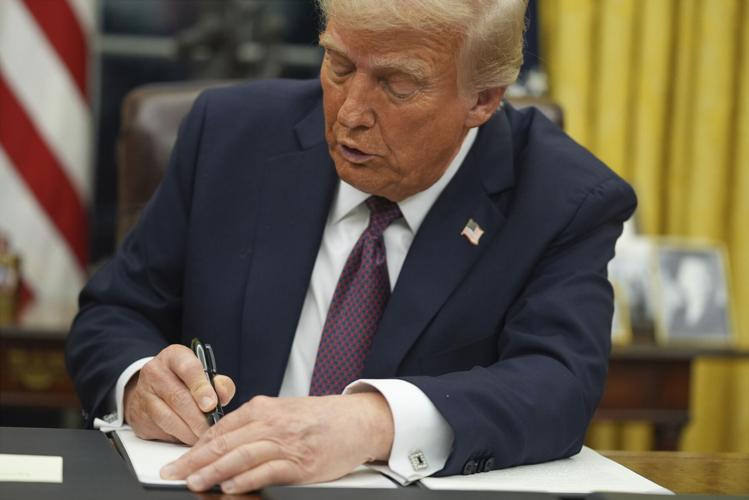
President Donald Trump signs his executive order on birthright citizenship Monday in the Oval Office of the White House.
She also said it could undermine the work of the Arizona Department of Child Safety. When the department removes a child from a home, it seeks to place them with a relative, something that may not be possible if the child lacks legal status, Mayes said.
But the attorney general said there’s an even more basic reason for her opposition.
“It is designed to intimidate with cruelty and chaos,’’ Mayes said. She said that is underlined by the fact the executive order “has nothing to do with national security or protecting American jobs,’’ both issues that helped Trump win the 2024 election
“This is a bizarre attempt to undermine 150 years of jurisprudence and the 14th Amendment,’’ Mayes said. “And I don’t think that voters in Arizona, whoever they voted for, ever thought they’d be really voting to undermine birthright citizenship or to destroy birthright citizenship.’’
When asked about the fact that Trump spoke during his campaign about eliminating birthright citizenship, Mayes responded, “He said a lot of things that were pretty crazy. This might have been at the top of crazy for him. But I don’t really think voters thought he was going to do this.’’
Mayes said one reason she chose not to join the separate lawsuit filed by 18 other Democratic attorneys general came down to finding what she and the AGs from Washington, Oregon and Illinois hope will be a friendly legal reception.
“We know the Ninth Circuit,’’ she said, where the case ultimately will go after being heard in federal court in Seattle. That appellate court has a reputation of being the most liberal of the federal appellate courts in the nation.
Still, the ultimate decision will end up before the U.S. Supreme Court where there already are three Trump appointees and three others chosen by Republican presidents. But Mayes insisted she’s not worried.
“In our minds, this is not even a close call,’’ she said.
“We hope that the court will read the Constitution,’’ Mayes continued. “We have a lot of ‘strict constructionists’ on the Supreme Court, and that means they read the plain language of the Constitution and they follow, hopefully, the plain language of the Constitution.’’
Some Republican lawmakers in Arizona tried to have the state declare birthright citizenship illegal in 2011, at least in part in their own attempt to get the issue to the Supreme Court. But that faltered when a majority of senators refused to go along.

