


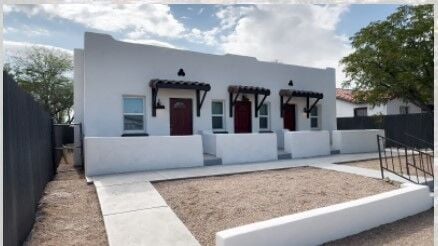
PHOENIX — A sharply divided House committee advanced a measure that would allow large cities and towns to exempt designated historic neighborhoods from a 2024 law requiring them to permit "middle housing'' such as duplexes and townhomes within a mile of their city centers.
The bipartisan measure passed the House Government Committee on a 4-3 vote Wednesday. That came after one of its Democratic co-sponsors amended it to require that even if cities continue allowing duplexes and other higher-density housing, they may require the new buildings to be built only if they are designed to be "compatible with the historic character, scale and setting'' of the neighborhood's existing homes.
Rep. Aaron Marquez, D-Phoenix, also tacked an emergency tag onto House Bill 2375, allowing it to take effect immediately upon the governor's signature if it passes with a two-thirds vote.
But the measure appears to face somewhat of an uphill fight in the Legislature even to pass, let alone manage a supermajority, if the committee vote is an indication. Two Republicans on the panel and one Democrat opposed the bill, while even some of those who supported it said it would need further changes.
Rep. Betty Villegas, D-Tucson, opposed the measure after trying to remove the broad exemption that the initial proposal allowed cities to adopt to the 2024 law.
Under that law, all cities with populations of 75,000 or more were required to change their zoning by Jan. 1 of this year to allow duplexes, triplexes, fourplexes and townhomes in all areas near their downtowns that are zoned for single-family homes. The law also mandates those "middle housing'' units be allowed on at least 20% of any new development of 10 acres or greater anywhere in the city.

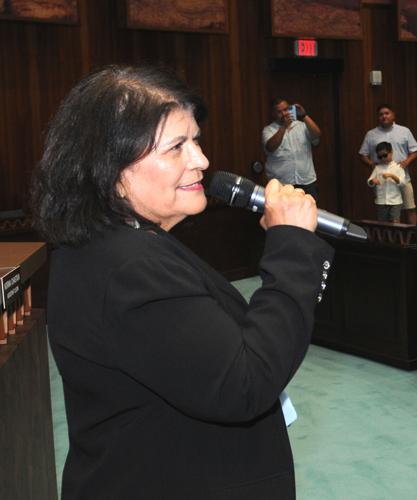
Rep. Betty Villegas, D-Tucson
Villegas's "strike-everything'' amendment would have allowed cities to dictate design and other standards and limit demolitions in their city centers while still requiring them to allow middle housing citywide with no added design rules. A provision said the legislation was intended to preserve neighborhood character in historic districts while maintaining new housing options close to downtown employment and services.
"My amendment does not weaken historic preservation, it strengthens it,'' Villegas said.
"It protects contributing structures, it protects neighborhood scale through objective standards,'' she said. "It strengthens demolition safeguards so historic buildings cannot simply be torn down to side-step reform. What it does not do is allow entire district boundaries to become blanket exemptions from housing solutions.''
She noted that the 2024 bill passed with bipartisan support. The existing law was supported by the building industry and housing advocates amid a shortage of affordable housing statewide.
"My amendment protects the buildings,'' Villegas said. "It does not create a shield against housing access. We can preserve what is historic and still allow families, teachers, nurses and working people a chance to live in our communities.''
Rep. Matt Gress, R-Phoenix and the primary sponsor, allowed Villegas to explain her proposal, but she was not allowed to get a vote on it.
Advocates for historic neighborhoods in Phoenix and other large cities across the state have pushed for the past year for a change to the law that would protect their neighborhoods. Several of them testified on Wednesday.
Jim Huntwork, an attorney who lives in the Los Olivos historic district in central Phoenix, said the districts were first created in the early 1970s to help keep those areas from being decrepit, run-down areas, and they worked to do just that.
"Middle housing incentives are inherently incompatible with the existence of historic districts — they will inevitably destroy any historic district that they touch,'' Huntwork said.
"They can exist and they should exist side by side,'' he said. "That would be a beautiful thing, but they cannot be put on top of each other.''
Gress said his measure is "designed to protect what little history we do have in Arizona.''
"When you look at historic neighborhoods, there aren't that many of them, and the so-called reform (in 2024) puts these historic neighborhoods in jeopardy," Gress told the committee.
"The thrust of the middle housing bill ... is that if you're within one mile of the central business district, these local communities must allow you to move forward with your development for duplexes, triplexes, fourplexes,'' he said. "What we're trying to do here is say that there are certain areas that are very special and that we want to preserve and protect.''
The bill now goes to the full House for consideration.

