

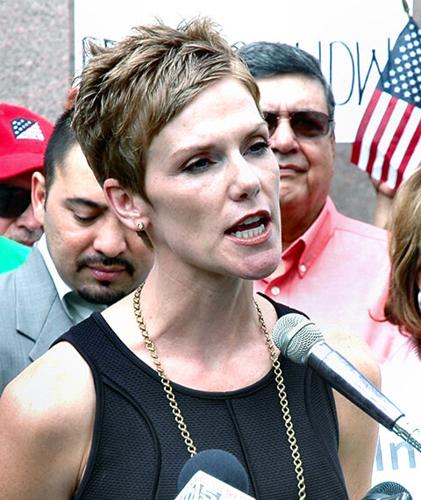
PHOENIX — More than a dozen years ago, Sen. John Kavanagh voted along with every Republican in the Arizona Legislature to require any firearm used in a crime to be sold off to raise money for local governments.
Now the Fountain Hills Republican is having second thoughts.
The reason: A weapon that could now be sold and put back into public circulation was used to kill a Phoenix police officer.
Kavanagh says what changed his mind was Julie Erfle filing a lawsuit in October to prevent the city of Phoenix from selling off the gun that was used in 2007 to kill her husband, Nick, during an attempted arrest. The gunman fled the scene but was later killed by police.
Erfle said she believed that the weapon had since been destroyed. It was only after she inquired earlier this year whether police had ever done a trace on the weapon to find out who supplied the gun — they had not — that she learned it was still being held as evidence even though there was no active case for which it was needed.
And that, she said in her lawsuit, leads her to believe that the gun will be sold, "allowing the city of Phoenix to profit from the sale of a weapon used to murder her husband.''
Erfle contends that, at the very least, the city should be required to consult with her under the Victim's Bill of Rights before taking any further action about the gun. That 1990 voter-approved measure requires police and prosecutors to keep victims and their families informed of every development in a case, including consultation in some cases.
In this case, Erfle said, the city broke the law by not keeping her informed of the fact that the gun was not destroyed and could now be sold.
But she also wants Maricopa County Superior Court Judge Scott Blaney to issue an injunction preventing the gun's destruction while her lawsuit is pending. And, ultimately, Erfle wants the judge to direct the city to destroy it.

Julie Erfle
The original requirement to sell off seized weapons was approved in 2013. The idea was that there was no reason to destroy a perfectly good gun just because it was used in a crime or turned in by an owner.
A lobbyist for the Arizona State Rifle and Pistol Association, the local chapter of the National Rifle Association, said government resources were being wasted by collecting and destroying weapons.
"This is a valuable asset that the city has come in possession of,'' said Gary Christensn, no different from cars, boats and houses that are seized as part of criminal investigations and must be used for law-enforcement purposes or sold off.
"That money goes back to help fund programs that we depend on, including the police departments, that are trying to make the streets safe,'' he told lawmakers at the time.
"When we were having the hearing, when we were having the debate, nobody, not any of the opponents, not any of the commentators ever foresaw that you would have a situation where a weapon used to murder a police officer was going to be auctioned,'' Kavanagh said, calling that "macabre and certainly insensitive to the survivors of the officer — or any homicide victim.''
And now?
"No bill can possibly foresee every future contingency,'' Kavanagh said of his 2013 vote in support.
His new SB 1028 would create an exception to the sell-all-firearms law. It says that if it was used in a homicide, "the court shall order the firearm forfeited and destroyed or otherwise properly disposed of'' after the case is over.
Erfle, who became active in political causes following her husband's death, said the measure is a step in the right direction. But she's not sure that it actually would help her situation.
"It says very specifically 'on the conviction of any person for a homicide in which a firearm was used,' '' she said. "Well, there was no conviction here because the individual who killed my husband was killed later that same morning in a shootout with police.''
Kavanagh conceded the point, saying the measure may need to be tweaked.
Even if the measure is altered during debate, Erfle said she still doesn't think it goes far enough.
"I know we were hoping for something a little more expansive than just 'homicide,' '' she said.
"Definitely, you can have situations where there is an attempted murder, they are very seriously injured, there's an attempted assassination,'' Erfle said, where she believes it would be wrong to sell off the weapon. She specifically cited the 2001 shooting in Tucson of then-Congresswoman Gabby Giffords, who survived. That means it would not be covered under Kavanagh's bill.
"We were approaching it from a victim's standpoint and what that gun then means to somebody who has been victimized by it,'' Erfle said. "So I think this is quite narrow.''
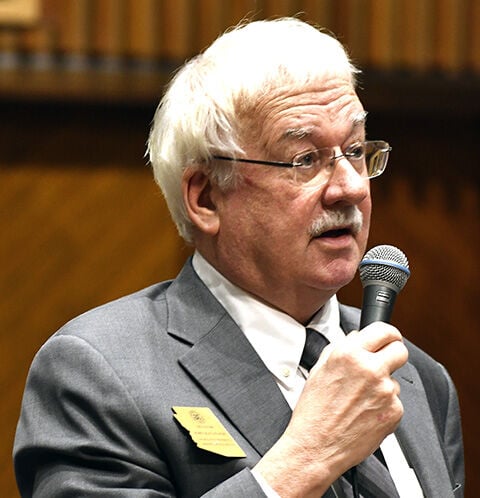
Sen. John Kavanagh
Kavanagh, for his part, said he's not interested in broadening his bill.
"Murder is the ultimate crime,'' he said. "And to have the weapon resold, especially in a noteworthy murder — and perhaps having somebody display it in a museum or resell it with that theme — is disrespectful and insensitive.''
But that, he said, is where the requirement to destroy a weapon should end.
"If you seize a weapon that a felon illegally possessed and it's a perfectly good weapon, why wouldn't you sell it to a licensed gun dealer to get some money for the municipality?'' Kavanagh asked. Anyway, he said, it's not like destroying a weapon means there are fewer weapons on the street, as someone who doesn't get the seized gun through a dealer would simply purchase another one.
"So, what was the purpose, other than making a virtue-signaling, anti-gun statement?'' he asked.
But Erfle is not alone.
An aide to Attorney General Kris Mayes said she is supportive of not just requiring the destruction of guns used in homicides but also any deadly weapon that is used to victimize people.
Any change to the law could also reopen the door to Tucson, once again destroying seized weapons.
That is what is required under a 2005 city ordinance. But the Arizona Supreme Court, in a 2017 ruling, overruled that ordinance, saying the city has no authority to ignore the 2013 law.
Since that time, the city has sold off all seized and surrendered weapons through a contract with a third-party auction house.

