



Arizona health officials will continue recommending a hepatitis B shot for all newborns within 24 hours of birth, despite a new recommendation to the contrary Friday by a U.S. Centers for Disease Control panel.
The Arizona Department of Health Services believes the risks to newborns of not getting the immunization — which has, until now, been standard medical procedure for decades — far outweighs any concern about the shot, said Dr. Joel Terriquez.
Scrapping the practice will lead to more children with life-long medical complications and even the need for liver transplants, said Terriquez, who heads the department's Bureau of Infectious Disease Services and the Bureau of Immunization Services.
He acknowledged that the action by the CDC's Advisory Committee on Immunization Practices is based on the argument that not all mothers are infected and can pass the disease along to their newborns. The panel's members were all hand-picked by Health and Human Services Director Robert F. Kennedy Jr.
The panel's reasoning ignores the evidence, Terriquez told Capitol Media Services.
"This vaccine has been very successful in the past, and it has been noted to be very safe and effective,'' he said.
Prior to the inoculation being standard procedure, which first happened in 1991, there was up to a 90% risk for babies of developing acute infection, Terriquez said. That can develop into complications, including cirrhosis and liver failure.
"Treatment is very complicated,'' he said. "Treatment has a lot of side effects, treatment is expensive. And sometimes those patients could end up requiring liver transplants, which are not readily available for everyone.''
He said that makes not giving the shots automatically far riskier than any risk — if there is any — from the vaccine itself.

Dr. Joel Terriquez
According to the Mayo Clinic, hepatitis B spreads through blood, semen or other body fluids. Transmission can be through sexual contact, sharing of needles, and accidental needlesticks that can infect health-care workers and caregivers.
Pregnant women with the virus can pass it on to babies during childbirth, which is what led to the recommendation for vaccinations of newborns.

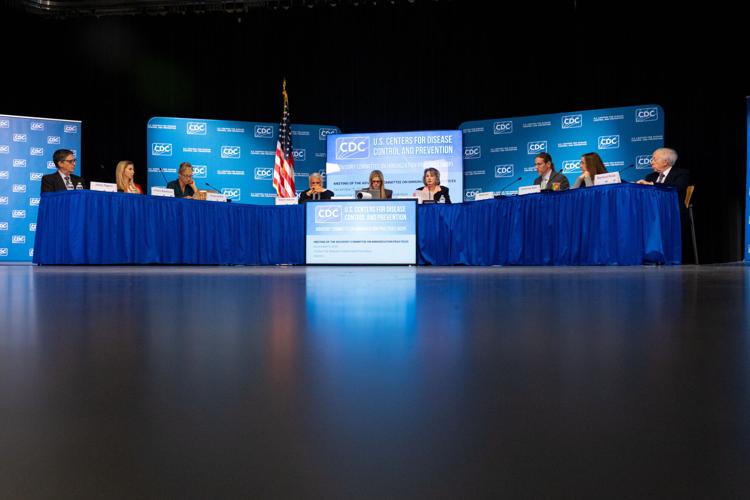
The CDC Advisory Committee on Immunization Practices meets in Atlanta on Friday, Dec. 5, 2025 to consider changes in hepatitis B vaccine recommendations for infants.
In its 8-3 vote Friday, the CDC panel altered its recommendation for universal vaccination in favor of providing it only for mothers who test positive for the infection or have an unknown health status.
Terriquez said there's a flaw in that.
He said most mothers are supposed to be tested as soon as they are pregnant for immunity against hepatitis B.
However, "some mothers who are not getting the appropriate prenatal care may not be tested at the appropriate time,'' Terriquez said.
"We know that when someone gets infected it can take up to nine weeks sometimes for that test to be detectable,'' he said. "That's a huge missed opportunity if mom actually happens to be infected without us having the ability to detect it.''
That, in turn, means the newborns would not get the initial dose, increasing their risk of significant complications, Terriquez said.
He isn't the only one raising questions.
"This has a great potential to cause harm,'' said committee member Joseph Hibbeln at Friday's hearing of the panel in Atlanta. "And I simply hope that the committee will accept its responsibility when this harm is caused.''
The recommendation is not final, with the last word belonging to Jim O'Neill, the acting director of the Centers for Disease Control. Sen. Bill Cassidy, a Louisiana Republican who chairs the Senate Committee on Health, Education, Labor and Pensions, already is calling on O'Neill — a Kennedy appointee like all the members of the advisory panel — to reject the move, which he called "a mistake.''
"Before the birth dose was recommended, 20,000 newborns a year were infected with hepatitis B,'' Cassidy, a medical doctor, wrote in a social media post on X.
"Now it's fewer than 20,'' he said. "Ending the recommendation for newborns makes it more likely the number of cases will begin to increase again. This makes America sicker.''
The panel, while recommending an end to universal vaccination, did say that mothers who test negative still can talk with their doctors and decide themselves whether to vaccinate their child. But even then, the panel suggested that the vaccine be administered no earlier than two months after birth.
Dr. Kirk Milhoan, who chairs the committee, said that date is the point where infants have matured before the neonatal stage. But Hibbeln said there was no evidence to support the delay, calling it "unconscionable.''
Terriquez also said there is no reason for a delay.
He said adults who get infected generally don't need treatment. "They will just clear it and develop lifelong immunity against hepatitis B,'' Terriquez said.
But he said that's not the case for newborns and babies.
"They actually have a worse outcome because a vast majority of them will keep the infection, they will progress into developing complications,'' he said. "So, the earlier the better in order to avoid those huge missed opportunities.''
It is unclear whether the CDC panel's recommendation, if adopted, would affect whether insurance companies pay for the inoculation.
Terriquez noted the state has a federally funded Vaccines for Children Program, which provides free vaccines to eligible kids, including those who are uninsured or underinsured.
Asked whether that program could be affected if the CDC no longer says all children should be vaccinated for hepatitis B, Terriquez responded, "I think this is still being discussed.''
Kennedy, who had a history of questioning vaccine safety before he was tapped by President Donald Trump for the cabinet, fired all 17 members of the advisory committee in June, replacing them with his own picks.
Since that time, the advisory panel has made some other controversial decisions, including scaling back recommended COVID vaccinations for those between 6 months and 64 years to say individuals should do a risk-benefit analysis.

