

PHOENIX — The state’s top water official is warning that unless a deal is reached with other states, cuts in Colorado River water deliveries could force Arizonans to change their lifestyles.
Tom Buschatzke said Tuesday there is a stalemate between Arizona and the river’s other Lower Basin states on one side, and the four Upper Basin states, over who must absorb anticipated cuts in water deliveries as there simply is not enough water in the river.
Talks continue but so far, Colorado, New Mexico, Utah and Wyoming say they shouldn’t have to share in future cuts in river allocation, said Buschatzke, who is director of the Arizona Department of Water Resources.
But he said that, absent some “give’’ by those Upper Basin states, the loss of so much Colorado River water will be felt — especially if the federal government imposes a deal that forces most of the cuts on the Lower Basin states of Arizona, California and Nevada.
Lifestyle changes would be likely, he said.

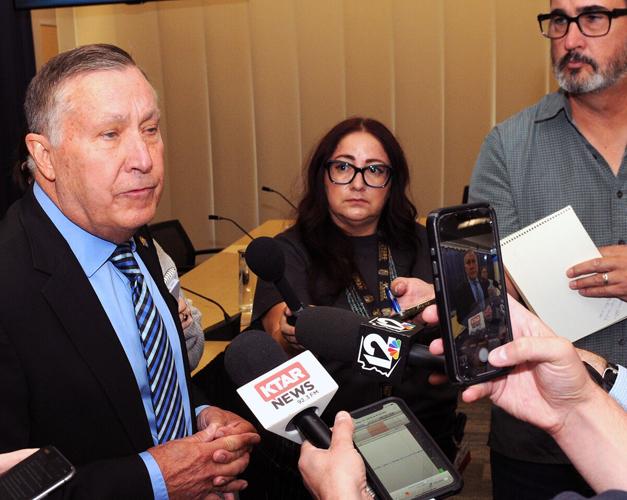
Tom Buschatzke, director of the Department of Water Resources, talking Tuesday about Arizona’s ongoing efforts to reach a deal with other states over cuts in Colorado River water allotments.
For example, Buschatzke said that could start with restrictions on residential landscaping.
There would also be a greater need to pursue alternate water sources, including the processing of wastewater to the point it can be put back into the drinking water supply. That, too, has a price — and not just financially.
He said much of that treated sewage is now being used to maintain wildlife habitats and riparian restoration. Arizonans will need to make some “policy choices’’ on exactly how important those areas are, Buschatzke said.
But the big unknown, he said, will be the effect on the Arizona economy of having less water, “which is going to impact everybody.’’
The problem is that the water expected to be available, when a deal to divide Colorado River water rights was first cut in 1922, just isn’t there in today’s drought and changing climate.
Buschatzke said Arizona, California and Nevada officials believe the Upper Basin states are required to allow more than 8.3 million acre-feet a year to be delivered downstream. An acre-foot is the amount of water that could serve three or four households for a year.
He said Arizona officials believe that obligation exists regardless of the flow. And that calls for forced reductions in what those Upper Basin states can use, he said.
But the Upper Basin states, citing the overall reduced flow, contend they shouldn’t have to cut their usage. They also have a different view of what the existing agreements require.

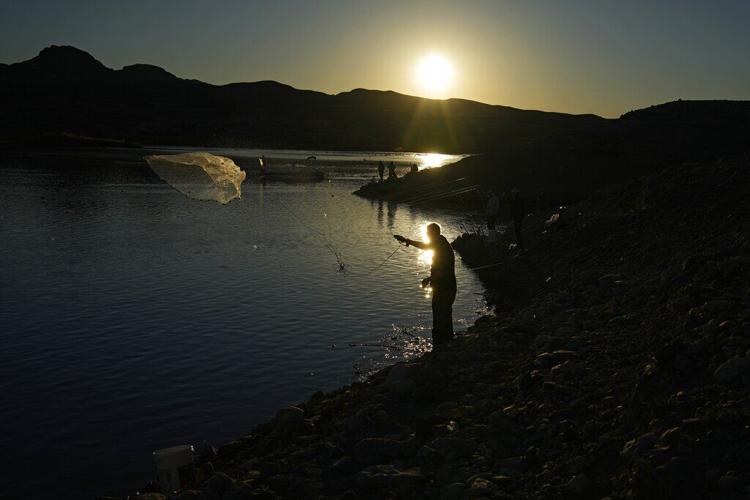
A fisherman throws a cast net along shore of Lake Mead, which stores dwindling Colorado River water.
Any failure to reach an agreement will throw the issue to the federal government. And Buschatzke said that having Trump in the White House could be helpful.
He said the Biden administration put together its own “alternative report’’ about how the shortage should be handled, one that did not consider proposals submitted by the affected states. A request to rescind that report “has not happened,” he said.
“But I think the current administration is more willing to tweak alternatives and to talk with us, collectively, the seven states, about something different that may be a collaboratively created alternative,’’ Buschatzke said. “This administration is taking more of the tack that we asked for,’’ he said, meaning that both the Upper and Lower Basin states should share some “risk’’ in having to take cuts.
However, “if there’s no collaborative outcome, I believe the federal government will move forward with whatever alternative they want to analyze,’’ Buschatzke said. “And you probably won’t like what they analyze.’’
If everything else falls apart, the state does have a contingency plan.
Buschatzke has asked state lawmakers to give him $1 million that he can set aside to hire lawyers to file suit if that becomes necessary. Democratic Gov. Katie Hobbs already gave her blessing to the proposal, though the Republican-controlled Legislature has yet to approve it.
Hobbs does insist, as does her water chief, that it’s only fair that the Upper Basin states agree to accept some cuts to ensure Arizona is not damaged.
“Our growing economy is not just important to Arizona,’’ she said. “It is important to the nation’s economy, to national security, to moving manufacturing back to America.’’
But the governor, speaking to reporters Tuesday along with Buschatzke, sidestepped a question about whether, given the limited water supply, Resolution Copper company’s proposed new mine at Oak Flat in Pinal County makes sense.
The transfer of federal land for the controversial project has been held up because of litigation by Native American tribes over the destruction of the land they consider culturally and spiritually important. One estimate says the mine would consume 250 billion gallons of water over its lifetime, equal to the annual water needs of a city of 140,000 for 40 years.
“All of these projects, again, go back to that conversation about the economic growth and the dependence that a clean energy future has on critical mineral mining, on copper mining,’’ Hobbs said.
“It is imperative that we work to find the right balance so that we can continue to build a sector, to contribute to our national security and our continued path forward,’’ she said. “And mining is a part of that.’’
Hobbs also said she has no answer to a question of whether the state should be more transparent in disclosing the amount of water used by certain industrial users, including data centers.
That would allow for greater public discussion about whether such development should be a priority. But the state does not keep track of how much each uses.
“That’s a good question, not something that I’ve thought about,’’ the governor said. “And certainly something we can look at doing more about.’’
Behind the series: The Star's longtime environmental reporter Tony Davis shares what inspired him to write the investigative series "Colorado River reckoning: Not enough water."

