



PHOENIX — State lawmakers gave up on enacting a new state budget late Friday night, hoping to start again Saturday morning.
The reason remains in dispute.
House Speaker Ben Toma told Capitol Media Services the votes are there for the package, which includes fixes to balance the budget for the current year that ends June 30 and a spending plan for the next fiscal year. He said adjourning for the night was simply so lawmakers wouldn't have to hang around for hours waiting for the final bills to be drafted.
And after the language is drafted, legislative leaders and staffers for Democratic Gov. Katie Hobbs need time to proof it to ensure it says what they want, said Toma, a Peoria Republican.
"Assuming there are no errors, you're talking a start time of 2 a.m. or so'' Saturday to start debate, if leaders had kept legislators waiting at the Capitol. "At that point, everybody's tired.''
The better alternative, said Toma, was sending everyone home until 8 a.m. Saturday.
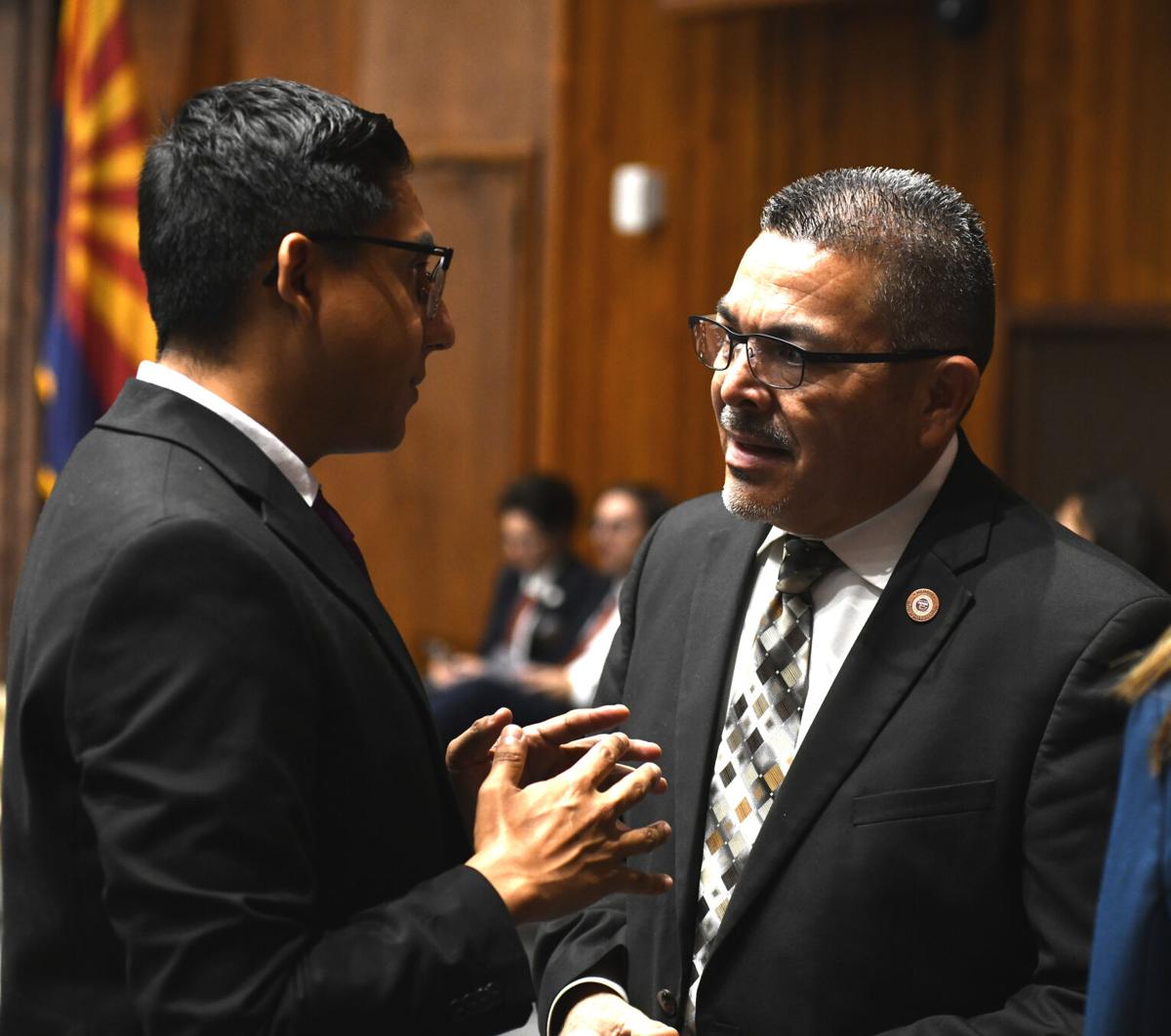
But House Minority Leader Lupe Contreras said that explanation doesn't wash.
"You don't leave the building when something's baked,'' said the Avondale Democrat.
Contreras noted that the package needs 31 votes to get out of the House — the precise number of Republicans in the chamber.
He pointed out, though, that several Republicans already said they intend to vote against it, meaning they need Democrats, many of whom have panned many of the spending cuts. The proposal is for a $17.2 billion spending plan for the balance of this fiscal year and a $16.1 billion budget for next year.
"They don't have enough of theirs,'' Contreras said of votes. "They don't have enough of ours.''
A similar situation exists in the Senate, where several of the 16 Republicans in the 30-member chamber also are balking, meaning there is a need for Democrats' support.
And the fact that Hobbs was involved in crafting the deal is not enough for all Democrats to be willing to go along. Part of the problem is that the package was negotiated between the governor and GOP leaders — and presented to the Democrats as a done deal.
"We're just not happy at this point,'' said Contreras. "We have to find some happiness. And we're trying to find a bridge across.''
One of the disputes is over the proposal to take money from a special fund created when the state got $1.14 billion in a settlement with opioid manufacturers and pharmacies.
Hobbs and GOP leaders want to use $75 million now to help pay to treat prison inmates with Hepatitis C and for medication-assisted therapy for prisoners. But that's just the beginning, with the plan also calling for sweeping another $40 million a year for each of the coming three years from the settlement.
Democratic Attorney General Kris Mayes, who met Friday with Senate Democrats, is balking. "We're not going to release it,'' Mayes told Capitol Media Service of the money.
"This budget does an end-run around the process spelled out in the settlement agreement,'' Mayes said. "It's my fiduciary responsibility as the attorney general to make sure that this money is spent for all Arizonans and not just to backfill the budget of the Department of Corrections, Rehabilitation and Reentry.''
Lawmakers need the cash in part because a federal judge ruled the state grossly underfunds inmate health care and last year ordered the state to improve that care. The budget deal earmarks $188 million to address those issues.
Mayes' reticence has provoked only anger among those who made the budget deal.
"The AG has an unfortunate habit of threatening legal action against other elected officials without doing her homework,'' Toma said. He noted Mayes made a similar threat last year when lawmakers did the same thing but ended up backing off.
The Governor's Office also is taking issue with the attorney general.
"The attorney general's characterization of these funds as 'backfilling' the budget of ADCRR could more accurately be described as funding vital opioid use disorder treatment for a population that is disproportionately impacted by the opioid epidemic,'' said gubernatorial press aide Christian Slater.
But he said Hobbs has agreed to make changes in the legislation to resolve Mayes' legal concerns "so that there is no doubt that any opioid settlement funds could not be used for a non-approved purpose.''
Even without Mayes' objections, there are plenty of complaints from lawmakers on both sides of the aisle about the deal.
Between the current and coming year, GOP legislative leaders and Hobbs came up with $1.4 billion in cuts that hit across all parts of government, from state agencies to universities to a big water fund set up the last year of former Gov. Doug Ducey's term.
Sen. Priya Sundareshan, D-Tucson, said she has concerns about many aspects of the budget deal, from the legality of using opioid settlement funds to the ways Hobbs and GOP leaders crafted the compromise deal. With those issues and others, she said the fate of the budget when votes actually occur remained unclear.
“So there’s a lot of questions and of course, Democratic lawmakers haven’t really been allowed to negotiate with Republicans on this,’’ Sundareshan said Friday morning.
She said she was leaning toward opposing the budget and didn’t know if there were the 16 Senate votes needed to pass it.
“I think there’s a lot of concern that keeps growing by the hour,’’ Sundareshan said.
Some Republicans, both in the House and the Senate, also were opposed to the plan.
Rep. Matt Gress, R-Phoenix, said Friday he remained opposed because of what he said were gimmicks and policy choices made to reach a deal. He noted his opposition in particular to the across-the-board cuts to agency budgets, which he called short-sighted.
And Sen. Anthony Kern, R-Glendale, said he was dead set against the plan because of caps on tax credits that can be taken for donations to School Tuition Organizations that help pay private school costs and mandates requiring fingerprinting of private school employees if the school accepts state vouchers, formally known as Empowerment Scholarship Accounts.
Democrats and Hobbs strongly oppose the universal voucher program enacted in 2022, but have been unable to get majority Republicans to agree to scale it back. The best Hobbs could get in the agreement was putting the fingerprinting rule in the budget along with some new limits on how cash for empowerment scholarship accounts can be used and random spending audits.
Kern said he also wants new border security money earmarked for sheriffs and not the state Department of Public Safety. But in a sign of how disparate the opposition was even among GOP lawmakers, he said he wanted bigger agency cuts and for vacant positions to be permanently eliminated.
Republican leaders of the Senate and House appropriations committees hammered out the deal after weeks of intense negotiations along with President Warren Petersen, House Speaker Ben Toma and Hobbs.
Sen. John Kavanagh, R-Scottsdale, who leads the Senate Appropriations Committee, said the deal is a decent one that closes the $729 million hole in the current budget and a $690 million deficit in the spending plan that starts July 1. Not passing a budget would prompt a government shutdown.
“The governor had plenty of angst about what’s in, what’s not in, what wasn’t cut, what is cut,” Kavanagh said during a Thursday committee meeting where the budget passed with no Democratic votes. “And we have some (Republican) members that also have angst.’’
But he said a deal needed to be made.
“The bottom line is that the budget is a zero-sum game — it has to end with no deficit,’’ he continued. “And that’s a tough thing to do when you have a revenue shortfall like we have right now, $1.4 billion. ‘’
Despite the cuts, Kavanagh said most of government — including schools, prisons and the state’s Medicaid program — actually would see spending increases.
Get your morning recap of today's local news and read the full stories here: tucne.ws/morning
“That is the big victory that everybody should be celebrating here,’’ he said.

