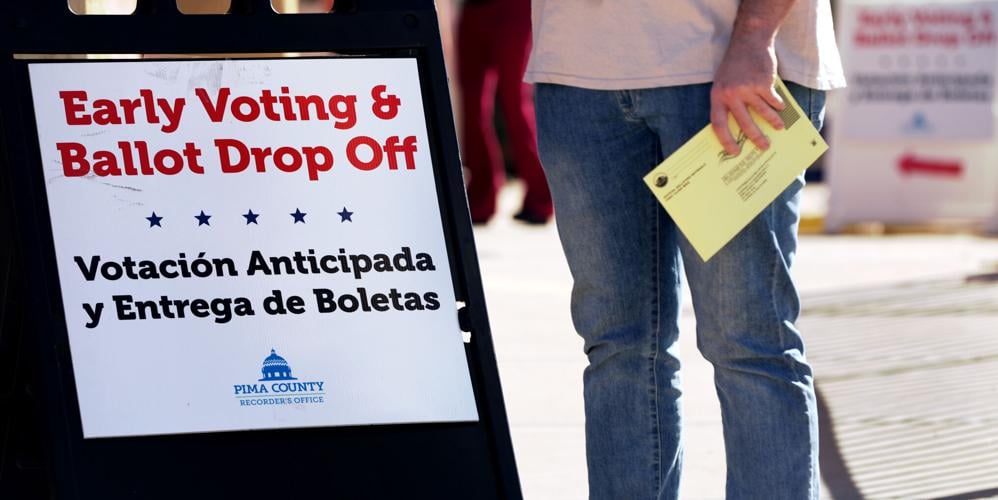
PHOENIX — A new initiative seeks to ask Arizona voters whether they want to constitutionally preserve the right used by nearly 90% of them to vote early, and even to drop off their ballots on Election Day.
A petition drive has been launched by a group calling itself Protect the Vote Arizona, which would put a provision in the Arizona Constitution saying there is a "fundamental right'' to be able to vote early as well as vote on Election Day. And that, according to Stacy Pearson, whose Lumen Strategies is managing the campaign, includes not just showing up in person to cast a ballot but also dropping off the ballots that were mailed to their homes.
What it also would cement into the constitution is that the right to vote early can be exercised "without providing a reason or excuse.''
Who is behind the campaign is less clear.
Pearson has a history of working with Democratic candidates and causes. But she insisted that this is a bipartisan effort.
She also would not disclose now who are the leaders of the effort — nor who will be funding what could be an expensive campaign to gather the 383,923 valid signatures by July 2 to get the issue on the November ballot. Instead, Pearson said that will have to wait until the group actually starts gathering signatures.
But Rep. Alexander Kolodin, who is pushing his own contrary measure, said he is "well aware of who this progressive, far-Left organization is and the out-of-state dark money billionaires backing them.''
The Scottsdale Republican, however, did not respond to inquiries asking him to provide specifics.

A petition drive by Protect the Vote Arizona would add a provision in the state Constitution that says there is a "fundamental right'' to be able to vote early as well as use mail ballots on Election Day.
Kolodin is seeking to get his legislative colleagues to put his own measure on the ballot.
One key provision of his HCR 2001 would preserve the right of the legislature to conclude at some future date that there is no right to vote early.
That is not a sure thing.
In fact, Kolodin himself, prior to becoming a legislator, filed an unsuccessful lawsuit on behalf of the Arizona Republican Party arguing that the Arizona Constitution permits only in-person voting.
What his measure definitely would do is end early voting no later than 7 p.m. on the Friday prior to the election.
What's behind that new deadline is the argument that last-minute drop-offs lead to delays in people finding out who actually won.
The problem is that early ballots cannot be tabulated until the signatures on the envelopes are verified. And that verification process for what are called "late-early ballots'' cannot begin until after Election Day.
That's not a problem when there are just of few of those ballots.
But in the 2024 general election, there were about 265,000 of these. That includes more than 210,000 in Maricopa County.
All that has led to Arizona gaining a reputation of being among the last states in the nation — if not the last — to have final election returns.
It occurred in 2022 when it took days to confirm that Democrat Katie Hobbs had beaten Republican challenger Kari Lake. And the situation repeated itself in 2024 when delays in processing ballots left many wondering whether Kamala Harris could make up her vote deficit against Donald Trump.
Kolodin, who is running for secretary of state — the state's chief elections officer — said what is in the newly filed initiative is designed to "confuse voters and codify policy that would render Arizona's elections less secure, less trustworthy, and less lawful.''
But Pearson said there is nothing radical about it.
"This now takes mail-in voting as it currently stands, the windows in which it currently stands, and codifies that in the state constitution,'' she said. "It takes mail-in voting that has worked well in Arizona for decades out of the whim of the legislature.''
And that includes the right to vote early.
That is not a given. In 2022, before he was elected to the House, Kolodin filed suit on behalf of the Arizona Republican Party in an effort to declare early voting illegal.
Kolodin, in his legal papers, argued that there is nothing in the state constitution to allow for early voting. He said the only form of voting specifically authorized by the framers of the Constitution is in person and on Election Day.
And what that means, Kolodin said, is that anything else — including the current system of no-excuse early ballots created by the legislature in 1991 and used by nearly 90% of Arizona — is illegal.
He also presented an alternate legal theory.
Kolodin said that, at the very least, the state was required to return to the way the situation was before 1991. That's when voters could get early ballots — but only if they provided some proof they needed it, like being away from their voting precinct on Election Day or a physical disability.
Those arguments were rebuffed by both a trial judge and the Court of Appeals.
What is in the initiative would forever foreclose future efforts to restrict early voting.
It also would overturn another law, signed in 2021 by then-Gov. Doug Ducey, which eliminated the state's "permanent early voting list.''
Prior to that, people who signed up to get a ballot by mail kept getting one until they moved, died or opted out. The new law said anyone who hasn't used the early ballot in two election cycles would be taken off the list, though they could sign up again.
The initiative would overturn that, with a constitutional right of people on the early voting list to keep receiving them for any election for which they are registered unless they ask to be removed, the voter's registration is canceled, or the ballot is returned as undeliverable.
Kolodin's measure is awaiting a final House vote before going to the Senate. If approved there, it would go to voters in November as the governor has no veto power over what lawmakers put on the ballot.
The Protect the Vote Arizona Initiative will be on the ballot if backers get the signatures and it survives expected legal challenges.
Kolodin dismissed the chances of competition with his own plan
"Republicans in Arizona are unfazed by the astroturfed efforts of groups like this to confuse voters and codify policy that would render Arizona's elections less secure, less trustworthy, and less lawful,'' he said in a prepared statement.
Kolodin did not respond to follow-up questions about exactly what he believes is in the initiative that does any of that.
If both measures are on the ballot and are approved, sections of each that do not conflict with each other both could take effect. But where both cannot coexist, the proposal that gets more votes would take precedence.