



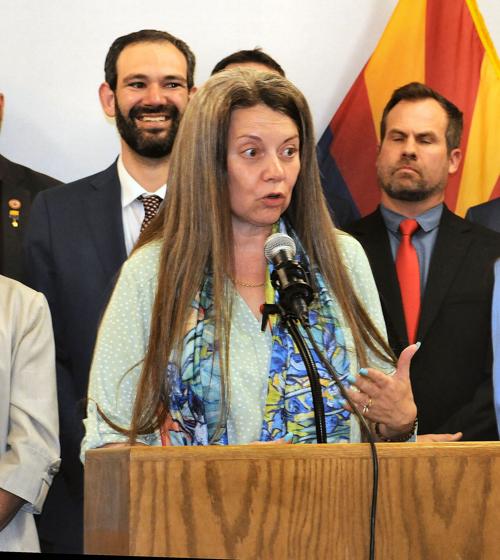
PHOENIX — The head of the Arizona Republican Party wants the state Supreme Court to void two executive orders issued by Gov. Katie Hobbs designed to make registration and voting easier.
In a lawsuit filed late Thursday, Gina Swoboda charges that the Democratic governor exceeded her authority in directing some state agencies to make voter registration forms available to the public. Swoboda said Hobbs also acted illegally in directing those agencies, including the adult and juvenile corrections systems, to act as ballot drop-off locations.
At the very least, the lawsuit says, the latter order fails to address important issues such as ballot security.
Hobbs’ press aide Liliana Soto called the lawsuit “frivolous” and said the governor is using her “lawful authority’’ to protect the right to vote.
Swoboda, by contrast, called Hobbs’ actions a “blatant overreach of her authority.’’
“We will not stand by as our constitutional rights are trampled,’’ Swoboda said.
Claims, rebuttals
Andrew Gould, the lead attorney for the lawsuit, said state law gives the Legislature — which happens to be controlled by Republicans — the power to decide voting and ballot drop-off locations as well as to enact laws on voter registration. And it is the county recorder who authorizes individuals to accept registration forms and designates where the forms can be distributed and where they can be received.
Gould took the unusual step of filing the action directly with the Arizona Supreme Court versus the normal process of having to first get a ruling from a trial court.
He told the justices there is no need for a trial because this is a simple legal question: Are the orders legal or not?
Also, the GOP wants the case resolved as soon as possible, saying it would have “immediate ramifications for the impending 2024 elections throughout the state.’’
Soto, for her part, said that Hobbs, when secretary of state, “oversaw two of the most secure election cycles in history,’’ meaning 2020 and 2022. Both of those elections remain the subject of ongoing lawsuits by losing Republican candidates Kari Lake and Abe Hamadeh, whose claims have been rejected by courts.
The governor is not the only one defending her actions.
Before filing his own suit, Gould tried to get Democratic Attorney General Kris Mayes to go to court to restrain the governor’s action. That drew a skeptical response.
“I fail to understand how increased access to voter registration forms or polling places could be harmful to anyone, including your clients,’’ Mayes said.
The executive orders
At issue is a series of executive orders Hobbs issued last November dealing with voting.
One is Executive Order 23 to use state buildings as voting sites or ballot drop-off locations this year and into the future.
Gould, in the lawsuit, specifically mentions that includes not only the Department of Corrections, but also the Department of Juvenile Corrections.
“EO 23 is silent about important issues regarding completed ballots and voting procedures including, for example, where to store completed ballots until they can be sent to the appropriate election officials or keeping a chain-of-custody log for those completed ballots,’’ Gould wrote.
He acknowledged that Hobbs, in issuing the order, claims she has such authority based on a constitutional provision allowing her to “transact all executive business with officers of the government ... and take care that the law be faithfully executed.’’ But he said that is insufficient.
First, he said, the order has no expiration date, meaning it remains in place unless or until a future governor revokes it or it is declared unconstitutional by a court, a ruling he is seeking here.
By contrast, Gould said, a 2020 order issued by then-Gov. Doug Ducey during the COVID outbreak on voting locations was written to self-destruct in 180 days.
Closely related to that, he pointed out Ducey acted under state laws, giving the governor certain powers during an emergency.
“In contrast, here, in issuing EO 23, Gov. Hobbs cites not emergency, but rather relies on her limited and general grant of executive authority’’ in the Arizona Constitution.
Gould also wants the Supreme Court to void Executive Order 25, which directs agencies to include on their public websites a link that directs users to either the Secretary of State’s voter registration website or an online voter portal operated by the Motor Vehicle Division.
It also says the agencies should make paper registration forms available in “conspicuous public locations.’’ And it says if a form is completed and turned in, the agency must return it to the Secretary of State or appropriate county officials within five days of receipt.
Gould said that “substantively and fundamentally exceeds her constitutional and statutory authority.’’
He sent a letter earlier this month asking Hobbs to rescind or modify her orders.
In a response, Bo Dul, the governor’s general counsel, defended the legality of her actions.
“These executive orders further the important goals of increasing Arizonans’ access to voter registration,’’ Dul wrote. She also said one reason for allowing state sites to be used as polling locations has been complaints from some counties that they find fewer suitable locations willing to do so.
Get your morning recap of today's local news and read the full stories here: tucne.ws/morning

