


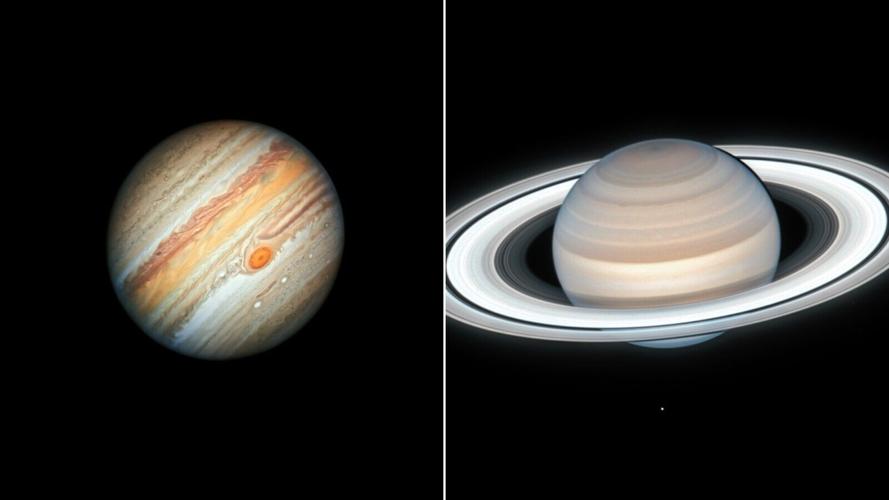
Once every 20 years, the two largest planets in our solar system—Jupiter and Saturn—appear to meet in Earth’s skies. This “Great Conjunction” happens next on December 21, 2020, but this time, Jupiter and Saturn will be closer than they’ve been in nearly 400 years. December 21 also happens to be the night of the winter solstice, and the peak of the Ursid meteor shower.
For most Great Conjunctions, Jupiter and Saturn are separated by about 1 degree, which is the width of two full moons in the sky. This year, they will be separated by just one-tenth of a degree, which is one-fifth the size of the full moon. A Great Conjunction happens every 20 years, but the last time Jupiter and Saturn were this close was the year 1623.
Join Lowell Observatory at 5pm MST on Monday, December 21, 2020, to celebrate the Great Conjunction with an evening of telescope viewing and commentary from Lowell's own astronomers and educators.
The two largest planets in our solar system are coming closer together than they have been since the Middle Ages, and it's happening just in time for Christmas -- hence the nickname of the "Christmas Star."
While it's not an actual star, the two planets will certainly make a bright splash in the night sky.
On the night of December 21, the winter solstice, Jupiter and Saturn will appear so closely aligned in our sky that they will look like a double planet. This close approach is called a conjunction. The fact that this event is happening during the winter solstice is pure coincidence, according to NASA.
Keep scrolling for a look back at the world's space achievements in 2020
"Alignments between these two planets are rather rare, occurring once every 20 years or so, but this conjunction is exceptionally rare because of how close the planets will appear to one another," said astronomer Patrick Hartigan, a professor of physics and astronomy at Rice University in Houston, in a statement.
"You'd have to go all the way back to just before dawn on March 4, 1226, to see a closer alignment between these objects visible in the night sky."
If you're a stargazer, you've likely noticed Jupiter and Saturn have been getting closer together since the summer. And they're currently visible in our night sky, inching ever closer to one another.

Between December 16 and 25, they will become even cozier. Look for the Jupiter-Saturn conjunction low in the western sky for about an hour after sunset each evening during this time.
"You can imagine the solar system to be a racetrack, with each of the planets as a runner in their own lane and the Earth toward the center of the stadium," said Henry Throop, astronomer in the Planetary Science Division at NASA Headquarters in Washington.
"From our vantage point, we'll be able to be to see Jupiter on the inside lane, approaching Saturn all month and finally overtaking it on December 21."
How to watch
"On the evening of closest approach on Dec(ember) 21 they will look like a double planet, separated by only 1/5th the diameter of the full Moon," Hartigan said. "For most telescope viewers, each planet and several of their largest moons will be visible in the same field of view that evening."
While these two planets may appear close, they are still hundreds of millions of miles apart, according to NASA.
Hope for clear skies because the conjunction will be visible around the world, with the best perspective for those near the equator.

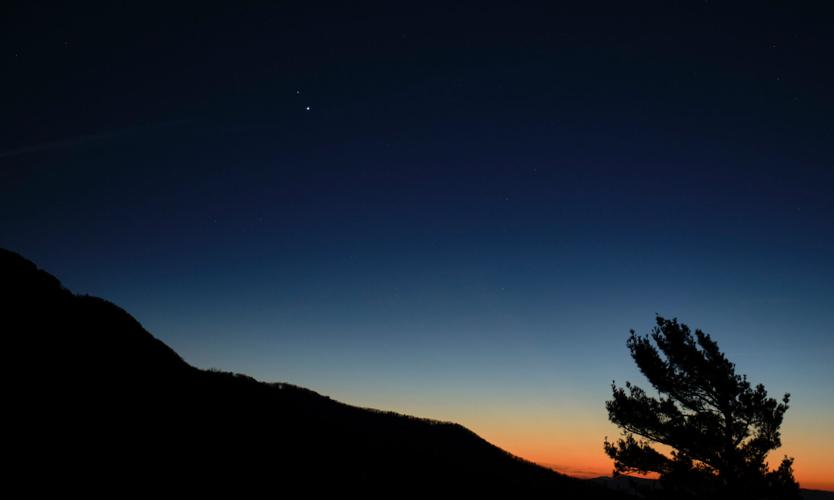
Saturn (top) and Jupiter (below) are seen after sunset from Shenandoah National Park, Sunday, December 13, in Luray, Virginia.
"The further north a viewer is, the less time they'll have to catch a glimpse of the conjunction before the planets sink below the horizon," Hartigan said.
The planets will be bright enough to be viewed in twilight, which may be the best time for many US viewers to observe the conjunction.
"By the time skies are fully dark in Houston, for example, the conjunction will be just 9 degrees above the horizon," Hartigan said. "Viewing that would be manageable if the weather cooperates and you have an unobstructed view to the southwest."
If you're in New York or London, or along those latitudes, try to spot the conjunction right after sunset. Waiting an hour after the sun sets will only put the planets closer to the horizon, making them more difficult to spot.
The best conditions to see this astronomical event will include a clear southwestern horizon and no low clouds in the distance, Hartigan said. Binoculars or a telescope may help you distinguish the planets. A telescope would enable a view of Saturn's rings and the brightest moons of both planets, he said.
Jupiter will appear brightest and be easily visible. Saturn will be slightly fainter and will appear slightly above and to the left of Jupiter. On December 21, Jupiter will overtake Saturn and they will swap places in our sky.
"On December 21, the sun will set around 4:30. After that, it is a race -- the sky must get dark enough to see Jupiter and Saturn before they set as well, around 6:45," said Walter Freeman, assistant teaching professor in the department of physics at Syracuse University's College of Arts and Sciences in New York state.
"Jupiter and Saturn will likely stand out from the twilight glow starting around 5:00 or 5:15. With binoculars, a telescope, or a telephoto lens of 500 (millimeter) focal length or more, you may also be able to see the four largest moons of Jupiter. There's no better way to celebrate the longest night of the year than watching the stars. So if you're planning a night of stargazing on the solstice, start off by admiring the largest planets before they set."
Live events around the conjunction
If you miss this conjunction and want to see the planets with the same proximity, just higher in the sky, it won't happen until March 15, 2080 -- and then not again until after 2400.
Between 0 and 3000 CE, or Common Era, only seven conjunctions were or will be closer than this one -- and two of those were too close to the sun to be seen without a telescope, according to Hartigan. So, yes, this is an incredibly rare event.

The two largest planets in our solar system are coming closer together than they have been since the Middle Ages, and it's happening just in time for Christmas -- hence the nickname of the "Christmas Star."
In case weather conditions in your area aren't agreeable to witnessing this celestial event, several livestreams will be available.
The Lowell Observatory in Flagstaff, Arizona, will host a program beginning at 7 p.m. ET, showcasing live views through its telescopes. The stream will be on the observatory's YouTube page.
The Virtual Telescope Project in Rome will also share live views on its website.
The year in space
Here's a look back at the world's space achievements in 2020:
Year in space
SpaceX
Updated
Elon Musk's SpaceX was buzzing in 2020. In May, it became the first private company to put people into orbit, an achievement previously claimed by just three global superpowers. The two test pilots, Doug Hurley and Bob Behnken, were the first NASA astronauts to fly a new brand of spaceship in almost 40 years and the first to blast off from Florida since the shuttle program ended in 2011.
Moon rocks
Updated
A Chinese lunar capsule, the Chang’e 5 probe, returned to Earth on Thursday with the first fresh samples of rock and debris from the moon in more than 40 years. Two of the Chang’e 5’s four modules set down on the moon on Dec. 1 and collected about 4.4 pounds of samples by scooping them from the surface and by drilling about 6 feet into the moon’s crust. This photo shows the landed Chang'e-5 spacecraft and a moon surface picture, below, taken by camera aboard Chang'e-5 spacecraft during its landing process.
Asteroid samples
Updated
Japan brought back pieces of asteroid Ryugu — its second asteroid batch in a decade. In this Dec. 6 photo, a member of the Japan Aerospace Exploration Agency (JAXA) retrieves a sample from the space capsule Hayabusa2 after its landing in southern Australia. More asteroid samples are on the way: NASA’s Osiris-Rex spacecraft vacuumed up handfuls of gravel from asteroid Bennu in October for return in 2023.
Mars
Updated
In this July 28 photo, Alexander Mather, of Burke, Va., stands next to a model of the Mars 2020 rover he named "Perseverance" in a contest at the Kennedy Space Center in Cape Canaveral, Fla. Launched in July, NASA’s Perseverance rover is set to land on Mars on Feb. 18 at an ancient river delta and lakebed where microscopic life may have once flourished. The rover will drill into the dry crust, collecting samples for eventual return to Earth.
People in space
Updated
Elon Musk capped the year with a stratospheric test flight of Starship, the rocketship he's building to carry people to the moon and Mars. The Dec. 9 demo, shown here, went better than anyone imagined until a fiery explosion at touchdown. Even so, Musk was ecstatic. At the same time, SpaceX is expanding its Dragon-riding clientele. Late next year, SpaceX expects to launch the first privately financed Dragon flight in a deal arranged by Houston-based Axiom Space.
United Arab Emirates' Mars probe
Updated
In this July 20, 2020, file photo, an H-IIA rocket with United Arab Emirates' Mars orbiter Hope lifts off from Tanegashima Space Center in Kagoshima, southern Japan. The UAE's first interplanetary spacecraft, named Amal, or Hope, will scrutinize the Martian atmosphere from orbit.

