


The following column is the opinion and analysis of the writers.
Gov. Ducey’s “Stay Home, Stay Healthy, Stay Connected” order to mitigate the COVID-19 pandemic has dramatically “flattened the curve,” reducing spread and protecting our hospital system and health care professionals.
But, the order is set to expire April 30th. As Arizona looks towards re-opening, it is important to consider how we re-enter without jeopardizing the gains achieved by a month in lockdown.
In an ideal world, states would re-open only after a sharp and sustained reduction in new COVID19 cases. We would exit lockdown armed with widespread testing to detect new infections, infrastructure for contact tracing and antibody testing to determine those that have been infected, recovered, and now have some immunity to the virus.
But we are far from the ideal situation. Arizona’s largest counties are just approaching the peak in new infections. Testing for infection has not yet been extended beyond those who are sick. Without testing and contact tracing, we lack the classic tools deployed in tamping down pandemics.
In an ideal world, the decision to re-open would be driven by data. But the data are not coming fast enough to inform decisions and SARS-CoV-2 is here to stay. Until there is an effective vaccine or antiviral, we will not be free to resume pre-pandemic life.
Further, controlling the COVID19 pandemic poses unique challenges due to its propensity for asymptomatic spread (possibly up to 25% of all infections), making infections difficult to identify and isolate. We must learn how to find a new normal to re-build life and the economy amidst the pandemic.
Social distancing (6 ft of separation), restricting the size of gatherings and diligent handwashing must continue as a primary means to combat spread of SARS-CoV-2. Return to work needs to be a primary focus for re-entry to bolster the economy.
But we must have a phased strategy to put the workforce back in place, starting with jobs where social distancing is possible for risk management, then gradually working up to jobs where distancing is less attainable.
Face coverings are critical in communal or public spaces, especially where 6-ft distancing is not possible. Work hours need to be staggered and flexible to minimize contact, and activities that can be done remotely should remain remote.
Implementation of each successive phase should be separated by two weeks to assess the resulting rise in cases. When numbers of new cases spike, restrictions will have to be reinstated.
The relaxation of restrictions should be slower and more controlled in more densely populated cities, which are at greater risk than more sparsely populated rural areas. Activities that draw high densities of people together, such as concerts and sporting events, will remain a tenuous proposition for many months to come. Travel too remains a large source of risk.
A recent Washington Post poll shows that Americans are two times more worried about opening up the country too fast than too slow. This suggests that the majority of people are concerned about the risk of COVID19. This level of concern will hopefully translate into sustained attention to social distancing and hand washing.
Whether or not we can safely exit lockdown amidst the pandemic, and in the absence of testing and tracing, remains a big question.
The lockdown has come at great economic and personal expense. It is important that the sacrifices made in the interest of public health are not for naught.
For Arizona to roll the dice and re-enter society requires a well-designed plan to lift, monitor and re-implement restrictions once we have gone too far.
Felicia Goodrum Sterling is a virologist, President-elect of the American Society of Virology, and a fellow of the American Academy of Microbiology. She is a professor and scientist at the University of Arizona. James Alwine is a virologist, a fellow of the American Academy for Microbiology and of the American Association for the Advancement of Science. He is a professor emeritus at the University of Pennsylvania and a visiting professor at the University of Arizona.
Photos for April 23: Tucson gets by during Coronavirus Pandemic
Tucson, coronavirus
Updated
Erika Munoz, owner of Seis Kitchen, hands over a bag of meals to Michael Gallagher Carondelet, a registered nurse at St. Joseph's Hospital, to distribute to other nurses and hospital workers, on April 23, 2020. The donation was made in conjunction with A+C (Athletes/Artists+Causes) Foundation's “Project Frontline.” In two deliveries, 400 meals (200 poc chuck chicken and 200 puerco verde burritos) will be given to medical personnel at Carondelet St. Joseph’s Hospital. The particular donation was made possible by the Houston Astros' Pitching Coach Brent Strom, who lives in Tucson.
Tucson, coronavirus
Updated
Hospital workers wheel in carts full of catered meals donated by Seis Kitchen to Carondelet St. Joseph's Hospital, on April 23, 2020. The donation was made in conjunction with A+C (Athletes/Artists+Causes) Foundation's “Project Frontline.” In two deliveries, 400 meals (200 poc chuck chicken and 200 puerco verde burritos) will be given to medical personnel at Carondelet St. Joseph’s Hospital. The particular donation was made possible by the Houston Astros' Pitching Coach Brent Strom, who lives in Tucson.
Tucson, coronavirus
Updated
Kristi Hall, a sixth grade teacher at Desert Sky Middle School, participates in planning a lesson with a fellow teacher on Zoom, at her home on April 17, 2020. Schools in the Vail School District are supposed to open in July due to their year-round school calendar. Plans are being made for the possibility of students returning to the physical classroom.
Tucson, coronavirus
Updated
Bry Kelley, a warehouse assistant, places a pallet filled with food down next to other items donated to the Community Food Bank of Southern Arizona on on April 21, 2020. Forty-one thousand pounds of flour, pasta and canned goods were donated by The Church of Jesus Christ of Latter-day Saints. The donation is part of an ongoing global effort by the church to address immediate needs of people and orgainzations due to the coronavirus disease (COVID-19) pandemic.
Tucson, coronavirus
Updated
A pallet of food is placed down next to other items donated to the Community Food Bank of Southern Arizona on on April 21, 2020. Forty-one thousand pounds of flour, pasta and canned goods were donated by The Church of Jesus Christ of Latter-day Saints. The donation is part of an ongoing global effort by the church to address immediate needs of people and orgainzations due to the coronavirus disease (COVID-19) pandemic.
Tucson, coronavirus
Updated
Christian Bergman, 4th year University of Arizona medical student, takes the temperature of a patient outside the Z Mansion, 288 N. Church Ave., in Tucson, Ariz., on April 19, 2020. Medical students from the University of Arizona and other universities volunteer to help the homeless population with the growing concerns of Coronavirus Disease (COVID-19) within the homeless population. “This is a vulnerable population in our community; they can’t defend themselves in a society already running short on supplies and resources,” said Bergman. Medical students and medical personal help by giving out food, drinks with electrolytes and masks to the homeless. Those who are sick, medically impaired or have been exposed to those with COVID-19 are isolated outdoors in tents on the property. As of Sunday April 19, there were 13 individuals whom are isolated in tents.
Tucson, coronavirus
Updated
Lekha Chesnick, 1st year medical student at Burrell College of Osteopathic Medicine, talks with a homeless man (whom choose to not give his name) outside of the Z Mansion, 288 N. Church Ave., in Tucson, Ariz., on April 19, 2020. Medical students from the University of Arizona and other universities volunteer to help the homeless population with the growing concerns of Coronavirus Disease (COVID-19) within the homeless population. Medical students and medical personal help by giving out food, drinks with electrolytes and masks to the homeless. Those who are sick, medically impaired or have been exposed to those with COVID-19 are isolated outdoors in tents on the property. As of Sunday April 19, there were 13 individuals whom are isolated in tents.
Tucson, coronavirus
Updated
Christian Bergman, 4th year University of Arizona medical student, checks on a patient outside the Z Mansion, 288 N. Church Ave., in Tucson, Ariz., on April 19, 2020. Medical students from the University of Arizona and other universities volunteer to help the homeless population with the growing concerns of Coronavirus Disease (COVID-19) within the homeless population. “This is a vulnerable population in our community; they can’t defend themselves in a society already running short on supplies and resources,” said Bergman. Medical students and medical personal help by giving out food, drinks with electrolytes and masks to the homeless. Those who are sick, medically impaired or have been exposed to those with COVID-19 are isolated outdoors in tents on the property. As of Sunday April 19, there were 13 individuals whom are isolated in tents.
Tucson, coronavirus
Updated
Elliott Dumont, owner of Roadrunner Bicycles, 6177 E. Broadway Blvd., works on a customer's bike on April 22, 2020. The coronavirus disease (COVID-19) has not slowed down bike shops. With many people at home, they are bringing bicycles for repairs and buying new ones for exercise. Dumont says he's booked out till the first week of May for tuneups on bikes.
Tucson, coronavirus
Updated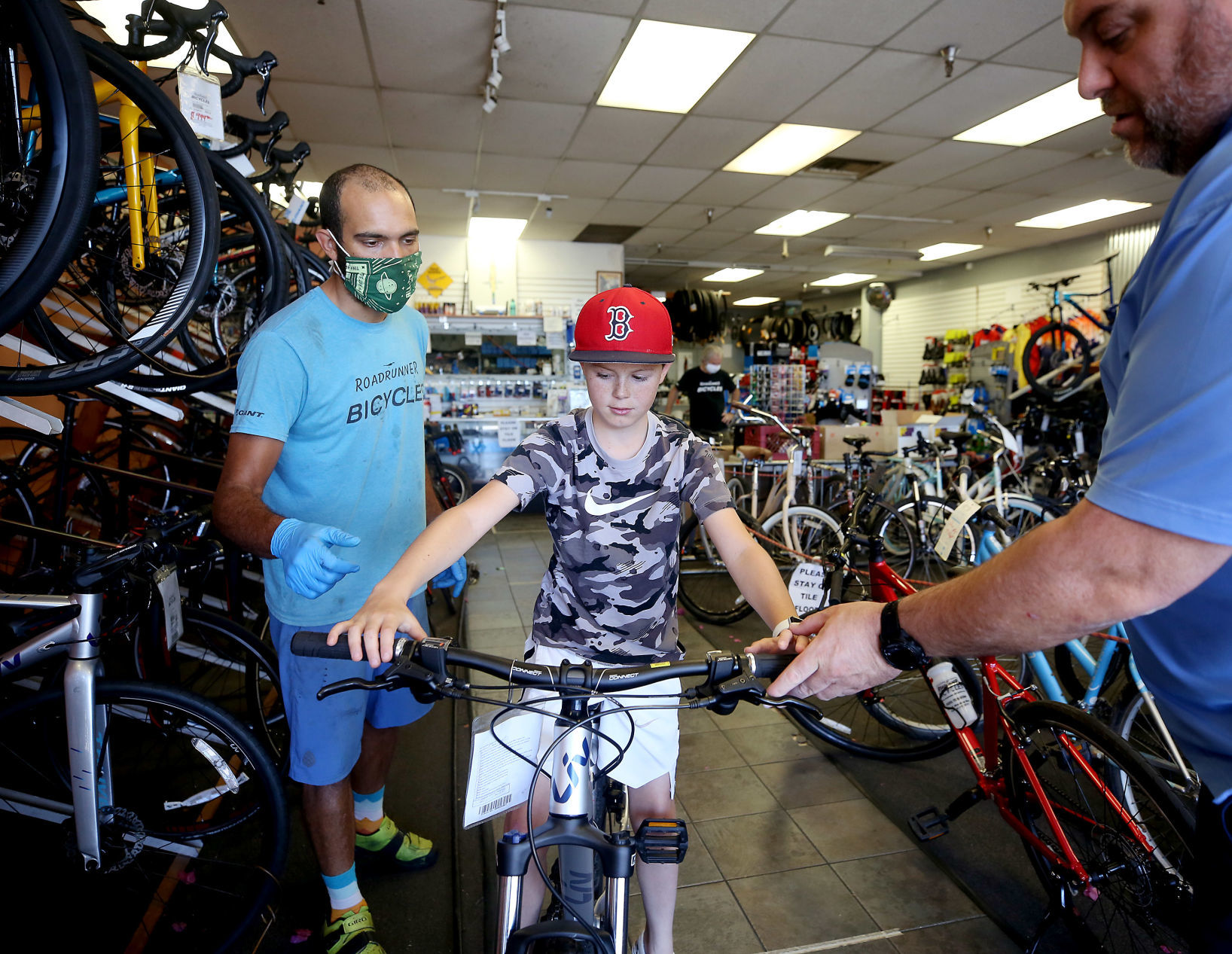
Elliot DuMont, owner of Roadrunner Bicycles, 6177 E. Broadway Blvd., far left, helps Ethan Sasz, far right, and his son, Evan, 10, with a mountain bike purchase on April 22, 2020. The coronavirus disease (COVID-19) has not slowed down bike shops. With many people at home, they are bringing bicycles for repairs and buying new ones for exercise. Dumont says he's booked out till the first week of May for tuneups on bikes.
Tucson, coronavirus
Updated
Marcella Montoya waits in her vehicle as general manger David Kessler brings out her order, as Bear Canyon Pizza serving their customers despite COVID-19 restrictions, April 22, 2020, Tucson, Ariz.
Tucson, coronavirus
Updated
Kitchen manger Koa Hoffmann tosses dough while working up a crust for a call-in order as he and few others keep cooking at Bear Canyon Pizza despite COVID-19 restrictions, April 22, 2020, Tucson, Ariz.
Tucson, coronavirus
Updated
Alvaro Enciso, a local artist, works in one of his studios at his home on April 9, 2020. Every Tuesday Enciso travels into the Sonoran desert to post crosses where migrants have died after crossing illegally over the U.S./Mexico border as part of a project he's titled Donde Mueren Los Suenos / Where Dreams Die. With the outbreak of the coronavirus disease his six year project is on hold and instead he works on other artwork at home.
Tucson, coronavirus
Updated
Dolly Spalding works on a pen and ink drawing in her apartment at the Redondo Tower Apartments on April 7, 2020. During her quarantine, Spalding has been creating drawings of all the Greek goddesses. She is collaborating with Emlyn Boyle, an artist from Ireland, and plans to publish a book with Boyle's writings.

